



Findings reported in Nature Nanotechnology show how the image sensor goes beyond light's diffraction limit to detect minuscule objects.

Published Feb 22, 2023 | 1:14 PM ⚊ Updated Feb 22, 2023 | 1:14 PM

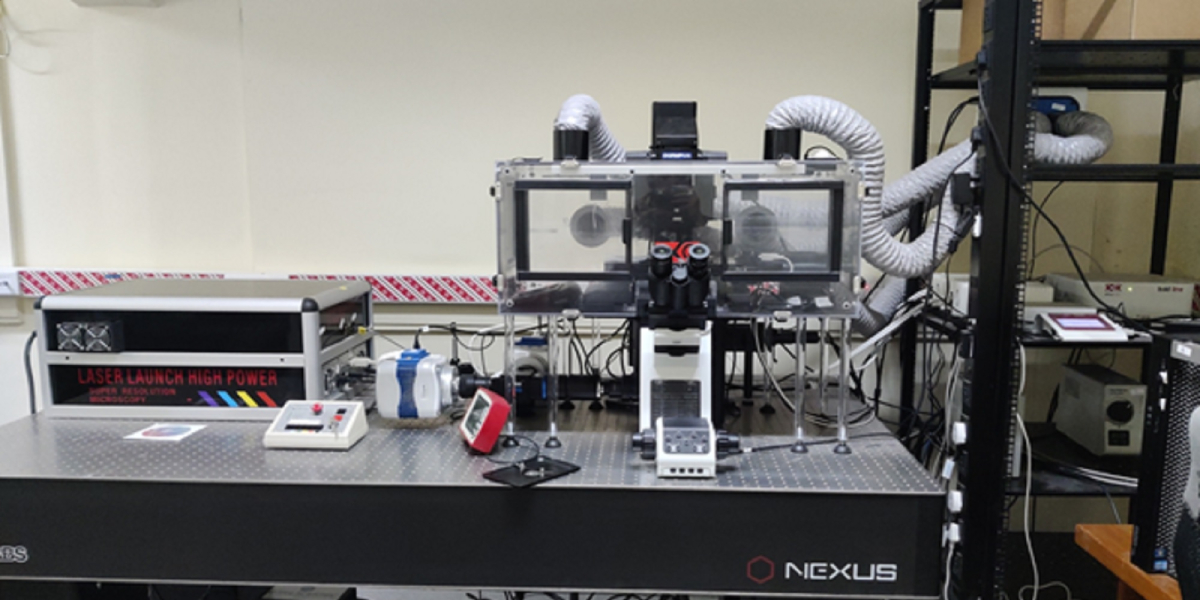
View of the microscopy setup (Supplied)
An Indian Institute of Science (IISc) scientists has developed image sensors to detect nanoparticles invisible to the best microscopes.
The novel sensors, which combine optical microscopy with a neuromorphic camera and Machine Learning (ML) algorithms, is a major step forward in pinpointing objects smaller than 50 nanometres in size.
Details of the sensors have been published in Nature Nanotechnology and describe how a brain-inspired image sensor can go beyond the diffraction limit of light to detect miniscule objects such as cellular components or nanoparticles invisible to current microscopes.
Diffraction is the spreading of waves around obstacles.
Since the invention of optical microscopes, scientists have strived to surpass a barrier called the diffraction limit, which means that the microscope cannot distinguish between two objects if they are smaller than a certain size (typically 200-300 nanometres).
Researchers’ efforts so far have largely focused on either modifying the molecules being imaged, or developing better illumination strategies — some of which led to the 2014 Nobel Prize in Chemistry.
“But very few have actually tried to use the detector itself to try and surpass this detection limit,” Deepak Nair, associate professor at the Centre for Neuroscience (CNS) at IISc and corresponding author of the study, said in a statement.
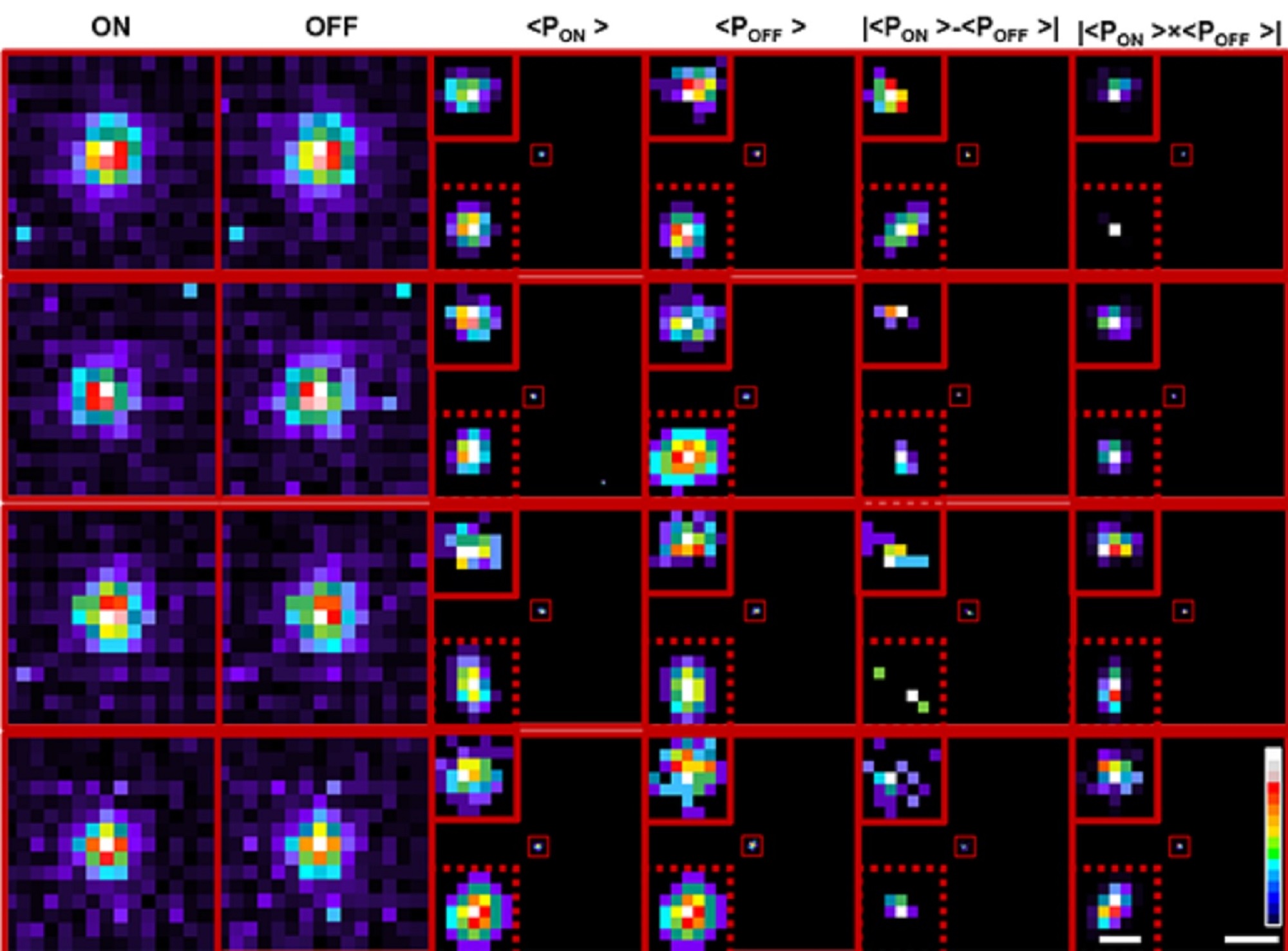
Transformation of cumulative probability density of ON and OFF processes allows localisation below the limit of classical single particle detection. (Supplied)
Measuring roughly 40 mm (height) by 60 mm (width) by 25 mm (diameter), and weighing about 100 gm, the neuromorphic camera used in the study mimics the way the human retina converts light into electrical impulses, and has several advantages over conventional cameras.
In a typical camera, each pixel captures the intensity of light falling on it for the entire exposure time that the camera focuses on the object, and all these pixels are pooled together to reconstruct an image of the object.
According to the study, in neuromorphic cameras, each pixel operates independently and asynchronously, generating events or spikes only when there is a change in the intensity of light falling on that pixel.
This generates sparse and lower amount of data compared to traditional cameras, which capture every pixel value at a fixed rate, regardless of whether there is any change in the scene.
The researchers said that the functioning of a neuromorphic camera is similar to how the human retina works, and allows the camera to “sample” the environment with much higher temporal resolution — because a frame rate like normal cameras does not limit it — and also perform background suppression.
“Such neuromorphic cameras have a very high dynamic range (>120 dB), which means that you can go from a very low-light environment to very high-light conditions,” Chetan Singh Thakur, assistant professor at the Department of Electronic Systems Engineering (DESE), IISc, and co-author, explained in the statement.
“The combination of the asynchronous nature, high dynamic range, sparse data, and high temporal resolution of neuromorphic cameras make them well-suited for use in neuromorphic microscopy,” he added.
The IISc scientists used their neuromorphic camera to pinpoint individual fluorescent beads smaller than the limit of diffraction, by shining laser pulses at both high and low intensities, and measuring the variation in the fluorescence levels.
As the intensity increases, the camera captures the signal as an “ON” event, while an “OFF” event is reported when the light intensity decreases.
The data from these events were pooled together to reconstruct frames.


