

Published Mar 12, 2026 | 3:00 PM ⚊ Updated Mar 12, 2026 | 3:00 PM

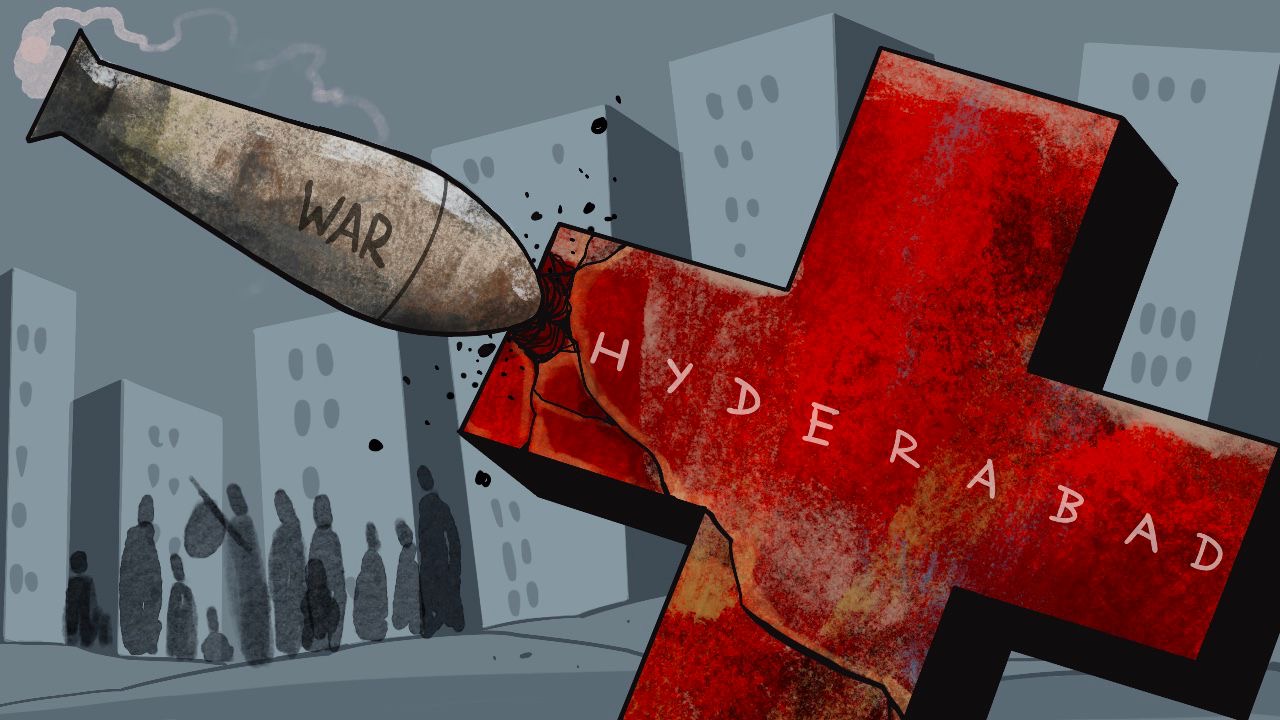
Synopsis: Hyderabad’s medical tourism sector has taken a severe hit from the ongoing conflict triggered by US–Israel strikes on Iran, reducing the flow of medical tourists from West Asia and Africa. Hospitals say elective surgeries and international outreach programmes have been disrupted amid widespread flight cancellations, suspension of services by Gulf airlines and the closure of regional airspace. But industry insiders see a silver lining: while the conflict has disrupted patient traffic in the short term, instability in parts of West Asia, along with a weaker rupee, could help position India as a preferred destination in the long run.
In June 2025, senior officials from Rajiv Gandhi International Airport in Hyderabad gathered on the tarmac with representatives of Ethiopian Airlines to mark the first direct flight between the city and Addis Ababa Bole International Airport in Ethiopia. It was a significant moment, particularly for the city’s burgeoning medical industry.
Long a favourite destination for medical tourism from West Asia, the direct route—three flights a week, each taking six hours and 25 minutes—allowed Hyderabad to attract African nationals travelling to India for medical care on equal footing with cities such as Mumbai and Delhi.
“Earlier, Mumbai and Delhi had an advantage because of connectivity, but once Ethiopian Airlines began connecting Hyderabad directly, that advantage reduced significantly,” Prem Gokul, Associate Vice President of International Business Development at KIMS Hospitals, Hyderabad, told South First. “That is how we are now able to compete and promote Hyderabad more actively in those markets.”
Hyderabad’s medical tourism market is estimated at ₹500 crore, according to data from the Telangana government, with projections suggesting it could triple to ₹1,500 crore within three to four years.
The number of foreign patients visiting for treatment has more than doubled over the past decade, from just over 75,000 in 2014 to 1.55 lakh in 2024.
Ethiopian Airlines, unlike Gulf carriers, flies deep into tier-2 African cities. That made Hyderabad reachable from parts of Africa that previously had no easy connection.
The Union Budget 2026, presented in early February, spotlighted medical value travel, proposing the development of five national hubs. The same month, Telangana was also exploring the creation of a dedicated Medical Tourism Society.
But just weeks later, the US and Israel launched joint “pre-emptive” strikes on Iran, and Hyderabad saw its medical traffic from Africa and West Asia nearly crash to a halt.
Within hours of the joint US–Israel strikes on its soil, Iran launched retaliatory attacks against Israel and, more importantly, against US military bases across the Gulf. These included strikes on military infrastructure such as radar installations, including those located at civilian airports. Dubai International Airport, one of the busiest in the world, was also hit.
The scale of the attacks forced several Gulf countries to shut their airspace as the conflict dragged on.
Emirates, Etihad, Qatar Airways and Oman Air, the four airlines most used by patients travelling from the Middle East and Africa to India, either cancelled flights or severely curtailed operations.
The impact on Hyderabad’s medical sector was immediate.
“We saw a sudden drop in elective surgeries. Usually, patients book their travel at least 15 days to a month in advance. We had a pipeline in February of patients scheduled to travel in March, and we saw a drop, particularly from countries such as Bahrain, Kuwait, Saudi Arabia and the UAE, and especially Dubai,” said Gokul.
He estimated that roughly 30 percent of expected elective cases for the month were cancelled. The disruption was not limited to patient inflows.
A senior specialist at one of Hyderabad’s leading hospitals, which focuses on brain and spine care, concurred.
“Typically, in a week we may see around four to five patients from African countries and one or two from the Middle East. However, the Middle East numbers have dropped sharply. Earlier we would get around seven to fourteen patients a week from that region, but now it has fallen to about one or two,” the specialist told South First.
The specialist said flight cancellations were the main reason for the decline, adding that the month of Ramzan may also have reduced travel from the region.
Even Ethiopian Airlines was not immune. Disruptions at Gulf hub airports pushed passengers who would normally route through Dubai or Doha onto African routes instead.
Fares on the Airline, which had been around $1,000, shot up to $2,500. Flights were full for weeks.
“I spoke to one patient who was supposed to travel,” said Gokul, “and he said that until the 28th there were no available seats on Ethiopian Airlines flights because all six flights were already full.”
Outreach activities, the monthly trips that doctors and hospital teams make to Africa to conduct CME programmes and OPD camps, also came to a halt.
“I had a meeting scheduled in Tanzania a few days ago but we could not travel because Emirates cancelled its flights,” he said.
Despite the immediate disruptions, the industry sees a potential upside.
“A lot of Iraqi patients usually travel not only to India but also to Iran, Jordan, and the UAE for treatment. Because of the war, travel to some of these destinations has become difficult. As a result, we have already started seeing an increase in enquiries and patient interest in coming to India,” said Gokul.
Dr Krishna Chaitanya Mantravadi, Scientific Head and Clinical Embryologist at Oasis Fertility, said his clinic had not yet seen an immediate decline. Many of his international patients had already arrived and begun treatment cycles. But he said the longer-term outlook was shifting.
He also noted that fertility treatment, which accounts for roughly 15–20 percent of his clinic’s business from African and Middle Eastern countries, requires planning months in advance.
“It is unfortunate to see conflict affecting places like Iran or Israel, especially since cities like Tel Aviv are known for cutting-edge medical research,” Dr Mantravadi told South First.
“When such disruptions happen and healthcare services are affected, patients often start looking for alternative destinations. India is geographically close to many of these regions and has strong diplomatic relationships, which makes travel and visas relatively easier.”
Iran’s targeting of US infrastructure in the Gulf has also dented the reputation for safety that Gulf nations spent decades cultivating. That, in turn, could help position India as an alternative destination.
“In today’s world, perception becomes reality. It takes years to build credibility around things like safety and stability. Dubai had built a reputation as one of the safest places in the world where nothing could go wrong. But when incidents like the recent conflict happen, it creates a strong perception among people about safety. And such perceptions can stay for a long time,” said Gokul.
Dr Mantravadi also said weakened healthcare infrastructure in conflict-affected regions could further push patients towards India.
“Even after the conflict subsides, it may take a decade or more for those countries to restore the level of medical infrastructure they had before the war,” he said.
“In the short term, there will definitely be a negative effect because of higher air ticket prices and travel disruptions. But in the long run, if the war subsides, hopefully within the next 15 days to one or two months, then over the next two to three years India could benefit significantly from this conflict in terms of medical value travel,” said Dr Mantravadi.
The geopolitical disruption follows several policies under consideration by both the Telangana and Union governments to position India as a leading destination for medical tourism.
On 20 February, just days before the conflict began, Telangana Tourism convened a high-level policy round-table where senior government officials and industry representatives discussed plans for a dedicated Telangana State Medical Tourism Society.
The proposed body would serve as a single coordinating platform for global branding, international outreach, grievance redressal and the licensing of facilitators.
“Hyderabad stands institutionally and operationally prepared to scale as a globally trusted medical value tourism destination,” V Kranthi, Managing Director of the Telangana Tourism Development Corporation, had earlier said.
“With our integrated healthcare-hospitality-aviation ecosystem and clinical excellence, we are well positioned to emerge as one of India’s five regional Medical Value Tourism hubs.”
The Union Budget 2026 also proposed five national medical value travel hubs under the ‘Heal in India’ initiative. Industry estimates project India’s total medical value travel market to reach $20.4 billion by 2026 and potentially $25–28 billion by 2030.
Gokul said the disruption could create an opportunity for both the industry and the government to accelerate that ambition.
“When you approach markets in Africa, the Middle East, or other regions as an industry platform rather than as individual hospitals, it becomes more effective,” he said.
“Hospitals can participate together, and the platform can act as a flag bearer for the sector. That also helps bring greater credibility and standardisation in areas such as billing practices, patient confidence and infrastructure development.”
He pointed to the recent resumption of traffic from Bangladesh, where patient numbers had fallen sharply over the previous year due to diplomatic frictions under the previous government, as an example.
A weaker rupee has also made India more attractive for international patients. Since early 2025, the rupee has fallen by more than 4 percent against the US dollar, from roughly ₹84–₹85 per USD in early 2025 to above ₹91–₹92 by early 2026, a record low.
For patients paying in dollars, this effectively reduced the cost of treatment in India. As a result, Gokul said a surgery that previously cost around $10,000 might now come to about $9,200 or $9,500.
“In a way, healthcare services for international patients also function like an export. We are not exporting products, but we are exporting services when patients come to India for treatment,” said Gokul.
(Edited by Dese Gowda)


