

Published Apr 10, 2026 | 11:13 AM ⚊ Updated Apr 10, 2026 | 11:13 AM

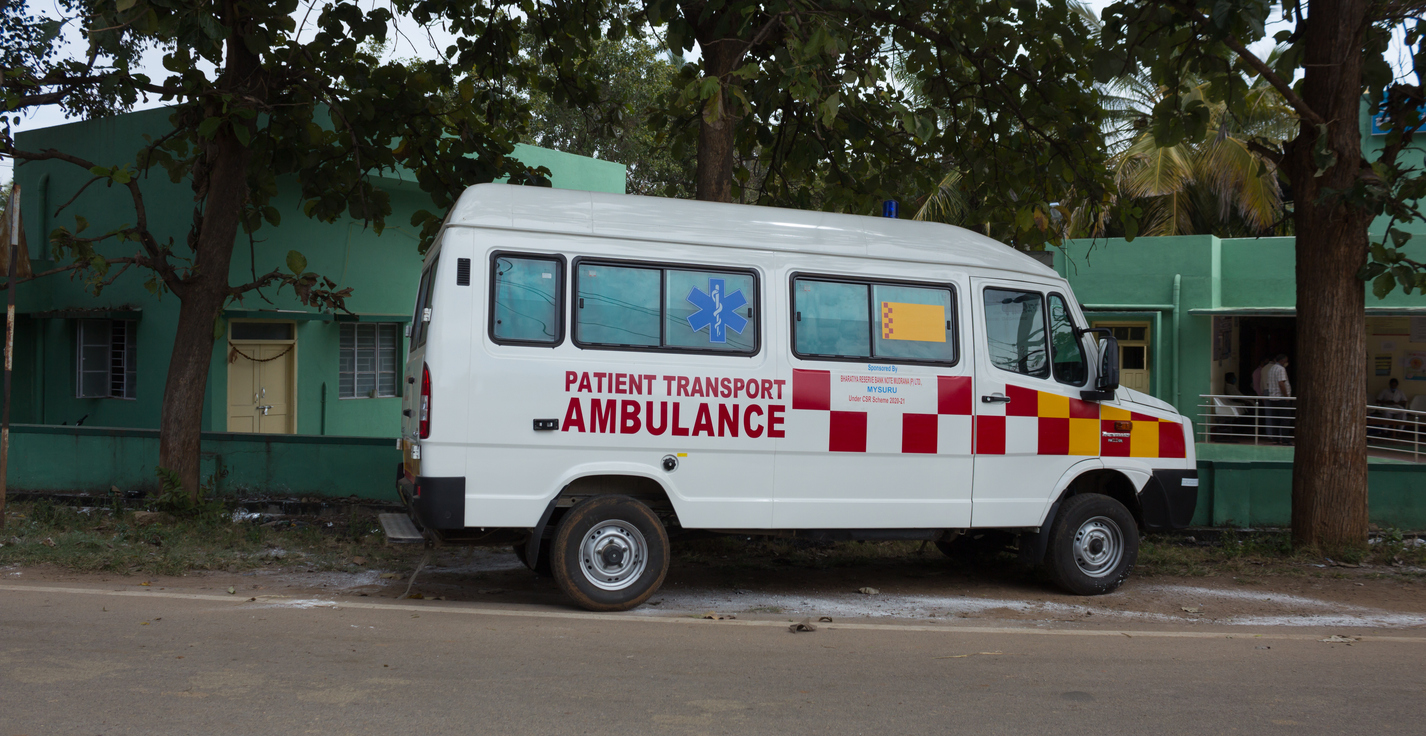
Representational image. Credit: iStock
Synopsis: Telangana has unveiled a trauma care policy to cut ambulance response times on highways from 13–15 minutes to 8–9 minutes, aiming to save lives within the “golden hour.” The plan designates trauma centres every 30 km, upgrades hospitals, trains EMTs, and strengthens referral chains, targeting a 25% reduction in trauma-related deaths by 2030.
Every minute after a road accident, the body bleeds, brain starves of oxygen, and the chances of survival fall. In trauma medicine, doctors call the first 60 minutes the “golden hour.” Telangana wants to own that hour, and it starts with cutting nine minutes off a clock.
Right now, when someone dials 108 after a crash on a Telangana highway, an ambulance takes roughly 13 to 15 minutes to arrive. The state wants to bring that down to eight or nine minutes. That gap, six minutes, is the difference the government is now building an entire system around.
“The basic concept is that there should be one trauma centre every 30 to 35 kilometres,” said Dr Narendra Kumar, Director of Medical Education, Telangana to South First.
“This is linked to what we call Emergency Response Time, the time taken for a patient to reach a healthcare facility after an accident.”
Picture National Highway 44, the spine of the country running through Telangana. A truck clips a motorcycle at 2 am. The rider goes down. The nearest bystander calls 108.
Where does the ambulance come from? How far does it travel? What happens when it arrives at a hospital that has no surgeon on duty?
These are the questions the state’s new trauma policy tries to answer, systematically, for every stretch of road in Telangana.
Officials have sat with the NHAI and state police and mapped six national highways, kilometre by kilometre. They identified the black spots, the curves, intersections, and stretches where accidents cluster. Then they asked: what hospital sits closest to each black spot?
The answer, often, was: nothing suitable.
The policy sets one hard number as its foundation. No two trauma centres should sit more than 30 to 35 kilometres apart.
The logic is straightforward. An ambulance travelling at highway speeds can cover 15 kilometres in roughly eight to nine minutes. If a trauma centre exists within that radius of any crash site, the golden hour survives. If it doesn’t, the arithmetic kills.
“The goal is to ensure that no two trauma centres are more than 30 kilometres apart,” Dr Kumar said. “With this, even an ambulance can reach within half that distance quickly.”
Right now, that coverage does not exist. The state has trauma facilities, but they cluster near cities and district headquarters. The stretches between them, where highway accidents happen most, remain thin.
The government is not building from scratch. That would take years and money the system does not have.
Instead, officials walk into an existing 30-bed hospital beside a highway and ask a different question: what does this place need to become a trauma centre?
The answer might be a surgical theatre. A blood bank. A critical care unit. An orthopaedic surgeon available around the clock. The building already stands. The government expands it to 50 beds, equips it, and designates it.
“A 30-bed hospital can be expanded into a 50-bed facility with enhanced trauma care capabilities,” Dr Kumar said.
This approach already runs through the policy’s bones. Across Telangana, 76 hospitals carry a designation in the new system, 12 at the highest level, 25 at the second level, and nearly 80 area hospitals handling initial stabilisation.
The state structures its trauma system into three tiers, each doing a specific job.
Level 3 centres, the most widespread, handle the first response. A general surgeon, an anaesthetist, an orthopaedic doctor. They stabilise the patient, stop the bleeding, secure the airway.
Level 2 centres step up the care. The critical difference at this level is a neurosurgeon. Head injuries, which kill and disable more road accident victims than almost any other trauma, need a neurosurgeon within reach.
“The key difference between primary and secondary centres is the presence of a neurosurgeon,” Dr Kumar said. “If a neurosurgeon is available, it becomes a Level 2 facility.”
Level 1 centres sit at the top. NIMS, Osmania, Gandhi Hospital in Hyderabad currently function here. Full super-speciality care, plastic surgery, emergency medicine, cardiothoracic surgery, advanced critical care. The state plans to expand this top tier by converting eight regional referral centres into Level 1 facilities, bringing the total to 12.
A trauma system fails when a patient lands at the wrong facility and waits.
The new policy fixes a referral pathway, a sequence every patient moves through. Sub-centre to primary health centre. Primary health centre to area hospital. Area hospital to district hospital. District hospital to regional referral centre.
Each step is deliberate. Each facility knows what it can handle and where to send patients it cannot.
“The referral system will be strengthened so that patients move systematically from sub-centres to PHCs, then to area hospitals, government hospitals, and finally to regional referral centres,” Dr Kumar said.
The goal behind this chain is not just speed. It is decentralisation. Most serious trauma care should happen at the district level. Patients should not travel to Hyderabad unless they need something only Hyderabad can provide, specialised eye care, complex neurosurgery, burns management.
Infrastructure alone does not save lives. The person riding in the back of that ambulance matters as much as the building at the end of the road.
The policy dedicates an entire pillar to training Emergency Medical Technicians, the EMTs who staff the 108 ambulances. The state currently runs 626 ambulances across 33 districts. Each one, under the new system, carries a designation. Each ambulance is, formally, a Level 4 trauma facility.
The EMT inside that vehicle must stop bleeding, open an airway, maintain circulation, and communicate with the receiving hospital, all before the ambulance reaches the gate.
The training system runs in three levels. Basic EMTs complete six months of training. Intermediate EMTs train for a year. Advanced EMTs, those capable of intubation, prehospital ultrasound, drug administration, complete a full degree programme.
By 2030, the policy targets a 25 percent reduction in trauma-related deaths across Telangana.
Road accidents currently kill people aged 15 to 49 at rates higher than almost any other cause. In 2023 alone, crashes across India claimed 1.73 lakh lives.
Telangana accounts for roughly five to seven percent of that national burden.
The state cannot prevent every crash. But the policy bets on something simpler, that most trauma deaths are not inevitable. They happen because a patient waited too long, travelled too far, or arrived at a facility that could not help.
Cut the waiting time to nine minutes. Place a trauma centre every 30 kilometres. Put a trained EMT in every ambulance. Build the referral chain so every patient finds the right care.
That is the plan. Six minutes. 30 km. One life at a time.


