

Published Nov 23, 2026 | 12:00 PM ⚊ Updated Nov 23, 2026 | 12:00 PM

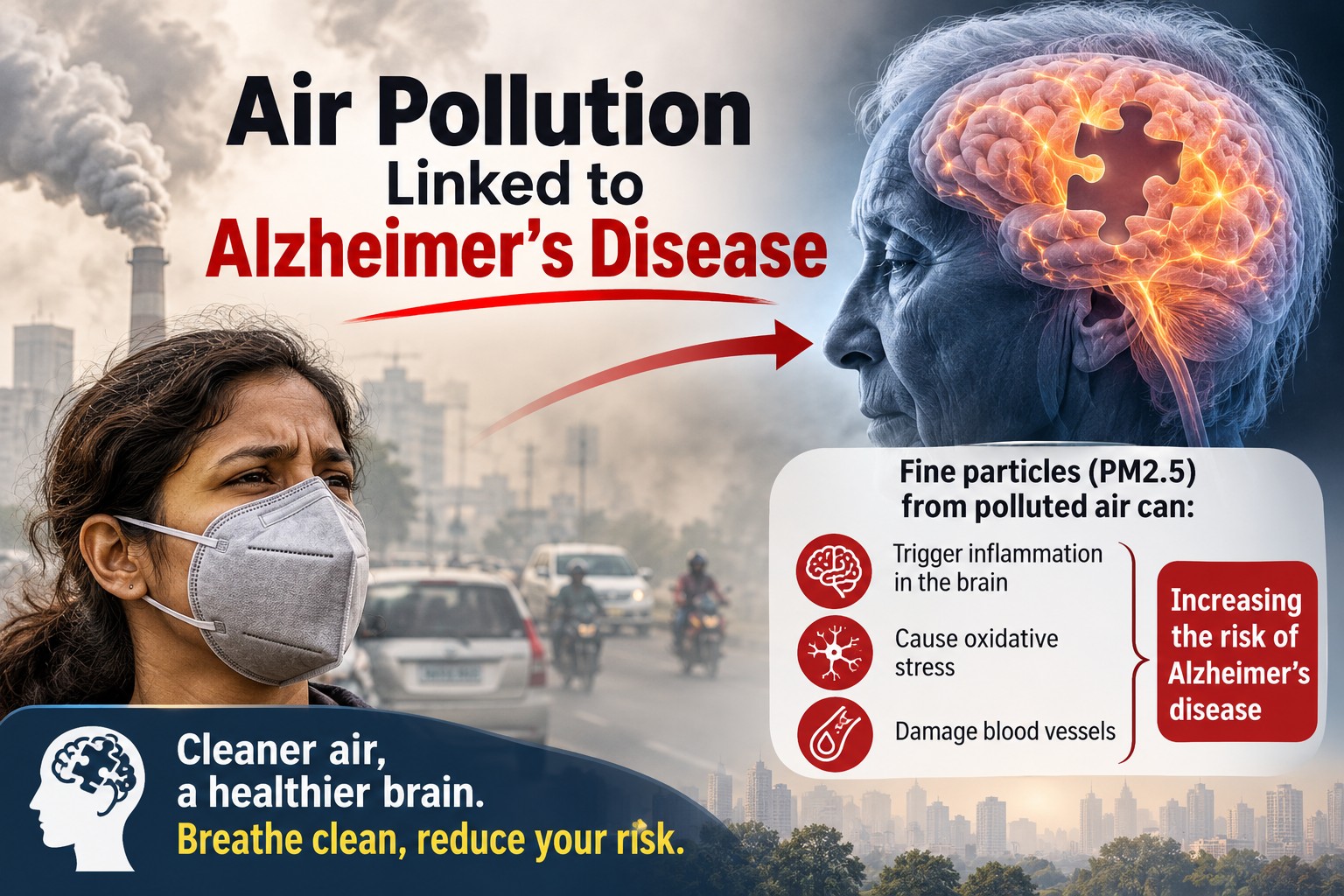
A new study attempted to explain the biological mechanisms through which air pollution could influence Alzheimer's risk.

Synopsis: A new study reveals how prolonged air pollution exposure may affect the brain through the lung-brain axis. Researchers found that pollution-related lung damage and inflammation could disrupt the blood-brain barrier and impair the clearance of amyloid-beta proteins, potentially increasing the risk of Alzheimer’s disease.
Air pollution is widely known to damage the lungs and cardiovascular system. But its effects may extend to the brain.
A new study published in the Journal of Neuroinflammation has examined how prolonged exposure to air pollution could trigger biological changes associated with Alzheimer’s disease.
The study, titled Causal Evidence Linking Ambient Air Pollution and Pulmonary Dysfunction to Alzheimer’s Disease Pathology Along the Lung-Brain Axis, examined four pollutants: fine particulate matter (PM2.5), coarse particulate matter (PM10), nitrogen dioxide (NO2) and nitrogen oxides (NOx).
Researchers Yibeltal Arega Ashebir, Andrew Shao and Yongzhao Shao used Mendelian randomisation analyses based on genetic data from 28 genome-wide association studies to investigate links between air pollution, lung diseases, inflammation and Alzheimer’s disease.
Dr Sudhir Kumar, Senior Consultant Neurologist at Apollo Hospitals, Hyderabad, said the study’s important contribution was its attempt to explain the biological mechanisms through which air pollution could influence Alzheimer’s risk.
“It is not proof that it causes it. The importance of this paper is that they have tried to look at the possible mechanisms,” he told South First.
Also Read: Scientists confirm link between Alzheimer’s and gut disorders
The researchers described the connection as the lung-brain axis. When pollutants enter the lungs, they trigger oxidative stress and inflammation. Prolonged exposure can impair lung function and contribute to conditions such as chronic obstructive pulmonary disease (COPD), emphysema and pulmonary fibrosis.
Inflammatory molecules released in the lungs can enter the bloodstream and affect the blood-brain barrier, the protective interface that regulates the movement of substances between the blood and brain.
The study identified associations between inflammatory markers such as interleukin-6 (IL-6) and interleukin-17A (IL-17A), along with MMP-9 and vascular endothelial growth factor (VEGF), and vascular injury.
MMP-9 can break down proteins that maintain the blood-brain barrier’s structural integrity. Persistent inflammation could therefore make the barrier more permeable, potentially allowing harmful inflammatory signals to affect the brain.
“People who had exposure to air pollution and inflammation had damage to the blood-brain barrier. So harmful substances in the blood can more easily reach the brain,” Dr Kumar said.
Also Read: Speech recognition tool to predict Alzheimer’s onset
The researchers also examined LRP1, a protein involved in clearing amyloid-beta from the brain. Amyloid-beta can accumulate and form plaques, one of the characteristic features of Alzheimer’s disease.
LRP1 helps transport amyloid-beta from the brain into the bloodstream. The study found that pulmonary disorders and inflammatory processes were associated with reduced levels of soluble LRP1 (sLRP1), potentially making the clearance of amyloid-beta less efficient.
“LRP1 is needed to clear the amyloid-beta protein from the brain. People exposed to air pollution have lower levels of LRP1. So the efficiency of clearing amyloid-beta is affected,” Dr Kumar said.
The researchers also identified a potentially self-reinforcing cycle in which lung damage increases inflammation, affecting the blood-brain barrier and interfering with protein clearance, potentially aggravating pulmonary dysfunction.
Also Read: Is there a correlation between abdominal fat and Alzheimer’s disease?
The analysis identified positive associations between all four pollutants and Alzheimer’s disease.
PM2.5 showed the strongest association, with an estimated odds ratio of 2.186. PM10 and nitrogen dioxide each had an estimated odds ratio of 1.519, while nitrogen oxides had an odds ratio of 1.428.
The estimates were based on genetic instruments and should not be interpreted as a direct prediction of an individual’s risk following a particular level of pollution exposure.
Dr Kumar said the findings were relevant to India, where several major cities face sustained air pollution.
“India has a high burden of air pollution in almost every city. Very few cities are left clean. All major cities, tier one and even tier two, are getting affected,” he said.
He added that air pollution should not be viewed only as a respiratory health issue. It is also associated with risks to brain health, including stroke and Alzheimer’s disease.
Also Read: Start hitting the brain gym at 25 to prevent Alzheimer’s
The study has limitations. Its genetic datasets predominantly involved people of European ancestry, so the findings may not directly apply to Indian populations. It also examined genetic associations rather than following individuals over several decades to establish whether particular levels of pollution exposure led to Alzheimer’s disease.
Dr Kumar cautioned against treating air pollution as the condition’s sole cause. Diabetes, obesity, hypertension, smoking and excessive alcohol consumption are among the other risk factors. Healthy diets, adequate sleep, physical and social activity, and addressing hearing and vision problems are also important.
He also highlighted research by neurologist Dr Suvarna Alladi, now at NIMHANS, which found that people who regularly used two languages may experience a delay in the onset of Alzheimer’s disease.
“What her study showed was that people who are bilingual delayed the onset of Alzheimer’s by four to five years,” he said.
Further research, including long-term studies in diverse populations, is needed to establish how the pathways identified in the study operate and whether targeting them could help prevent or slow neurodegeneration.
The findings added to concerns about the wider health consequences of air pollution, suggesting that its effects may extend beyond the lungs and cardiovascular system to biological processes associated with brain health.
(Edited by Majnu Babu).



