

Published Apr 23, 2026 | 7:00 AM ⚊ Updated Apr 23, 2026 | 7:00 AM

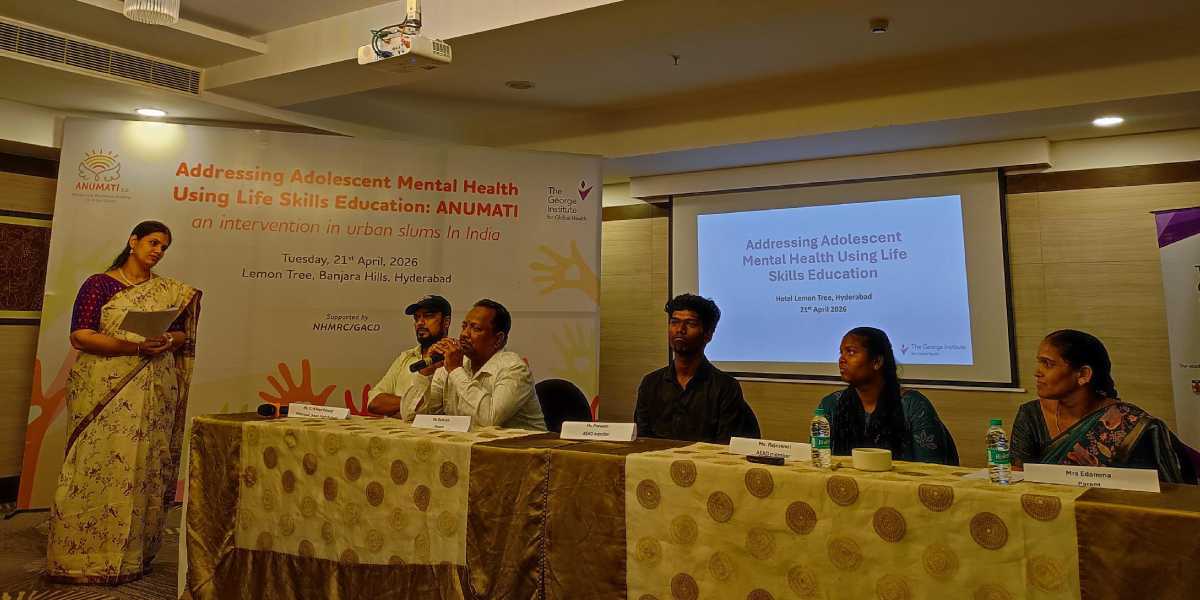
The most striking element of the symposium was its opening panel: adolescents speaking about their own experiences.

Synopsis: Nearly 38 adolescents die by suicide daily in India, underscoring a deep mental health crisis worsened by poverty, family conflict, and scarce professional support. At a Hyderabad symposium, experts and youth discussed ANUMATI, a slum-based life skills programme, highlighting community-led, cost-effective interventions beyond schools to reduce depression, stigma, and suicide risk among vulnerable adolescents.
Nearly 38 adolescents die by suicide every day in India. Behind that number are young lives navigating poverty, overcrowded homes, fractured family dynamics, and a near-total absence of professional mental health support.
On 21 April, researchers, government officials, community members, and adolescents themselves gathered in Hyderabad to ask a pointed question: what will it actually take to change this?
The occasion was a policy symposium hosted by The George Institute for Global Health India, centred on ANUMATI, an intervention designed to deliver life skills education to adolescents living in urban slums.
The event brought together voices rarely heard in the same room, policymakers, psychiatrists, parents, school principals, and teenagers from low-income neighbourhoods, all grappling with the same crisis from different vantage points.
Also Read: Youngsters turn to AI for mental health — sometimes, chatbot itself directs them to helpline
Adolescence is already a period of intense physical and psychological change. For young people in urban slums, that turbulence is compounded by stressors that rarely ease up. Family conflict, financial strain, overcrowded living spaces, academic pressure, and, for girls especially, concerns around safety and restricted mobility all feed into a growing mental health burden.
“Nearly 38 suicides occur every day among adolescents in India,” said Dr Salima Bhatia, Health Specialist at UNICEF India, addressing the symposium. She pointed to youth-led initiatives as critical to closing the gap, highlighting programmes like Yuva Clinics and the Hyderabad Declaration under Telangana’s T Hub as examples of the kind of joined-up thinking needed.
The data backs the concern. Depression rates among adolescents are rising, not just in absolute numbers as India’s population grows, but proportionally. Professor Pallab Maulik, Director of Research at The George Institute for Global Health India, noted that trends going back to the 1990s show a clear upward trajectory globally, and India is no exception.
Much of the existing mental health infrastructure for young people is routed through schools. The ANUMATI programme deliberately breaks from that model, and for good reason.
“Many adolescents are missed by school-based programmes,” said Prof. Maulik. “School drop-outs, adolescents who marry early, and those engaged in part-time work face different sets of challenges, and it is important that our interventions are designed to reach and capture the needs of all these groups as well.”
In slum settings, school attendance is often irregular. Children may be enrolled on paper but working on the side, attending two or three days a week at best. After the age of 14, dropout rates rise sharply. Any intervention tied exclusively to the school system will, by design, miss the most vulnerable.
ANUMATI 2.0 is a cluster randomised controlled trial currently running across 105 slums in Hyderabad and the Delhi NCR region, with roughly 6,500 to 7,000 adolescents aged 15 to 19 participating. It tests two delivery methods for life skills education: in-person sessions and content delivered via social media. A third arm receives only usual care, serving as a baseline for comparison.
The programme focuses on four areas: physical health, substance abuse, mental health, and suicide risk reduction. At the end of the 12-month study period, the key question is whether participants show improved quality of life and reduced rates of depression compared to the control group.
Social media is not incidental to the design. If it proves more cost-effective than in-person delivery, that has significant policy implications. “If something can be delivered in a more cost-effective way, that becomes very important for the government to know,” said Prof. Maulik.
The content is intentionally educational rather than entertaining, closer to structured health programming than social media scrolling. Parents reviewed materials before giving consent, which is mandatory in India for participants under 18.
Also Read: Suicide is not just an individual act, but the collective death of society!
India faces a severe shortage of mental health professionals, a gap that cannot be bridged quickly. The expert panel at the symposium, which included psychiatrists and public health officials from the National Health Mission and AIIMS Bibinagar, was candid about this.
The proposed solution is a layered support system. Community health workers and trained primary care doctors handle mild to moderate cases. Religious leaders, often a first point of contact for distressed families, can be trained to recognise symptoms and refer individuals appropriately. More complex cases are escalated to specialists.
“It is about them not being trained and not having the knowledge,” said Prof. Maulik of religious leaders. “If you train them about the symptoms of depression and anxiety, they refer such individuals to a mental health professional very willingly.”
Stigma remains a formidable barrier. The panel stressed that mental health must be woven into broader health conversations and treated as a normal aspect of growing up, not a source of shame.
Perhaps the most striking element of the symposium was its opening panel: adolescents speaking about their own experiences. Several described how their involvement in ANUMATI’s Adolescent Expert Advisory Group had changed them, sharpening their awareness and giving them the tools to influence peers and family members, including in conversations around suicide and addiction.
Parents, too, reflected honestly on their own gaps, acknowledging the need to listen more, communicate better, and understand the transitions their children are going through.
The research continues. Results are expected next year. But the symposium itself signalled something important: that meaningful change in adolescent mental health will not come from clinics alone. It will come from communities.



