

Published Feb 21, 2026 | 8:00 AM ⚊ Updated Feb 23, 2026 | 4:11 PM

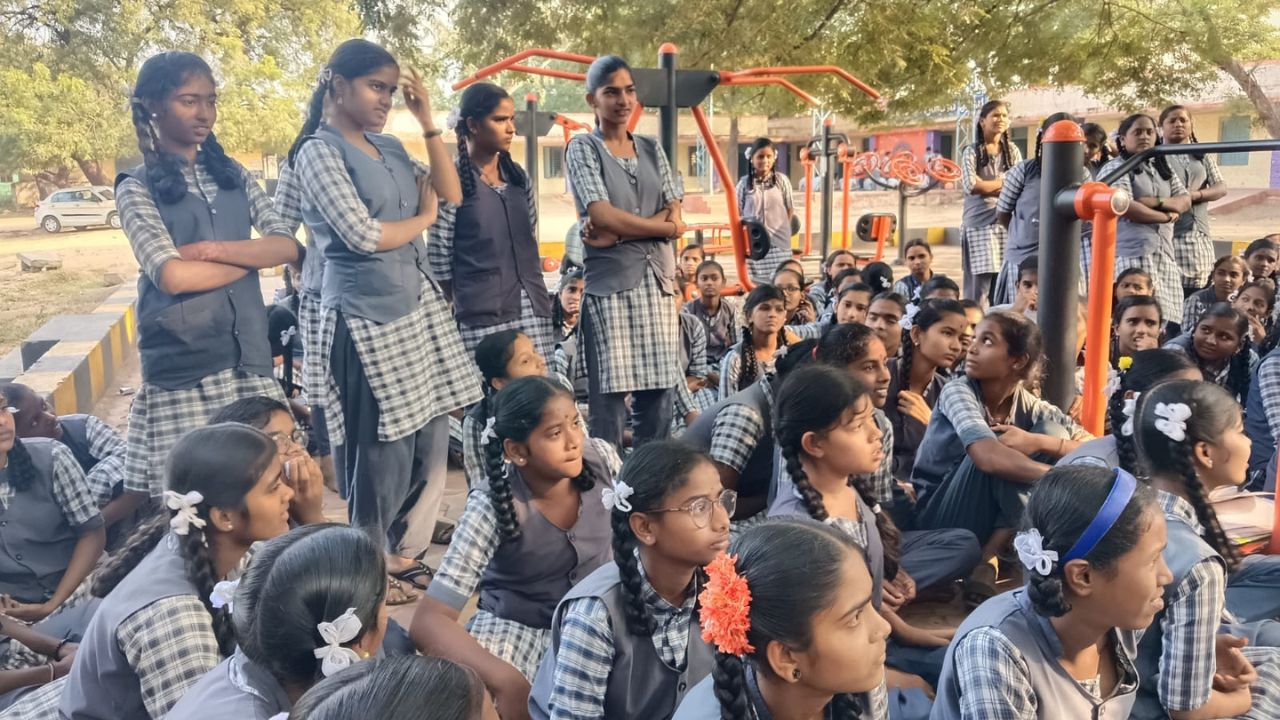
Students at a government school in Koppal. (Supplied)
Synopsis: The Karnataka government recently decided to discontinue the supply of sanitary pads for school students from class 9 to 12 and supply menstrual cups. However, on the ground, girls are hesitant to use them due to a variety of reasons. Citing that even the sanitary pad supply has not been consistent, they demand an uninterrupted supply of sanitary pads.
In Koppal, a district that sits on the dry, sun-baked plains of North Karnataka, where life runs on hard work, sparse water, and where toilets are few and privacy rarer, the conversation about menstruation doesn’t begin with choice. It begins with fear.
For many adolescent girls, the first response is not about comfort, sustainability or savings. It is a flinch, a nervous laugh, a quick look at the floor. The shape feels unfamiliar, the idea of insertion feels frightening; and in villages where periods are still managed in silence, even speaking about it can feel like crossing a line.
As Karnataka is attempting to pivot its flagship menstrual hygiene programme, Shuchi, towards menstrual cups for schoolgirls, the state is facing cultural gaps and fears.
On paper, the move is described as forward-looking and environmentally friendly. On the ground in Koppal, it is running into a wall of stigma, lack of toilets, poor water access and, crucially, a loss of trust caused by something far more basic: The state’s inability to keep sanitary napkins flowing consistently through government channels.
In December 2025, teachers across several government schools told the media that Shuchi kits had not reached schools even as the academic year was nearing its end, and that girls were missing classes due to the unavailability of pads.
Later, the government approved district-level local purchases for a limited period to manage urgent needs, a move that effectively acknowledged the disruption.
In early January 2026, the state’s revised order said sanitary napkins would continue for the remaining months, and that menstrual cups would be introduced for older students in the next academic year, while students in classes 6 to 8 would continue to receive pads.
In February 2026, Karnataka cleared procurement worth ₹51.35 crore for sanitary napkins through Karnataka State Medical Supplies Corporation Limited (KSMSCL) for distribution to schools, colleges and hostels.
South First visited at least six to eight gram panchayats in four villages of Koppal district, which was “technically” declared as one of the first Open Defecation Free (ODF) districts in India, to understand if replacing sanitary pads with menstrual cups is a feasible idea.
However, even this reporter found it shocking that there wasn’t even one decent toilet in the village. Not even the schools had good toilet access, let alone cleanliness and water facilities.
The Karnataka government, in a government order (GO), said that 19,64,507 girls in classes 6 to 12 are beneficiaries of the Shuchi programme 2025-26 and sanitary napkins will be supplied to girls of classes 6 to 8 and menstrual cups to students of classes 9 to 12 next academic year.
However, for girls in Koppal, these are not just policy timelines. They have been managing blood flow for months with whatever is available, and a mention of menstrual cups and discussions on them brought out a sense of strong resentment and discomfort.
In Ginigera village, Nandini (name changed) said, “I heard about this from an ASHA, and then she showed me the cup. I will never dare to insert anything like that into my body. My friends also refused to try it even once. Why can’t the government continue to give us sanitary napkins? Why have they stopped that?”
Interestingly, the government announced the procurement of 10,38,912 menstrual cups through KSMSCL. The decision towards this was made after a pilot study bythe Department of Health and Family Welfare in the Chamarajanagara district in 2022-23. However, there was no official information regarding this pilot project.
Media reports also claimed that several frontline workers who were appointed to train students to use the cups themselves were unsure of how to use them.
For instance, in Venkatapura, an ASHA worker spoke plainly about what she saw and what she didn’t. “No. I wasn’t really given any training on the use of menstrual cups. In our village, girls are comfortable using cloth. I do ask them and train them on hygiene. But they were comfortable only with the use of sanitary napkins, except for the cost. Many girls ask for pads. They even buy and use them,” she says.
There is also a contradiction between what the government intends and the reality on the ground. The state may be imagining a transition from disposable pads to reusable cups. However, most girls in villages have been living a different reality: Cloth at home, pads when they can afford them or access them, and silence about both.
In the village of Kal Thavargera, the resistance is even more immediate. An Auxiliary Nurse Midwife (ANM) said the fear is so strong that girls even hesitate to look at menstrual cups.
“Our girls are scared to even look at the cups. The shape of it itself is off for them, and they are hesitant about anything that needs to be inserted. They don’t want to do that. Parents also won’t allow it. This is an absolute no for them,” she said.
Parents’ opinions matter because adolescent menstrual health in rural Karnataka is not only about what a girl wants, it is also about what her family permits, what her mother believes, what the community polices, and what the school can support.
A senior official from the village explained that in places where virginity is often treated as something that can be “lost” by a medical device, cups become not just unfamiliar but a suspect.
It can be recalled that the state’s own narrative around cups has repeatedly recognised stigma and misconceptions as major hurdles, particularly in rural areas, requiring sustained counselling and communication. Yet Koppal’s girls are being asked to make this leap without the conditions that make the leap safe.
The same village’s ASHA worker, who, unlike the Venkatapura ASHA, received training on cup use. Her view is nuanced, and it undermines the simplistic “cup versus pad” framing.
“Yes. We were trained regarding the use of menstrual cups. I am convinced it is comfortable, but not for our young girls. Toilets are a huge problem. Water is an issue. Hygiene and cleanliness are surely a concern. Supplying sanitary napkins is a better way. Many environmentally friendly pads are available, and NGOs have supplied them to us. We could use those,” she said.
That one statement carries the full story. It is not a rejection of new ideas. It is a warning that a device cannot replace infrastructure. It is also an indictment of policy design that treats menstrual care as a product supply problem while ignoring the lived environment of the body that will use it.
In Koppal, where the girls are either married off or forced to drop out of school once they hit menarche, the lack of functional toilets is not a side issue. It dictates what is possible during a period.
A cup is not a one-time insert-and-forget tool; it requires clean hands, privacy to remove and reinsert, clean water and a safe method of washing and sterilising across cycles. Even for women comfortable with their bodies, these requirements are non-negotiable.
“We used cloth, and our daughters used the same, and now our granddaughters also use the same. We change it every six months. We have been told to wash and dry it out in the sun, but we cannot put it out as it shows disrespect and feels odd. We have our own way of keeping it clean, and we do it. No problem has occurred. We don’t have money to pay for sanitary napkins, and also I have heard that it causes problems in the uterus, so cloth pads are safe,” 62-year-old Mallamma (name changed) of Ginigera village told South First.
Voicing similar concerns and a strong push for resupply of sanitary napkins, the head master of the government school in Kal Tavaragera told South First, “It has been four to five years since the supply of sanitary napkins has stopped for us. Our girls do come and ask for it. They are unaffordable for the families of our village. The government should supply that first. It’s my sincere request,” he said.
This is where the Karnataka government deserves sharper scrutiny. If the state cannot ensure an uninterrupted sanitary napkin supply in government schools for months due to tendering and procurement delays, then it has little credibility asking a nervous teenager to trust a more demanding intervention.
The government’s own patchwork solutions, including emergency local purchase windows and mid-year procurement approvals, tell a story of reactive administration rather than guaranteed support. The risk is that the cup rollout becomes a headline-friendly reform while the basic promise that keeps girls in school, reliable pads when needed, remains fragile.
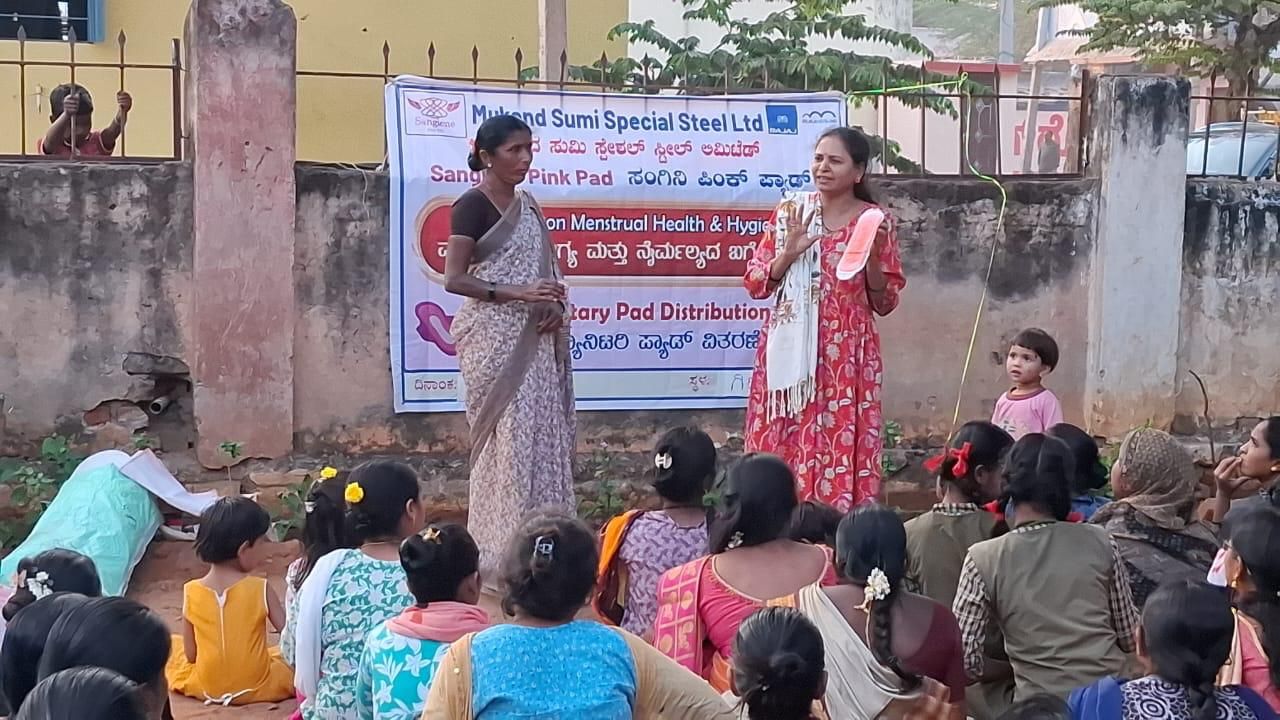
An image from an awareness session on Menstural hygiene and the use of sanitary napkins done by Bharathi. (Supplied)
The consequences of such fragility are not abstract, said Bharthi Gudlanur, known as Pad Woman of Karnataka. Her organisation Sangiene Pink Pad works with adolescent girls in rural areas of the Koppal district, not only creating awareness about menstrual hygiene but also the correct use and disposal of sanitary pads.
She also provides pads to several government schools in the Koppal district. “When pads don’t arrive, girls miss classes. When pads are too costly, girls ration them. When there are no toilets, girls stay home. When there is no water, girls cannot change safely or frequently. When stigma prevents drying reusable cloth in the sun, girls tuck damp fabric into dark corners and tell themselves it will be fine. With this mindset and reality, menstrual cups, though a good product for adults, are extremely unwelcoming amongst adolescent girls of our district,” she told South First.
Cloths are familar for them; it is accessible and discreet because it looks like any other piece of fabric. It can be folded, hidden, and reused. And when the state supply breaks, cloth becomes the one option that does not depend on a tender, a shipment, a school cupboard, or a committee meeting.
However, the ASHAs and ANMs in the villages agree that cloth’s safety depends entirely on conditions: Clean water, soap, adequate washing, thorough drying in sunlight or open air, and safe storage away from moisture.
“In settings where toilets are scarce and water is limited, these conditions are not guaranteed. Research from India has pointed out that reusable menstrual materials become risky when they are not washed properly or dried in the sun, and that cultural pressure to hide cloth can push girls to dry them indoors, where they may remain damp,” said another ANM from Koppal.
People of Koppal insist that the government should take their issues seriously and first modernise their surroundings. They said that it is undeniable that, in policy conversations, menstrual cups are often sold as empowerment. However, empowerment is not a cup in a box; it is a functioning toilet, running water, soap, privacy, and trustworthy, consistent support at school,” said one of the panchayat officers who did not want to be named.
(Edited by Muhammed Fazil.)


