

Published Sep 23, 2026 | 7:00 AM ⚊ Updated Sep 23, 2026 | 7:00 AM

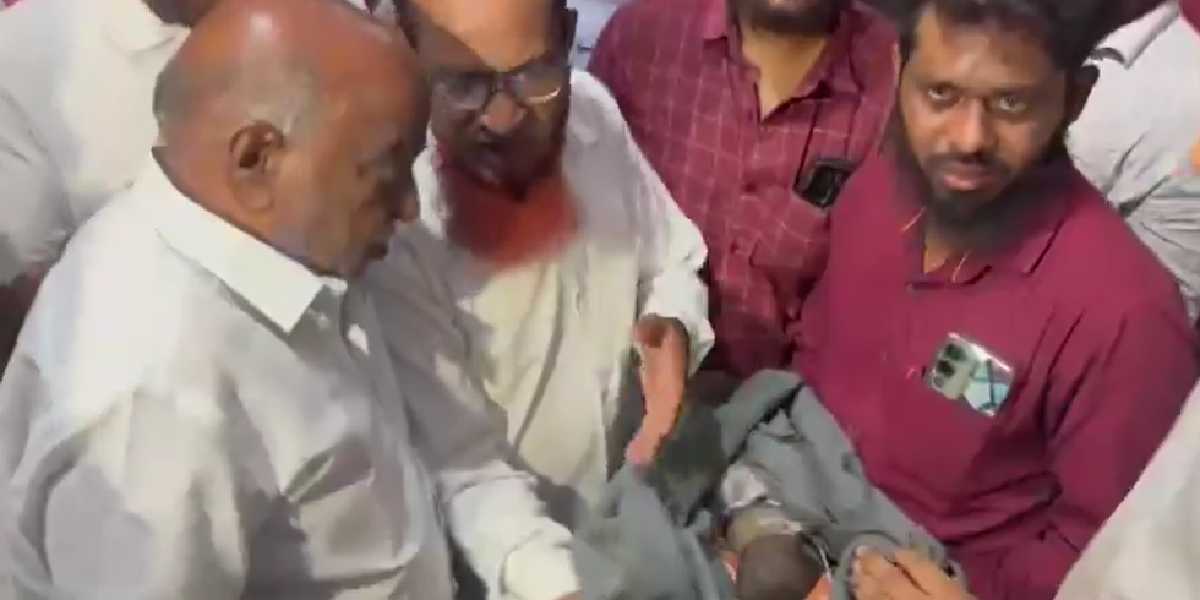
Fasil holding his daughter.

Synopsis: A five-day-old premature baby died in the Adilabad RIMS fire, turning a brief visit by her father into a final goodbye. As smoke engulfed the SNCU, parents and staff scrambled to evacuate the newborns. Three babies died, while others were shifted to private hospitals. The government has ordered a probe into safety lapses.
The first time M. Fasil saw his daughter up close after Sunday night was the last time he saw her alive.
She was a five-day-old premature baby, Fasil recalled. Soon after she was born, doctors moved her to the Special Newborn Care Unit (SNCU) of the Rajiv Gandhi Institute of Medical Sciences (RIMS) in Telangana’s Adilabad.
“She required specialised care,” Fasil remembered the doctor’s words. “Specialised care,” he repeated as if cursing himself.
On the night of Monday, 21 September, the SNCU staff let Fasil in. The father and daughter had a few minutes together.
“I stayed there for five or six minutes, checked on her and prayed before I stepped out,” the man mumbled. Minutes later, his visit became the last time he saw her alive.
Early the next day, officials came out with an explanation. An air-conditioner in the neonatal unit burst into flames following an electrical short circuit. Thick smoke filled the ward as the flames spread through the section where newborns remained in incubators, even as staff members scrambled to evacuate babies.
Three babies died. Earlier, one of them had remained in the incubator, unaware of her father’s few minutes by her side.
The “specialised care” that Fasil repeatedly quoted kept ringing in the inner ear as if in a loop.
A short pause later, he spoke again, his voice getting louder. “Tell us, what should have been done? Please tell us. Our daughter has died, and so many other children are suffering. Please tell us what should be done,” Fasil asked.
Some around them pretended they heard nothing. Others looked at him in silence. There were no answers. Silence was cruelly blunt.
Fasil continued without prodding. He might have narrated the incident before, and might do it again.
He said the smoke made it hard for anyone to enter the ward. Nurses and doctors moved outside as the smoke spread. And the doors were locked.
“All the small babies were still in there. There were two babies on each bed,” his words came as if from afar. The mind painted the picture inside the ward. Small babies—little humans—helpless, as the smoke grew thicker.
Their tender skins might have felt the heat, and the smoke might have singed their little lungs, but they would never have understood the pain of being left out.
“Relatives could not go in and bring out their children,” Fasil continued. People reached the babies after the security staff and others broke the door’s glass.
“We couldn’t rescue our own babies. Someone else carried them out,” he said.
Fasil, too, had rushed out of the smoke-filled room, his eyes burning, with someone else’s baby cradled in his safe arms. The man said he went in three times within 20 minutes, helping to evacuate babies.
None of the babies he carried to safety was his daughter.
His wife had delivered the baby prematurely on Thursday, 17 September, through a caesarean section. The child was the couple’s third after two boys.
The family had travelled from Ichoda. The baby was admitted to another hospital where her condition did not improve. She was subsequently shifted to RIMS for specialised care on Sunday, 20 September.
On Tuesday morning, Fasil fought with himself to muster the courage. He had to face his family and tell them that the baby they had been trying to save did not survive.
A fire from the air-conditioner killed her; he will tell his family and repeat whatever he has been telling anyone willing to listen at the hospital.
He will have no further explanations, no answers to offer. The baby is gone.
Also Read: Three infants die after late-night fire at RIMS neonatal unit in Adilabad
The fire broke out around 11.40 pm on Monday, Health Minister Damodar Rajanarsimha said.
Early findings pointed to an electrical short circuit in the AC unit, with melting plastic components adding to the smoke.
The minister said a preliminary probe did not establish the exact cause of the fire, or whether safety standards had failed anywhere. He said those answers would come only after a full investigation.
The SNCU treats newborns who need specialised care, including babies born early and those with breathing difficulties. When the fire broke out, the babies were in incubators, their lives depending on machines.
Hospital staff, the district administration, fire and rescue personnel and police responded immediately after the fire was reported. The Health Department said the power supply was snapped, staff moved the newborns to safer locations, and doctors treated the affected infants. Some of them were sent to private hospitals for further neonatal care.
Eyewitnesses recalled the scene. Parents, relatives and hospital staff carried babies out as smoke filled the unit. Fire and smoke blackened parts of the ward, and the area around the AC unit took the worst damage.
Reports differed on the number of babies in the ward as orange flames took over. Some put the number at 24; the Health Department and RIMS officials cited 27. The gap between the two figures remained unexplained.
The ward definitely had a significant number of newborns when the fire broke out.
Also Read: Six killed in Dindigul hospital fire
Initial reports from the hospital confirmed two infant deaths: one during the evacuation, and another while receiving treatment.
A baby who had been moved to Nizamabad died soon after, taking the toll to three. Officials named the towns each family lived in: Ichoda, Indravelli and Utnoor. The babies carried no names.
Doctors sent the surviving infants to private hospitals on a need basis. At one hospital, staff received three babies as emergency cases at around 1 am, a doctor who treated them said.
Two of them struggled to breathe. Doctors administered oxygen and put them on CPAP machines—a medical device that uses mild air pressure to keep airways open while you sleep– and both stabilised.
The third baby’s condition remained critical.
One baby was born full-term; the other two were born early. They weighed 2.5 kg, 1.7 kg and 1.8 kg.
The 2.5-kg baby remained critical, developed fever roughly every three hours and had two seizures. The other two, born at lower weights, responded to treatment.
Doctors held back from predicting how the critically ill baby would recover, but noted that she had responded to treatment within the first six hours. The seizures stopped after around 3 am, and the fever eased.
“We expect the problem to reduce over the next two to three days,” the doctor said.
Also Read: Fire at Kozhikode Medical College Hospital
For newborns, and especially babies born early, smoke exposure could create a second emergency. Doctors treating the evacuated infants said they were watching for breathing problems and other smoke-related effects.
“Smoke exposure can cause breathing difficulties, while contact with the skin can cause burns,” the doctor said.
The babies he examined were not showing those problems. Their main issues stemmed from conditions they already had at birth.
He credited the speed of the evacuation and treatment. “Because we responded quickly and shifted the babies, there is currently no apparent harm caused to them by the incident. We hope there will not be any complications in the future either,” he said.
Doctors described the children moved to private hospitals as stable, though one still raised concern. They were monitoring the babies, both for their existing conditions and for anything that might follow from the fire.
Also Read: Patients shifted after fire at private hospital near Bengaluru
Once the immediate emergency eased, attention turned to safety, maintenance and how prepared the hospital had been.
District Collector Rajarshi Shah and Superintendent of Police Akhil Mahajan visited RIMS after the fire and reviewed the response. The state government ordered a full investigation into the fire and the deaths.
Minister Rajanarsimha said an expert committee would examine the cause of the fire, any safety lapses, missed maintenance processes, and what the hospital needs to change. The government also ordered three audits at RIMS: one for electrical safety, one for fire safety and one for the building’s structure.
Officials will use the findings to plan repairs, new infrastructure, restoration work, construction and staffing, the minister said. He added that the investigation would trigger action against anyone found negligent.
The government also announced a 150-bed Mother and Child Health building at RIMS, as part of a wider plan to develop the hospital from around 800 beds to nearly 950 and expand several departments.
Those are plans. For Fasil and the other families who lost their newborns, nothing can compensate for their loss. The smell of smoke will bring back to them memories of a fiery midnight that snatched away their bundles of joy—and death’s dance in a newborn care unit.
(Edited by Majnu Babu).



