

Published Apr 29, 2026 | 7:00 AM ⚊ Updated Apr 29, 2026 | 7:00 AM

The study's breakdown of who suffers most maps precisely onto India's existing inequalities.

Synopsis: A multicentre study led by Sree Chitra Tirunal Institute reveals the crushing economic toll of heart failure in India. With average annual treatment costs exceeding patient incomes, 37.7% face catastrophic spending and 3.8% sell assets. Families lose savings, income, and livelihoods every eight minutes. Insurance offers partial relief, but structural gaps leave millions vulnerable to financial ruin.
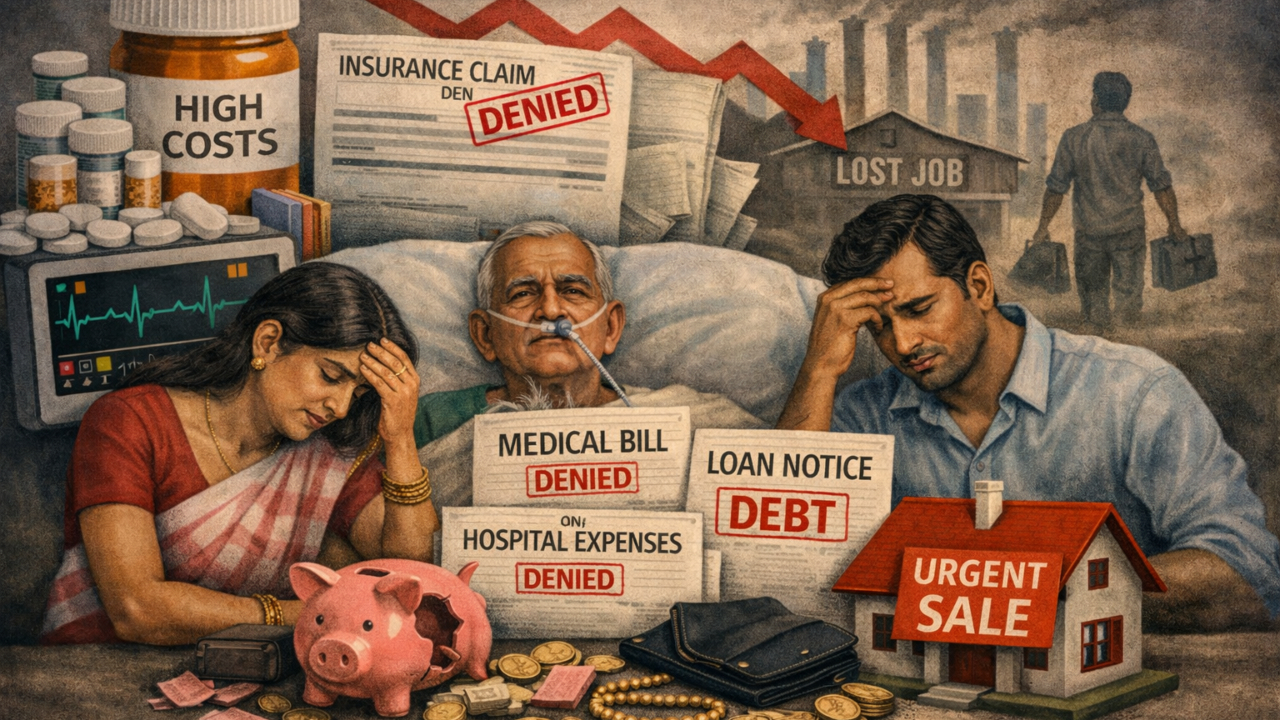
Somewhere in India, right now, a family is deciding what to sell.
Maybe it is land that has been in the family for two generations. Maybe it is the gold set aside for a daughter’s wedding. Maybe it is the small plot of agricultural land that is the only asset the household owns. The reason is the same in each case: someone’s heart failed, the hospital bill arrived, and there is no other way to pay it.
This happens every 8 minutes in India. Here is how we know.
A multicentre study published in Global Heart in March 2026, led by Panniyammakal Jeemon of the Sree Chitra Tirunal Institute for Medical Sciences and Technology in Trivandrum, Kerala, tracked 1,859 heart failure patients across 21 hospitals spanning every region of India. It is one of the largest economic assessments of heart failure ever conducted in the country.
The study found that 3.8 percent of heart failure patients sold their house, land, or other assets to meet treatment costs. That figure comes directly from patient interviews conducted by trained field staff across the country, in ten Indian languages, over three years.
India records approximately 1.8 million heart failure hospitalisations annually. Apply 3.8 percent to that figure and you get 68,400 families liquidating assets every year to pay a cardiac bill. Divide by 365 days and you get 187 families every day. Divide by 24 hours and you get one family every 7.7 minutes — every 8 minutes.
The arithmetic is not complicated. The reality it describes is.
Also Read: Tamil Nadu tops cancer costs, Telangana heart, Kerala kidneys—South India pays most for its diseases
The average annual out-of-pocket expenditure for a heart failure patient in India is Rs 1,06,566. The average individual monthly income of those same patients after their diagnosis is Rs 7,866 — an annual income of Rs 94,392.
The bill exceeds the income. Every single year.
“OOP health expenditure accounted for 92.6 percent of the total health spending,” the study records. Nine rupees out of every ten spent on heart failure treatment comes directly from the patient or their family.
The study found that 37.7 percent of patients experienced catastrophic health spending — defined as healthcare costs exceeding 40 percent of a household’s capacity to pay. At 1.8 million annual hospitalisations, that translates to 6,78,600 families crossing into financial catastrophe every year. One family every 46 seconds.
“Such expenditures often force families to reduce spending on essential needs, particularly among those with lower incomes, where even modest healthcare costs can be unaffordable,” the authors write.
When savings run dry, families find other ways.
67.7 percent paid from personal savings. 54.4 percent relied on family members contributing simultaneously — meaning the financial shock did not stay with the patient. It radiated outward to siblings, parents, adult children, anyone with any reserves.
14.6 percent borrowed from friends, family, or their employer. 7.6 percent went to banks or moneylenders. And 3.8 percent — nearly 1 in 25 heart failure patients — sold their house, land, or other assets to meet the bill.
The study classifies the broader phenomenon as distress financing — reported by 17.7 percent of patients.
“DF also included informal loans without interest,” the authors note, meaning the borrowing extended deep into the informal economy, to relatives who could not easily refuse and neighbours who did not charge interest but expected repayment.
“In India, seven out of 10 patients with HF lack any form of financial health protection,” the authors conclude. “With OOP expenses comprising over 90 percent of total health spending, the economic burden on HF patients is substantial, leading to financial burden in more than one-third of cases.”
Also Read: Same taste, fewer heart attacks: Indian scientists endorse a salt that does two jobs at once
The financial damage does not end with the bill. It continues for years.
Before their heart failure diagnosis, the average patient earned Rs 12,595 per month. After diagnosis, that figure fell to Rs 7,866 — a drop of Rs 4,729 every month, Rs 56,748 every year, gone permanently.
“A reduction in monthly income following HF diagnosis was reported by 32.3 percent of individuals and 36.2 percent of households,” the study records. The authors explain the mechanism: “This decline may result from the patient’s inability to continue working due to illness, or from a family member being forced to cut short working hours or stop working to care for the patient.”
The disease arrives and takes your health. Then it takes your income. Then it sends the bill for both.
At the household level, mean monthly income fell from Rs 32,372 before diagnosis to Rs 27,805 after — a 14 percent permanent reduction. For a household already paying Rs 1,06,566 annually in treatment costs, that income reduction is not a setback. It is the beginning of a spiral.
“Evidence from multiple countries suggests that the rising burden of chronic diseases, such as CVD, diabetes, and mental health disorders, negatively affects labour force participation,” the authors write. “Reduced income, in turn, can limit access to treatment, worsen clinical outcomes, and diminish overall quality of life.”
India has expanded health insurance substantially. The Ayushman Bharat scheme covers millions of households for up to Rs 5 lakh annually in hospitalisation costs. Yet in this study, only 32.2 percent of heart failure patients had any form of health insurance.
Even among those who did, the protection was incomplete.
Uninsured patients faced OOP spending of Rs 1,23,580 — 97.9 percent of their total health expenditure. Patients covered by social insurance schemes like PMJAY paid Rs 63,740 out of pocket. Private insurance reduced the bill to Rs 78,513.
Catastrophic spending was lower among insured patients at 30.8 percent compared to 40.3 percent among the uninsured. But 30.8 percent is not protection. It is a smaller catastrophe.
The structural reason is precise. “Most existing insurance schemes are largely limited to inpatient care, leaving outpatient visits and long-term medication costs uncovered,” the authors write. “This structural gap contributes substantially to financial burden, reflected in poor medication adherence and persistent economic strain after hospital discharge.”
Heart failure requires lifelong medication, regular follow-up visits, repeat blood tests, repeat echocardiograms, and frequent readmissions. The scheme covers the hospitalisation. It abandons everything that follows.
“Given that HF is a progressive condition requiring lifelong treatment, regular follow-up, and repeat hospitalisation events, the financial burden continues even among insured individuals, while those without insurance face a disproportionate risk of financial distress,” the study states.
The bill that destroys families is not always the admission bill. It is every bill that comes after.
Also Read: One region, many risks: How South India’s cities are diverging in diabetes and heart disease
The study’s breakdown of who suffers most maps precisely onto India’s existing inequalities.
Rural patients experienced catastrophic spending at 45.6 percent against 30.1 percent for urban patients. Rural distress financing ran to 21.3 percent versus 14.3 percent in cities.
“Our findings reinforce existing literature linking low income and rural residence to higher CHS risk,” the authors write. “Notably, participants from rural areas reported substantially greater financial hardship than their urban counterparts.”
Rural patients travel further, earn less, carry fewer savings, and face the same bill as their urban counterparts. Nearly half the study population — 48.6 percent — was rural.
Unemployed patients experienced catastrophic spending at 43.5 percent. Patients with less than secondary education: 42.4 percent. Lower socioeconomic status: 42.8 percent. Patients hospitalised more than once: 46.8 percent.
Each readmission pushes more households across the catastrophic threshold. “Heart failure, as a chronic and progressively worsening condition, requires frequent hospitalisations and continuous medical care, contributing to high OOP expenses,” the study notes. The financial damage compounds with every return visit.
“Low socioeconomic status is a major predictor of CHS; individuals from these groups often have limited access to timely care and face worse health outcomes, including premature mortality,” the authors warn.
One finding in the study explains everything about why the financial damage is so severe.
The mean age of heart failure patients in this study was 55.9 years. That is 10 to 15 years younger than heart failure registries in Western countries or China.
“The study population was at least 10 to 15 years younger than the Western or Chinese HF registries, highlighting the impact of the disease on people in their most productive years,” the authors write.
A 55-year-old patient in India is likely still employed, or recently was. They have children who may still be in school. They have family financial obligations that have not yet been discharged. They have fewer savings than a 70-year-old would have accumulated. And they face a bill that exceeds their annual income.
37 percent of these patients also had comorbid diabetes. 41.9 percent had hypertension. These are not isolated cardiac events. They are the end stage of years of unmanaged chronic disease — the same chronic diseases that the NSS 80th Round shows are most prevalent and most expensive to treat in southern India.
When a 55-year-old stops working, or reduces hours to manage their condition, the household loses its primary earner. Children’s education stops. Marriages are postponed. The economic damage radiates across a generation. “One out of three individuals and households reported a decline in annual income following an HF diagnosis in our study,” the authors state. “Similar income reductions have been observed in economic assessments of other chronic conditions.”
Also Read: 9 things your heart actually wants you to eat, according to American Heart Association 2026 guidance
The study’s lead author, works at the Sree Chitra Tirunal Institute for Medical Sciences and Technology in Trivandrum. He works in Kerala — the state where the NCD burden is most visible, most accurately measured, and most honestly recorded.
Kerala has a tested diabetes prevalence of 25.5 percent — one in four residents. Diabetes is the condition most likely to cause heart failure. The state records 19.1 percent of all medically certified deaths as diabetes-related — the highest rate in India and almost certainly the most accurate. Where other states write heart failure on the death certificate, Kerala writes the diabetes that caused it.
The NSS 80th Round, released in April 2026, records Kerala’s kidney failure hospitalisation costs at Rs 84,436 — the highest in the country, driven by the same diabetes epidemic. Cardiovascular disease costs Rs 70,456 per private hospitalisation in the state.
Meanwhile, Telangana records private cardiovascular hospitalisation at Rs 95,095 — the highest in India. Yet Telangana records only 368 diabetes deaths annually at a rate of 0.4 percent of certified deaths. Kerala, with similar population size, records 6,624 at 19.1 percent. The difference is not better outcomes in Telangana.
It is what the death certificate says. The undiagnosed diabetics of Telangana arrive at the most expensive cardiac wards in the country, sicker, later, and with larger bills.
The researcher documenting that 7 in 10 heart failure patients lack financial protection is watching the disease and the bill build simultaneously, in the state that sees it most clearly.
The study’s policy conclusions are direct.
“Expanding national insurance schemes to cover outpatient care and essential medications could substantially reduce the financial burden,” the authors write. “Strengthening publicly funded insurance, improving access to free medicines through primary care, and including all guideline-directed HF therapies in the Essential Medicines List would further enhance affordability, reduce OOP expenditure, and promote equity in long-term HF care.”
The NSS 80th Round makes the same case from a different direction. The national median government hospitalisation cost is Rs 1,100. Tamil Nadu’s government hospitals charge Rs 1,364. Telangana’s charge Rs 5,856. The public sector can deliver care at a fraction of private costs.
The challenge is not the price of public care. It is that most heart failure patients — particularly in southern India where the disease burden is highest — end up in private facilities where the bill is not Rs 1,100 but Rs 95,095.
“Addressing CHS and associated DF in chronic, debilitating conditions such as HF constitutes a critical public health priority,” the authors conclude, “necessitating policy interventions that enhance financial risk protection and ensure equitable access to affordable, guideline-directed care. Future research should explore sustainable financing models and evaluate the impact of expanded insurance coverage and community-based care strategies on reducing financial burden in HF patients.”
Every 8 minutes, a family sells their assets. The policy response has not yet arrived at the same pace.



