


Published Jan 25, 2026 | 7:00 AM ⚊ Updated Jan 25, 2026 | 7:00 AM

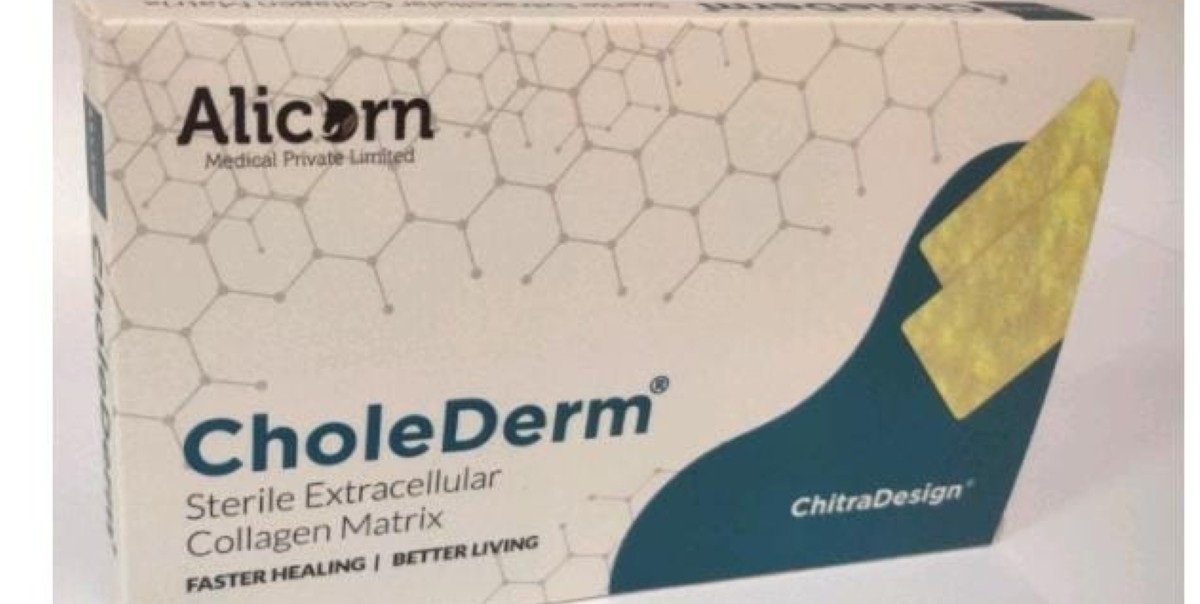
CholeDerm. (Supplied)
Synopsis: Officials said a key chapter in this journey began in 2008 at the institute’s Division of Experimental Pathology. Under the leadership of Prof. TV Anilkumar, Scientist-G, a veterinary pathologist, researchers pioneered a first-of-its-kind technology to extract the extracellular matrix from the gall bladder (cholecyst) of farm animals.
What was once discarded as slaughterhouse waste has now turned into one of India’s most advanced wound-care innovations.
The humble gall bladder of farm animals has become the starting point for CholeDerm, a high-end medical device developed through indigenous research at the Sree Chitra Tirunal Institute for Medical Sciences and Technology (SCTIMST), Thiruvananthapuram, and commercialised by a Kerala start-up.
The product was officially launched on Friday, 23 January.
Officials said a key chapter in this journey began in 2008 at the institute’s Division of Experimental Pathology. Under the leadership of Prof. TV Anilkumar, Scientist-G, a veterinary pathologist, researchers pioneered a first-of-its-kind technology to extract the extracellular matrix from the gall bladder (cholecyst) of farm animals.
This matrix was transformed into thin sheets, powders and gels for medical use. The effort, officials added, resulted in over 25 international peer-reviewed publications and 10 Indian patents.
The most significant outcome is CholeDerm—a lyophilised (freeze-dried) sheet developed for skin and wound-healing applications.
The product helps wounds heal faster with minimal scarring by promoting quicker skin formation, better blood vessel growth, reduced graft rejection and improved tissue regeneration.
In 2017, the technology was transferred to M/s Alicorn Medical Private Limited, a start-up incubated at SCTIMST’s TIMED facility.
After years of development and regulatory scrutiny, CholeDerm received approval from the Central Drugs Standard Control Organisation in 2023 as a Class D medical device, the highest risk category.
It is also the first indigenously developed animal-origin Class D medical device to meet all statutory requirements under the Medical Device Rules, 2017.
Importantly, gall bladders—earlier considered worthless waste—are now a value-added byproduct, providing additional income to livestock farmers and reducing slaughterhouse waste.
Sharing clinical experience, Dr Vishwajit Singh, dermatologist at DY Patil Medical College, Pune, on 23 January said CholeDerm achieved complete wound closure in patients with long-standing ulcers, including those with diabetes and leprosy.
“It is applied once and reviewed after seven days, unlike daily dressings,” he said, calling it a promising option for chronic wound care.
SCTIMST is an Institution of National Importance under the Department of Science and Technology, Government of India.
The institute owns around 250 Indian patents and has completed nearly 90 technology transfers to industry. Biological products now form a major focus of its research.
(With inputs from Dileep V Kumar)


