

Published Dec 04, 2025 | 3:27 PM ⚊ Updated Dec 04, 2025 | 3:27 PM

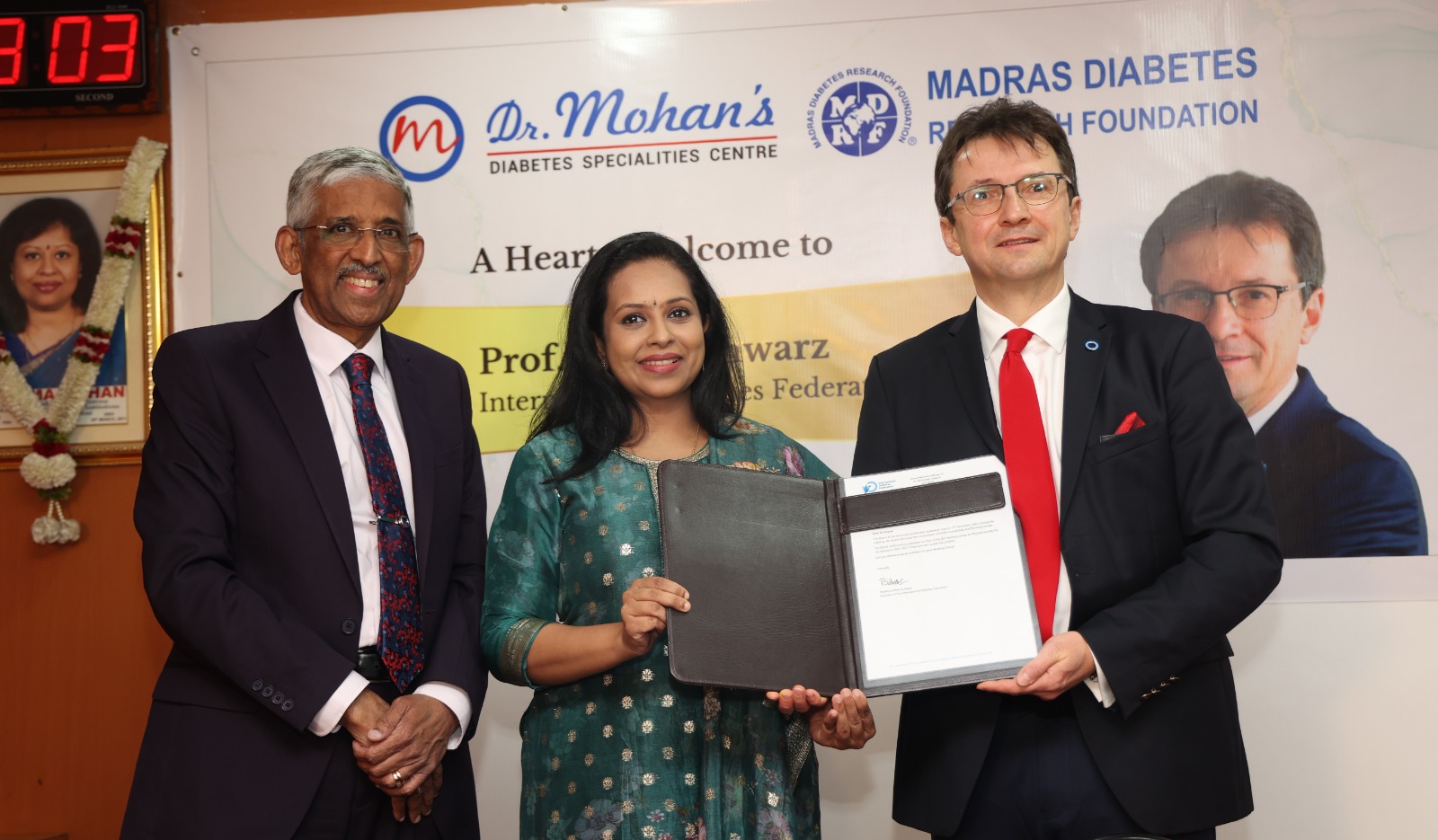
(L to R) Dr. V. Mohan – Chairman, Dr. Mohan’s Diabetes Specialities Centre & Madras Diabetes Research Foundation; Dr. R. M. Anjana – Managing Director, Dr. Mohan’s Diabetes Specialities Centre; President, MDRF & Chair, IDF working group on physical activity and Prof. Peter Schwarz – President, International Diabetes Federation. (Supplied)
Synopsis: IDF appoints India’s Dr RM Anjana as first-ever chair of its global Physical Activity Working Group and ACTIVE Initiative to combat rising diabetes through structured, systemic promotion of exercise worldwide. Marking a historic leadership role for India, the programme shifts focus from individual motivation to policy-driven, measurable interventions across all ages and regions.
As physical inactivity hits crisis proportions globally, the International Diabetes Federation (IDF) has tapped India’s Dr RM Anjana to lead a worldwide effort to turn exercise into a structured public health movement, marking the first time an Indian expert will spearhead a global physical activity consortium.
She will chair the IDF Working Group on Physical Activity and head the federation’s newly launched ACTIVE Initiative, a global programme designed to boost physical activity across age groups. Her leadership places India, not traditionally viewed as a policy-shaping health power—at the forefront of international strategies to combat diabetes and lifestyle-driven diseases.
Physical inactivity has emerged as a defining public health challenge, fuelling chronic noncommunicable diseases like diabetes, cardiovascular ailments and depression. Despite countless advisories urging people to move more, the world remains dangerously sedentary.
According to the IDF, 81 percent of adolescents and 27.5 percent of adults fail to meet minimum WHO-recommended physical activity guidelines, turning inaction into a global health emergency.
Until now, most physical activity efforts worldwide operated as fragmented, voluntary campaigns dependent on personal motivation. The IDF’s decision to formalise a dedicated working group marks a decisive shift—from awareness-based messaging toward structured, systemic
intervention. By creating a unified global platform with shared strategies, IDF acknowledges that physical activity must be enabled by environments, policies and institutions—not left to individual willpower.
Through Dr Anjana’s appointment, the IDF signals a new phase in preventive health—one that combines research, policy and community-level execution to reshape behaviour at scale. This consolidation aims to reverse decades of inertia that have made physical inactivity one of the most significant contributors to rising global disease burden.
The announcement positions India at a pivotal juncture in global health governance. Dr Anjana, who serves as Managing Director of Dr Mohan’s Diabetes Specialities Centre and President of the Madras Diabetes Research Foundation, has built an international reputation for research and community-based interventions in diabetes prevention. Her elevation marks a strategic recognition of India’s evolving leadership in noncommunicable disease management.
In her first statement after the announcement, Dr Anjana said she was “deeply honoured to take on this responsibility,” and stressed that inactivity could no longer be viewed as a mere personal failing. “Physical inactivity is now a global health crisis,” she said.
“What we need are bold, actionable strategies—not just discussions. The ACTIVE Initiative is designed to inspire children, adults and the elderly to embrace active living through structured, sustainable programmes.”
She underscored that the programme’s strength lies in global collaboration across cultural and infrastructural differences.
“By bringing together experts from every IDF region, we hope to drive a genuine worldwide movement that will meaningfully reduce the burden of diabetes and other chronic diseases,” she added.
The consortium she leads will ensure regional balance, gender diversity and representation from all IDF regions, preventing a one-size-fits-all paradigm.
Instead, the initiative seeks to develop frameworks adaptable to diverse geographies—an approach likely to become a
reference model for future multilateral health programmes.
Traditional health messaging has long centred on urging individuals to “exercise more,” but such appeals have produced negligible behavioural change. The ACTIVE Initiative aims to shift responsibility from individuals to systems—designing environments that make movement easier, more visible and socially reinforced.
During the announcement, the IDF outlined early programme elements: innovative fitness challenges across educational institutions, workplaces and communities; fitness scoring tools to track improvement; and the recognition of fitness ambassadors who inspire participation. These interventions are designed to standardise and measure activity, turning movement into a
shared, trackable norm.
Crucially, the IDF stated that the ACTIVE Initiative will integrate scientific evidence, policy frameworks and community action into a unified, scalable model—ensuring measurable outcomes rather than episodic enthusiasm. By embedding accountability and infrastructure, the initiative seeks to create a world where physical activity is not an afterthought, but an engineered part of daily life.
IDF President Professor Peter Schwarz emphasised that increasing physical activity remains “one of the most effective interventions we have to prevent diabetes and enhance global health,” adding that under Dr Anjana’s leadership, the working group will translate evidence into “practical, community-driven action”.
For India’s health ecosystem, this appointment represents more than individual achievement—it signals a turning point in how the world perceives India’s scientific and policy capabilities.
Dr V Mohan, Chairman of Dr. Mohan’s Diabetes Specialities Centre and MDRF, called the appointment “a moment of great pride for our organisation and for India,” noting her extensive contributions to physical activity research and community health.
He added that the ACTIVE Initiative is poised to become a “landmark programme that will create real impact across continents,” reflecting confidence rooted in decades of evidence-based interventions developed and tested on Indian soil. By steering this global effort, India is no longer a passive recipient of lifestyle-disease discourse but an architect of solutions.
The shift challenges historical patterns where global health direction flowed predominantly from the West, signalling the emergence of the Global South as a policy making force in preventive health.
(Edited by Amit Vasudev)


