

Published Jul 13, 2026 | 8:17 PM ⚊ Updated Jul 13, 2026 | 8:17 PM

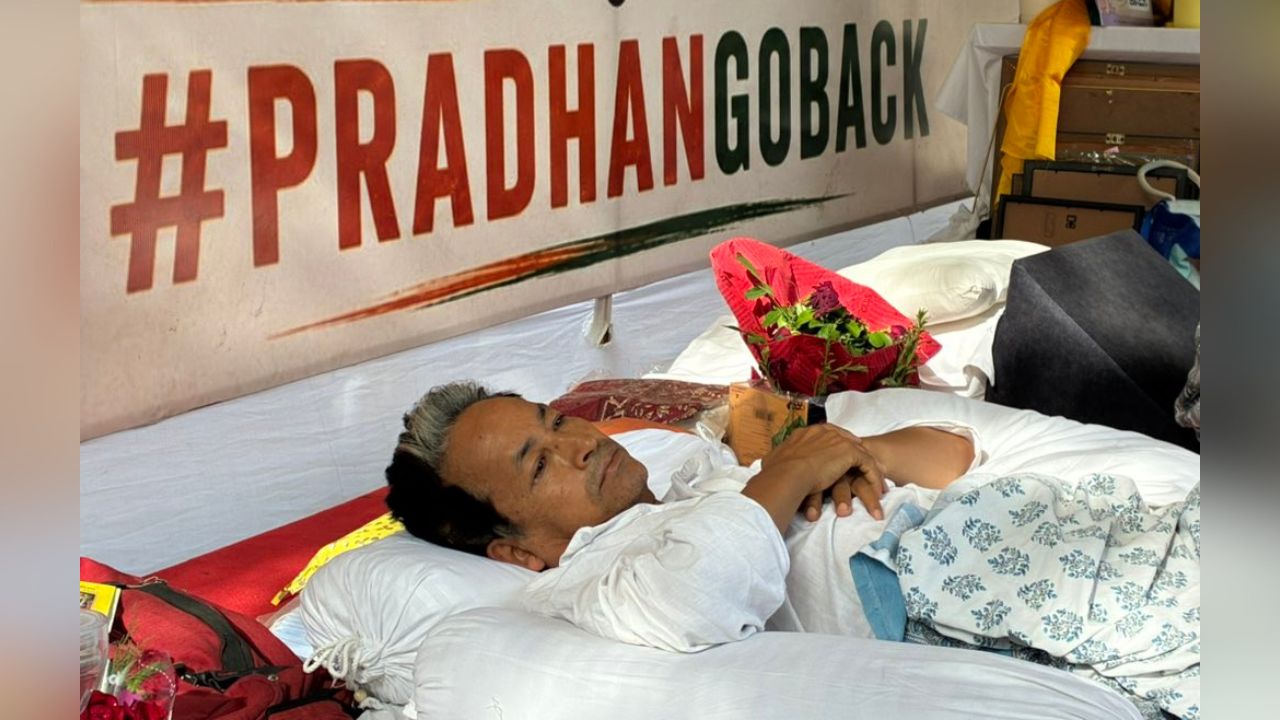
Sonam Wangchuk during his fast at Jantar Mantar.

Synopsis: As activist Sonam Wangchuk’s hunger strike over the alleged NEET-UG paper leak entered its 16th day, doctors warned that his body was approaching a critical stage of starvation. Medical experts explained how the body shifts from using glucose and fat to breaking down muscle, why weakness replaces hunger, and how prolonged fasting can affect the heart, kidneys and brain. They also cautioned that ending a prolonged fast requires careful medical supervision to avoid life-threatening complications such as refeeding syndrome.
As engineer, innovator and activist Sonam Wangchuk’s hunger strike entered its 16th day on Monday (13 July), organisers of the protest said they were increasingly worried about his health.
Medical experts said that while the body can adapt to prolonged fasting for a period, the third week marks a critical transition when fat reserves begin to run out and the risk of serious complications starts rising.
The Cockroach Janata Party (CJP), which has been protesting at Jantar Mantar in New Delhi since 20 June, is demanding the resignation of Union Education Minister Dharmendra Pradhan over the alleged NEET-UG paper leak. The group is also seeking ₹1 crore in compensation for the families of students who died by suicide after the controversy.
Wangchuk began his indefinite hunger strike on 28 June.
Speaking to South First, CJP spokesperson Sourav Das said the organisers remained concerned as Wangchuk refused to end the protest without a response from the Union government.
“His only intake is salt water. His health is deteriorating, but there has been no response from the Union government,” Das said.
Also Read: Sonam Wangchuk’s hunger strike enters 16th day amid health concerns
Doctors said the human body does not immediately begin consuming muscle when food intake stops. Instead, it follows a sequence designed to keep vital organs functioning for as long as possible.
According to Dr Sudhir Kumar, Senior Consultant Neurologist at Apollo Hospitals, Hyderabad, the body first consumes glucose circulating in the bloodstream before turning to glycogen, the stored form of glucose in the liver and muscles.
“In the first day or two, the body uses up its glycogen stores. After about three days, the brain switches from using glucose to ketones for energy. This is an adaptive mechanism that helps preserve muscle. For the first two weeks or so, the body primarily relies on its fat stores for energy,” he told South First.
Dr Kiran Madala, Professor and Head of the Department of Critical Care Medicine at Gandhi Medical College and Gandhi Hospital, Hyderabad, said the body’s fuel reserves are used in a predictable order.
“The body’s energy sources are used in a sequence: first glucose, then glycogen, followed by fat, and finally protein,” he told South First.
Once glycogen is depleted, stored fat becomes the body’s principal source of fuel. Fat is broken down into ketone bodies, which provide energy to sustain many organs during prolonged fasting.
Dr Madala said that a healthy individual with adequate fat reserves and muscle mass can tolerate starvation longer than someone who is already undernourished, although the duration varies from person to person.
Also Read: The struggles of creative people and the old tool-kit governments
One of the most common questions about prolonged fasting is why people on hunger strikes often report that they no longer feel hungry.
Dr Sudhir said the body gradually adapts after the initial days of starvation.
“Hunger is strongest during the first one or two days. Once a person gets past that phase, the body adapts. Insulin levels fall, and hormones such as leptin and ghrelin also change. Because of these hormonal changes, appetite decreases,” he explained.
Instead of hunger, weakness becomes the dominant symptom.
“At this stage, the person is more likely to feel weak than hungry. Sitting in one place may not be difficult, but walking, climbing stairs or doing any physical activity can become increasingly challenging,” he said.
The brain also adapts during this period. Dr Sudhir said most higher brain functions remain intact because the brain switches to ketones as an alternative energy source.
“The person can remain fully conscious. They can reason, understand information and make decisions normally,” he said.
However, subtle changes begin to appear. Concentration declines, attention span shortens and reaction time slows, making physically demanding or mentally intensive tasks more difficult.
Also Read: Cockroach Janata Party protest seeks Pradhan’s resignation
Doctors said the body’s survival strategy changes once fat reserves begin to run low.
“Once the body’s fat stores are depleted, muscle breakdown definitely begins,” Dr Sudhir said. “The heart is also a muscle, and prolonged starvation can eventually lead to the breakdown of heart muscle. That is when serious complications can start.”
Dr Madala echoed the same concern, saying the body eventually turns to protein after exhausting its fat stores.
“As muscle proteins are broken down, muscle mass begins to decline. The person develops visible weakness and progressive muscle wasting,” he said.
The exact timing depends on a person’s nutritional status before the fast began. Someone with greater fat and muscle reserves may tolerate starvation longer than a lean individual.
However, doctors agreed that after more than two weeks without food, the body enters a stage where close medical monitoring becomes increasingly important as the risk of organ dysfunction begins to rise.
As starvation progresses, the body’s efforts to conserve energy begin affecting the cardiovascular system.
Dr Sudhir said prolonged fasting slows both the heart rate and blood pressure. A person whose resting heart rate is normally around 70 beats per minute may see it fall by 10 to 20 beats per minute during an extended fast.
“Blood pressure also tends to decrease. Another common effect is postural hypotension, where a person feels dizzy or even faints on standing because the body is no longer able to adjust quickly to changes in posture,” he said.
To preserve blood flow to vital organs such as the brain and heart, the body reduces circulation to the hands and feet. As a result, the extremities may feel cold, while physical endurance declines sharply.
“Someone who was previously able to cycle, run or work out for an hour will no longer have that capacity. Sitting or walking a short distance may still be possible, but strenuous exercise becomes very difficult,” Dr Sudhir said.
Dr Madala said that once starvation progresses beyond the body’s energy reserves, the consequences become more widespread.
“After about two weeks of prolonged starvation, the body’s energy reserves become severely depleted and the risk of organ dysfunction begins to increase. The heart, kidneys and liver can all be affected as starvation progresses. How quickly this happens depends on the person’s health, nutritional status and body composition before the fast,” he said.
He added that individuals with greater fat and muscle reserves may survive longer, but the risk of complications rises steadily as starvation continues.
Although Wangchuk is reportedly consuming only saline water, doctors said hydration alone cannot prevent nutritional deficiencies.
“A person surviving only on water and salt is getting hydration and sodium, but no proteins, carbohydrates, fats or other essential nutrients,” Dr Sudhir said.
The body also requires potassium, calcium, magnesium and phosphorus to keep the heart, muscles and nerves functioning normally. As fasting continues, these electrolytes can become depleted.
“Potassium is especially important because it is essential for normal heart function. Both low and high potassium levels can be dangerous, but in this situation the greater concern is low potassium,” he said.
Dr Sudhir said dehydration, low blood pressure and electrolyte disturbances together can impair heart function and reduce blood flow to the kidneys, increasing the risk of kidney injury.
The immune system also weakens as prolonged starvation continues, making the body more vulnerable to infections.
Doctors said the body can rely on stored fat-soluble vitamins such as A, D, E and K for some time. Water-soluble vitamins, however, are depleted more quickly.
Dr Sudhir said deficiencies of vitamin C and B-complex vitamins, particularly thiamine, become a concern during prolonged starvation.
“Thiamine deficiency can affect brain function, while prolonged nutritional deficiency may also lead to muscle wasting and skin problems,” he said.
Dr Madala added that visible muscle loss becomes increasingly apparent once the body begins breaking down protein for energy.
“The body can continue using protein as an energy source for a period, but this stage marks the progression from adaptation to starvation-related tissue loss,” he said.
Doctors cautioned that the danger does not end when a prolonged hunger strike is called off.
Dr Sudhir said suddenly consuming large amounts of food after weeks of starvation can trigger refeeding syndrome, a potentially life-threatening condition.
“Someone who has not eaten for more than two weeks should not suddenly consume a large, carbohydrate-rich meal,” he said.
During prolonged starvation, insulin levels remain low. When carbohydrates are introduced rapidly, insulin rises sharply and causes electrolytes such as potassium, magnesium and phosphate to move into the body’s cells. If these minerals are already depleted, the sudden shift can trigger cardiac arrhythmias, seizures or even respiratory failure.
“Nutrition should be restarted gradually under medical supervision. Doctors should first assess electrolyte levels, correct any deficiencies and then slowly reintroduce carbohydrates and other nutrients,” Dr Sudhir said.
While the two doctors differed on the exact timeline of starvation, both agreed that prolonged fasting becomes progressively more dangerous after the second week.
Dr Madala said healthy individuals with greater nutritional reserves may survive longer than others, but warned that the body eventually reaches a stage where multiple organs begin to fail.
Dr Sudhir, meanwhile, said Wangchuk may not yet be facing an immediate threat to life but that the coming days would be critical if the fast continues.
“At this stage, there may not be an immediate threat to life. However, if the hunger strike continues for another week or so, the risk of life-threatening complications increases significantly unless nutrition is restored,” he said.
As Wangchuk continues his fast at Jantar Mantar, the political standoff remains unresolved. Medically, however, experts say the body is approaching the limits of its ability to adapt.
If the hunger strike extends further, the risks will no longer be confined to weakness and weight loss but could progress to organ dysfunction and potentially life-threatening complications.
(Edited by Majnu Babu).



