

Published Dec 25, 2025 | 7:00 AM ⚊ Updated Dec 25, 2025 | 7:00 AM

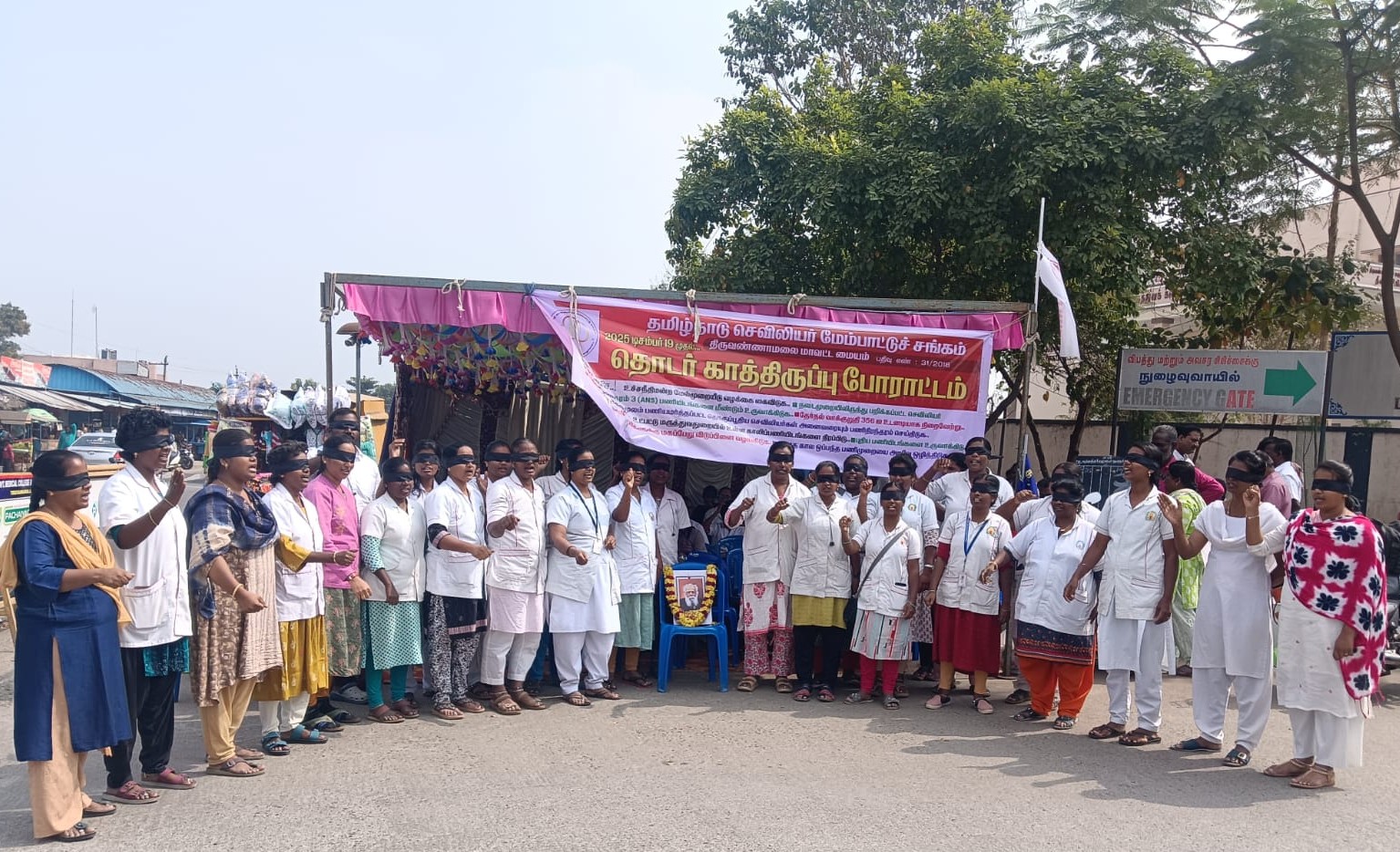
Nurses are demanding what have been promised to them.
Synopsis: The agitation began with a hunger strike in Chennai on 18 December and has since spread across multiple districts. Subsequent arrests and detentions drew the state’s attention to the unresolved grievances of the frontline healthcare workers.
Tamil Nadu’s Medical Services Recruitment Board (MRB)-hired contract nurses are protesting against the government’s failure to regularise their appointments, low and unequal wages, staff shortages, and a heavy workload.
The protesting nurses said the DMK government had not kept its promise made in the 2021 election manifesto, nor had it implemented a Madras High Court order.
In April, the high court directed the state government to comply with its 2018 order and grant equal pay and service benefits to MRB nurses (contract nurses). The nurses claimed that the DMK had promised to regularise their service in its Assembly election manifesto.
They alleged that Health Minister Ma Subramanian’s dismissive comments worsened their crisis. The nurses said they were struggling financially and professionally.
The agitation began with a hunger strike in Chennai on 18 December and has since spread across multiple districts. Subsequent arrests and detentions drew the state’s attention to the unresolved grievances of the frontline healthcare workers.
The nurses’ continued demand for regularisation and equal pay grew stronger and louder even as hospitals were grappling with severe manpower shortages.
Tamil Nadu Nurses’ Empowerment Association’s general secretary N Subin said the Medical Services Recruitment Board hired staff nurses after conducting written examinations and communal rotation in 2015.
Those recruited were placed on two years of consolidated, or contract, pay.
“Appointment orders were issued after the completion of two years in service stated that the nurses would be brought under regular pay. However, this was never implemented,” Subin explained why the nurses have been protesting since 2017.
He said the DMK government had promised in its election manifesto that the issue would be resolved after assuming power. “To date, nothing substantial has been done. Only a few nurses have been regularised. Around 8,000 nurses are still waiting regularisation,” he told South First.
Tamil Nadu has been following a cyclical recruitment model with no direct entry into regular posts, Subin said. Nurses must join on contract and later move to regular posts, if and when vacancies arise.
“When a nurse moves from contract to regular service, that vacant post is again filled through contract recruitment via the board. This cycle continues,” he added.
So far, MRB has recruited about 13,000 staff nurses, Subin said. Of them, nearly 7,000 have been regularised, while the remaining 8,000 continue to work on a contract basis.
The protest, he said, was not limited to regularisation alone. “We are also demanding equal pay for contract nurses and regular nurses. The High Court has clearly ruled that there should be equal pay for equal work, but this government has not implemented that judgment,” he said.
The gap between judicial orders and administrative action has fuelled resentment among nurses, who shoulder the same responsibilities as regular staff while receiving significantly lower wages and fewer benefits.
Association leaders argued that prolonged contractual employment has left thousands of nurses financially insecure despite years of service in public hospitals.
On 18 December, nurses launched a hunger protest in Chennai after talks had failed. Subin said around 1,800 nurses participated in the agitation.
“The police arrested us and took us to the Kilambakkam bus stand,” he said. Nearly 800 nurses were detained and later shifted to a marriage hall in Urapakkam.
The protesters were released in the evening but they stayed back in Kilambakkam. The following day, they continued their agitation at the Nandhivaram Primary Health Centre near Guduvanchery.
The crackdown intensified on the sixth day of protest. “Nearly 217 nurses were arrested and detained in a marriage hall in Kanchipuram. The remaining nurses were arrested later in the evening and taken to the same location,” Subin said.
He added that several nurses were arrested around 5 pm and transported in 10 Tamil Nadu government buses to different districts.
“We are now continuing our protests in whichever districts we have been taken to,” he added.
Highlighting the moral weight of the protest, a protester, CK Sujatha, said nurses were demanding what had been promised to them.
“One of our key demands is that the government fulfil the promises made in its election manifesto,” she told South First. “Nearly five years have passed, but no concrete action has been taken.”
Sujatha recalled the role nurses played during the COVID-19 pandemic.
“We worked tirelessly, risking our lives and staying away from our families. The government itself realised our importance during that period, yet the promises made to us remain unmet,” she said.
She stressed that the protest was not motivated by personal benefit. “We are fighting not for personal gain, but for the rights of nurses and for the welfare of society,” she added.
Offering a ground-level account of the government’s response, S Vinodhini, State Vice President of the association and a staff nurse at the Paramakudi Government Headquarters Hospital in Ramanathapuram district, said the Health Minister Subramanian’s remarks had deeply hurt the nurses.
Referring to point number 356 in the DMK election manifesto, Vinodhini said it promised regularisation of all MRB nurses during the party’s tenure.
“Even now, nearly 8,000 MRB staff nurses are waiting regularisation,” she told South First.
When nurses began the hunger protest on 18 December, Vinodhini said the health minister reacted dismissively.
“He told us that if we wanted to protest or go on a hunger strike, we could do so, and that he was not responsible for it. He did not give any assurance or take responsibility for resolving our demands,” she said.
The remark, she added, reflected a lack of respect towards nurses.
Vinodhini also challenged the minister’s claim that there were “zero vacancies” and no scope to create new posts.
“In Trichy alone, there are around 1,000 to 1,700 patient beds, but only about 100 to 200 staff nurses,” she said. Due to staff shortages, nurses are being deputed from districts such as Cuddalore, Ariyalur, and Perambalur to manage the workload.
Despite these shortages, she said, the minister continued to maintain that no new posts could be created. “That is why we are continuing our struggle—for the implementation of the election manifesto and for the regularisation of all MRB staff nurses,” she said.
Vinodhini also pointed to the financial strain faced by nurses. Currently, MRB nurses earn ₹18,000 per month. “In 2015, our basic pay was ₹7,700. After repeated protests, it was raised to ₹14,000 and later to ₹18,000. Even now, ₹18,000 remains our basic pay,” she said.
“With rising living costs and family responsibilities—especially since most nurses are women—surviving on this salary has become difficult. Regularisation is not a privilege. It is our basic need,” she added.
(Edited by Majnu Babu).


