

Published Dec 26, 2025 | 8:00 AM ⚊ Updated Dec 26, 2025 | 8:00 AM

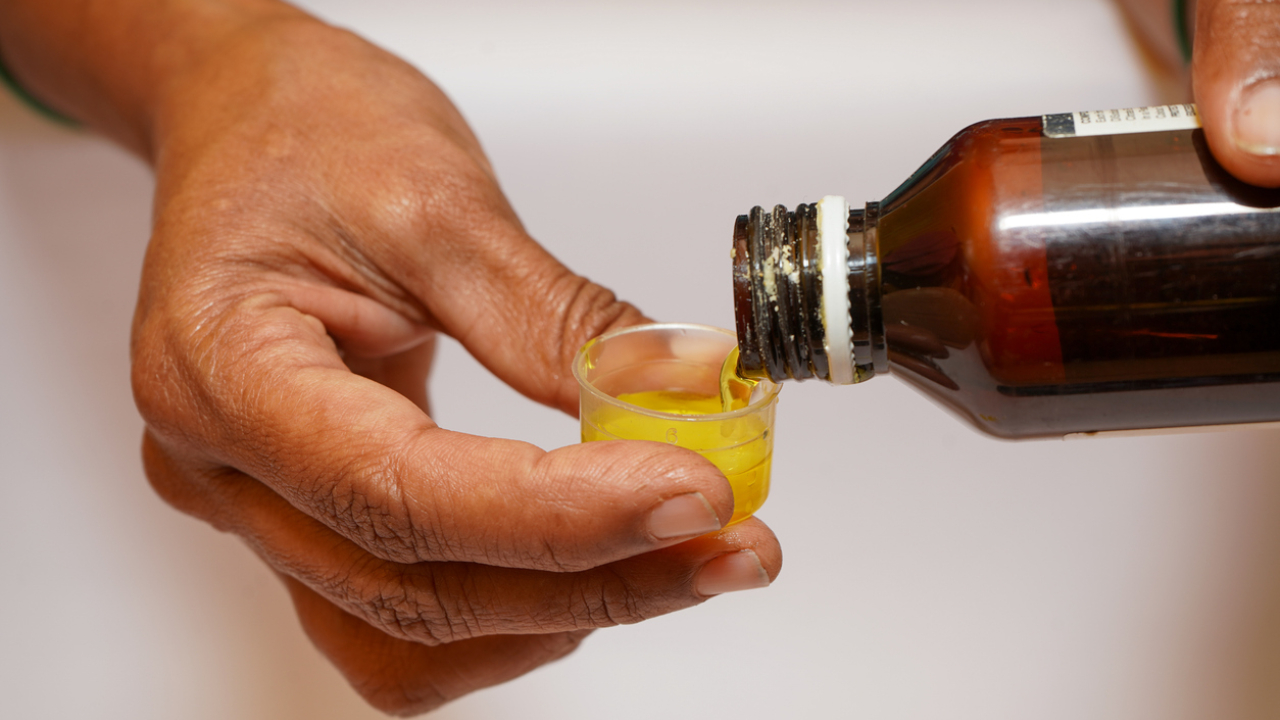
Cough Syrup. Representational image. (iStock)
Synopsis: The concentration of cough syrup failures in Tamil Nadu and Karnataka reflects these states’ roles as pharmaceutical manufacturing centres. Companies cluster in industrial zones near Chennai, Bengaluru and Trichy, producing millions of bottles that distribute across India. When quality control fails at one of these facilities, the substandard products spread through national supply chains before testing laboratories in distant states catch the problems.
The November 2025 drug alerts released by the Central Drugs Standard Control Organisation(CDSCO) reveal what health officials in Tamil Nadu discovered through routine surveillance: Two batches of paracetamol paediatric syrup manufactured in Chennai contained ethylene glycol at nearly four times the permitted limit. South East Pharmaceuticals produced both batches in November 2024.
Batch SP-684 measured ethylene glycol at 0.385 percent. Batch SP-683 showed 0.4 percent. The Indian Pharmacopoeia permits a maximum of 0.1 percent. At these concentrations, a child taking the recommended dose over several days accumulates enough toxin to damage kidney function.
However, Tamil Nadu laboratories caught more than just the paracetamol contamination. The November lists document 207 medicines that failed quality standards across India. Among them, 18 cough syrups failed tests, with Southern states detecting 14 of these failures through their laboratory networks.
Beyond the two ethylene glycol cases in Chennai, laboratories in Assam detected a third contamination that poses similar risks. Cetirizine Hydrochloride, Phenylephrine Hydrochloride and Dextromethorphan Hydrobromide Syrup, manufactured by Shreya Lifesciences in Roorkee and tested at the Regional Drugs Testing Laboratory in Guwahati, failed standards for diethylene glycol. Diethylene glycol destroys kidneys.
The Coldrif crisis from October demonstrated this: 20 children died in Madhya Pradesh and Rajasthan after consuming cough syrup contaminated with the industrial solvent. Manufacturers use diethylene glycol as a cheap substitute for pharmaceutical-grade glycerin, cutting production costs while creating products that kill.
Ethylene glycol causes similar damage, though it acts through a different metabolic pathway. Children’s bodies convert it to oxalic acid, which crystallises in kidney tubules and blocks filtration. Parents give the syrup to reduce fever, unaware that each dose deposits more poison. Symptoms appear days later: the child stops urinating, swelling develops in the face and ankles, and blood toxin levels climb until dialysis becomes necessary.
The bottles displayed proper manufacturing licenses, carried expiry dates extending to November 2026, and sat on pharmacy shelves alongside legitimate medicines. Only laboratory analysis revealed the problem.
Tamil Nadu’s drug testing laboratories flagged seven cough and cold preparations in November, the highest count among Southern states. Beyond the two toxic paracetamol syrups, five other formulations failed content or assay requirements.
Content failures mean the active pharmaceutical ingredients measured either too high or too low. A syrup claiming to contain 5mg of terbutaline per dose might deliver 3mg or 8mg. Children with asthma prescribed these bronchodilators receive inconsistent treatment. One dose fails to open airways during an attack. The next dose delivers enough to cause tremors and rapid heartbeat.
Karnataka laboratories also detected four cough syrup failures in November.
Meanwhile, Puducherry’s Drug Testing Laboratory identified multiple failures in cough preparations containing Dextromethorphan, Phenylephrine and Chlorpheniramine.
Four separate batches from different manufacturers showed assay problems, meaning children received incorrect doses of cough suppressants and decongestants.
Cyproheptadine Hydrochloride Syrup from Sresan Pharmaceutical appeared twice in the November reports. One batch failed pH testing, the other failed both pH and assay requirements. The syrup treats allergic reactions in children. pH failures indicate the solution became too acidic or alkaline, which affects how the body absorbs the medicine and can irritate the digestive tract.
The concentration of cough syrup failures in Tamil Nadu and Karnataka reflects these states’ roles as pharmaceutical manufacturing centres. Companies cluster in industrial zones near Chennai, Bengaluru and Trichy, producing millions of bottles that distribute across India. When quality control fails at one of these facilities, the substandard products spread through national supply chains before testing laboratories in distant states catch the problems.
The November data shows Southern states detected 95 of the 207 substandard medicines reported nationwide, representing 46 percent of all quality failures. This proportion exceeds the South’s share of India’s population or pharmaceutical production, suggesting either more rigorous testing or higher failure rates among local manufacturers.
Karnataka led with 38 failed products. Bengaluru’s Drug Testing Laboratory reported 25 medicines that did not meet standards, testing everything from basic antibiotics to complex injectable formulations. The Regional Drugs Testing Laboratories in Hubli and Bellary identified 13 additional failures.
Tamil Nadu followed with 24 products across three testing facilities. Chennai’s laboratory caught 19 failures, Madurai’s laboratory found four, and the King Institute identified one contaminated batch of sterile water for injection that failed bacterial endotoxin testing.
Telangana’s Drug Control Laboratory in Hyderabad flagged 14 substandard medicines. Several showed packaging defects where tablets crumbled inside strips, rendering them useless before patients opened the foil. Others failed basic assay requirements, containing too little or too much active ingredient.
Kerala’s network of laboratories in Thiruvananthapuram, Ernakulam, Thrissur and Konni detected 11 problematic medicines. Multiple batches of Clopidogrel and Aspirin tablets, prescribed to prevent heart attacks and strokes, failed dissolution tests. The tablets pass through the digestive system without breaking down, delivering no protection despite patients believing they are preventing cardiovascular events.
Puducherry, despite its small size, identified eight substandard products through systematic testing. The Drug Testing Laboratory there focuses on medicines commonly prescribed in the union territory’s public health facilities, catching problems that might otherwise go undetected.
The regional pattern suggests Southern testing infrastructure operates with different intensity than other parts of India.
Beyond the immediate threat of toxic cough syrups, the November reports revealed a broader crisis affecting pregnant women, elderly citizens and children: Calcium Phosphate and Vitamin D3 Suspension. Sixteen separate batches from Yacca Lifesciences in Roorkee, all manufactured in August 2024 with expiry dates in January 2026, failed microbial contamination tests at Kolkata’s Central Drugs Laboratory.
The laboratory found total aerobic viable counts exceeding permitted limits. This means bacteria grew in the suspension despite preservatives meant to maintain sterility. Patients consuming these contaminated batches introduce live bacteria into their digestive systems with every dose.
Doctors prescribe calcium and vitamin D3 to pregnant women to support fetal bone development and prevent pre-eclampsia. Elderly patients take these supplements to slow osteoporosis and reduce fracture risk. Children receive them during growth spurts. All of these populations have some degree of immune compromise or vulnerability. Bacterial contamination poses infection risks that healthy adults might resist but vulnerable populations cannot.
The pattern of 16 identical failures from one manufacturer over a two-month production period suggests systemic problems in Yacca Lifesciences’ quality control. Either the company’s testing protocols failed to detect the contamination, or the company shipped products knowing they failed microbial limits. Both scenarios represent serious regulatory violations.
Eight injectable medications in the November reports failed sterility tests, creating immediate threats to hospitalised patients. When contaminated products enter the bloodstream directly, bacteria can trigger septic shock within hours.
Diazepam Injection from Systochem Laboratories in Uttar Pradesh failed multiple tests: identification, pH, particulate matter, sterility and assay. The product contained foreign particles visible to the naked eye, bacterial contamination and incorrect drug concentrations. Hospitals use diazepam to stop seizures. A contaminated batch could kill a patient faster than the seizure it was meant to treat.
Rabeprazole Sodium Injection from Martin & Brown Bio-Sciences in Himachal Pradesh showed similar failures. The laboratory report noted clarity of solution problems, particulate matter, sterility failures and description defects.
Pheniramine Maleate Injection from Sanofi India, tested at Kolkata’s laboratory, failed sterility requirements despite coming from a major pharmaceutical company with international quality certifications. The batch was manufactured in June 2023 with expiry in May 2026.
Bupivacaine Injection from Protech Telelinks in Himachal Pradesh failed particulate matter testing and showed description defects. Anaesthesiologists inject bupivacaine near spinal nerves to numb surgical sites.
Compound Sodium Lactate Injection, commonly called Ringer Lactate and used in every emergency room for fluid resuscitation, failed sterility tests. The batch from Paschim Banga Pharmaceutical in West Bengal, manufactured in June 2023, developed bacterial contamination despite packaging that should have maintained sterility for three years.
Iron Sucrose Injection, Ferric Carboxymaltose Injection and Adrenochrome Monosemicarbazone Injection all showed particulate matter, sterility problems or both. Hospitals administer these products to treat severe anaemia. Patients receiving contaminated iron injections face infection risks while already weakened by low blood counts.
Beyond the 205 substandard products, two medicines in the November reports fall into a more alarming category: spurious drugs. These are not manufacturing errors or quality control failures. These are counterfeit products where the companies named on the labels deny ever producing those batches.
Telmisartan Tablets claiming to be Telma 40, batch 18240413, supposedly manufactured in May 2024 with expiry in April 2027, were found and tested at the Regional Drugs Testing Laboratory in Chandigarh. When investigators contacted the manufacturer listed on the packaging, the company responded: The actual manufacturer has informed that the impugned batch of the product has not been manufactured by them and that it is a spurious drug.
Pantoprazole Gastro-resistant Tablets marked as PAN 40, batch 24440478, showed similar characteristics. The packaging claimed manufacture in February 2024 with expiry in July 2026. The listed manufacturer denied production.
Both medicines treat common chronic conditions. Telmisartan controls high blood pressure. Millions of Indians take one tablet daily to prevent strokes and heart attacks. Pantoprazole reduces stomach acid and treats gastroesophageal reflux disease. Patients consume it for years to manage chronic symptoms.
The spurious versions might contain no active ingredient, leaving patients’ blood pressure uncontrolled or their reflux untreated. They might contain wrong ingredients that cause unexpected side effects. They might contain correct ingredients in wrong doses. Without knowing who actually manufactured these counterfeits or what substances went into the tablets, no one can predict the harm they might cause.
Thirteen paracetamol products in various strengths failed quality tests in November, continuing a pattern from October when 20 paracetamol batches showed dissolution problems. The November failures span multiple manufacturers across several states.
Alpha Pharmaceuticals in Faridabad produced 650mg tablets that failed dissolution tests at Kolkata’s laboratory. Hindustan Laboratories in Maharashtra had similar failures. Relief Biotech in Roorkee showed content problems in two separate products: 5mg Amlodipine tablets contained incorrect amounts of the active ingredient, while 10mg Atorvastatin tablets failed dissolution requirements.
(Edited by Sumavarsha)


