

Published Jan 28, 2026 | 1:18 PM ⚊ Updated Jan 28, 2026 | 1:18 PM

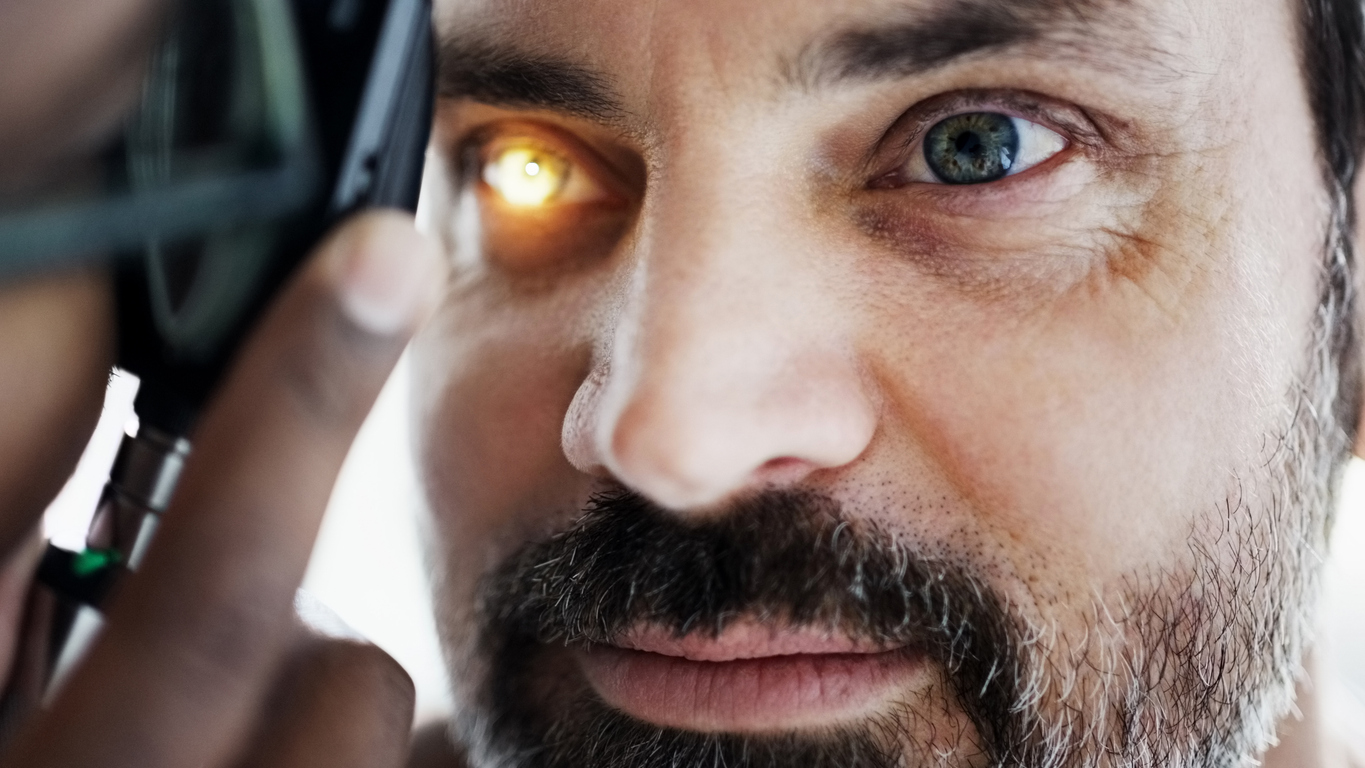
Close-up of doctor holding ophthalmoscope examining male patient eyes in hospital medical examination room. (iStock)
Synopsis: While larger studies are needed before clinical rollout, researchers say the findings point to a future where a routine eye test could also serve as an early warning for diabetes—long before symptoms appear.
A simple photograph of the back of the eye could soon help doctors detect diabetes—without needles, fasting or laboratory tests.
A new study shows that artificial intelligence (AI) can analyse routine retinal images to identify type 2 diabetes and even detect early blood vessel changes linked to prediabetes among Asian Indians.
The proof-of-concept research, published in Diabetes Technology & Therapeutics on 23 January, suggests that tiny changes in retinal blood vessels—often invisible to doctors during regular eye exams—can reveal whether a person has diabetes.
Researchers say this approach could make screening quicker, non-invasive and easier to scale, especially in countries like India where many people remain undiagnosed.
The retina offers a unique view into the body’s microvascular health. It is the only place where doctors can see live blood vessels directly without surgery, simply by taking a photograph during an eye check-up.
“Think of the eye as a window that looks into the rest of your body,” said Dr. Soujanya Kaup, Associate Professor of Ophthalmology at Yenepoya (Deemed to be) University, Mangalore, and Adjunct Associate Professor of Global Health at Emory University, Atlanta. “By using AI to read the tiny clues in this window, we can tell if someone has diabetes after a quick retinal photo.”
The research was carried out by scientists from Yenepoya University, the Madras Diabetes Research Foundation in Chennai and Emory University in the US. Their focus was on how diabetes affects the structure of blood vessels in the retina, particularly the veins.
The study analysed 273 retinal images taken from 139 adults who were classified as having normal blood sugar levels, prediabetes or diabetes. Using AI, researchers examined more than 200 features related to the shape, thickness and curvature of retinal blood vessels.
They found that people with diabetes showed clear changes in their retinal veins. These vessels tended to be thicker, more curved and more irregular compared to those in people with normal blood sugar levels.
Importantly, similar but milder changes were also seen in people with prediabetes, suggesting that damage begins even before diabetes is formally diagnosed.
“We trained the AI to look at specific shapes and patterns in the veins using retinal photos of people without and with diabetes,” explained Dr. Sudeshna Sil Kar, co-lead author from Emory University.
It is like a digital detective that is 95 percent accurate at identifying diabetes just by looking at one picture, he added.
The vein-based AI model correctly identified diabetes with a sensitivity of 95 percent. It was also able to flag prediabetes with moderate accuracy, highlighting its potential role in early detection.
One of the key strengths of the study is that it used retinal images already captured during standard eye examinations, rather than requiring special scans or tests.
“The study has utilised routine retinal images already captured during standard eye examinations,” said Dr. R. Rajalakshmi, senior author and Head of Medical Retina and Ocular Research at Dr. Mohan’s Diabetes Specialities Centre and the Madras Diabetes Research Foundation. “We noticed that there are subtle changes in the eye blood vessels that start, even before diabetes develops.”
Because retinal photography is widely used in eye clinics and diabetes centres, researchers believe AI tools could be added to existing systems with minimal disruption.
Unlike conventional screening methods, the AI-based approach does not require blood samples, fasting or laboratory infrastructure.
“This does not require expensive laboratory equipment,” said Dr. Anant Madabhushi, Director of the Emory Empathetic AI for Health Institute and a co-author of the study. “No blood draws, no fasting, just a quick photo of the back of the eye and the use of the AI.”
This could make large-scale screening more feasible in low-resource and rural settings, where access to blood tests is often limited.
“India has over 100 million people with diabetes, and very often, many do not even know they have it,” said Dr. V. Mohan, Chairman of Dr. Mohan’s Diabetes Specialities Centre. “If use of AI tools with simple retinal photos can help early diagnosis of diabetes, it can be used real-time in future to screen for diabetes. We have to validate these research findings in a larger population.”
Dr. K.M. Venkat Narayan, Executive Director of the Emory Global Diabetes Research Center, added that the study strengthens a growing body of evidence. “This study adds to the foundation for leveraging AI and the eye as an early window to systemic disorders,” he said.
While larger studies are needed before clinical rollout, researchers say the findings point to a future where a routine eye test could also serve as an early warning for diabetes—long before symptoms appear.
(Edited by Sumavarsha)


