


Published Jan 30, 2026 | 7:00 AM ⚊ Updated Jan 30, 2026 | 11:15 AM


Helicobacter pylori is the primary cause of chronic gastritis, painful peptic ulcers, and stomach cancer.
Synopsis: A non-invasive breath test for detecting the bacterium Helicobacter pylori, developed by Nobel laureate Barry Marshall, has been introduced in India for the first time at AIG Hospitals in Hyderabad. It offers a simpler alternative to endoscopy for diagnosing a common but often undetected gastric infection caused by the bacteria. Marshall is best known for challenging medical orthodoxy in the 1980s by ingesting the bacteria himself to prove, alongside pathologist Robin Warren, that H. pylori causes gastritis and ulcers.
In the early 1980s, a young Australian physician named Barry J Marshall took a dangerous gamble to prove a hypothesis the medical community had long dismissed, at great personal risk.
He deliberately ingested a cocktail spiked with Helicobacter pylori. At the time, conventional thinking held that no bacterium could survive the acidic environment of the human stomach.

Barry J Marshall currently serves as Professor of Clinical Microbiology and Co-Director of the Marshall Centre, University of Western Australia.
But Marshall and pathologist Robin Warren had earlier found that H. pylori caused gastritis and ulcers in infected patients.
Within days, Marshall’s gambit paid off when he developed painful gastritis, proving the infection could take hold. Two decades later, in 2005, the pair were awarded the Nobel Prize in Medicine.
Now, an innovation developed by Marshall himself has arrived in India for the first time, promising to greatly simplify one of the key bottlenecks in treating the infection: a cumbersome and painful diagnostic process.
AIG Hospitals in Hyderabad is offering PYtest, a breath test that can detect active H. pylori infection without endoscopy tubes or invasive biopsies.
“At AIG, we have always believed in combining clinical excellence with innovation,” said Dr D Nageshwar Reddy, chairman of AIG Hospitals.
“This test eliminates the fear and hesitation associated with invasive procedures and brings us one step closer to early detection and prevention of serious gastric diseases.”
Helicobacter pylori is paradoxically both widespread and poorly understood. The bacterium spreads through contaminated food, water, or close contact, and is particularly common in childhood.
It survives stomach acid by burrowing into the protective mucus lining, where it can remain for decades. More than half the global population carries H. pylori. Infection of the stomach does not necessarily cause illness, and most carriers remain symptom free throughout their lives.
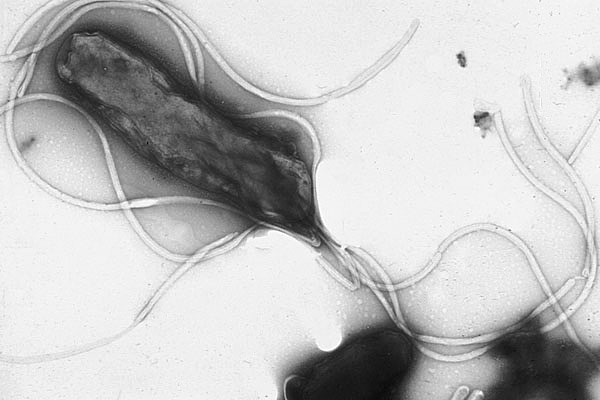
Electron micrograph of H. pylori.
But when problems do arise, they include abdominal pain, bloating, nausea, and loss of appetite. It is also the primary cause of chronic gastritis, painful peptic ulcers, and stomach cancer.
The good news is that infection is treatable with a combination of antibiotics and acid-reducing drugs called proton pump inhibitors. The challenge has always been identifying who needs treatment in the first place.
Endoscopy requires sedation, carries risks, and makes many patients anxious enough to avoid testing altogether. As a result, by the time symptoms are severe enough to trigger diagnosis, significant damage may already have occurred.
The test follows a simple process. Patients consume a small amount of urea tagged with carbon-14 and then breathe into a collection device.
If H. pylori is present, it breaks down the urea, releasing tagged carbon dioxide that appears in the breath. Results are available within minutes, with 93.8 percent sensitivity and 97.8 percent specificity, validated through Phase 3 clinical trials on Indian patients.
AIG Hospitals has also established the Prof Barry Marshall H. pylori Research Centre. It is dedicated to studying how the bacteria behaves in Indian populations, including antibiotic resistance patterns that can inform better treatment protocols.
“The Indian clinical trial demonstrated not just safety and accuracy, but also patient comfort and efficiency. In a country where millions live with undiagnosed gastric infections, PYtest offers a transformative, accessible, and evidence-based diagnostic option,” said Dr Rakesh Kalapala, Senior Consultant Gastroenterologist and Head of the GI Motility Centre at AIG Hospitals.
A specialised clinical team led by gastroenterologists Dr Aniruddha Pratap Singh, Dr Krithi Krishna, and Dr Rakesh Garlapati, under Dr Kalapala’s supervision, will implement the testing facility across AIG Hospitals’ Gachibowli and Banjara Hills branches.
(Edited by Dese Gowda)


