


Published Dec 04, 2025 | 11:39 AM ⚊ Updated Dec 04, 2025 | 11:39 AM

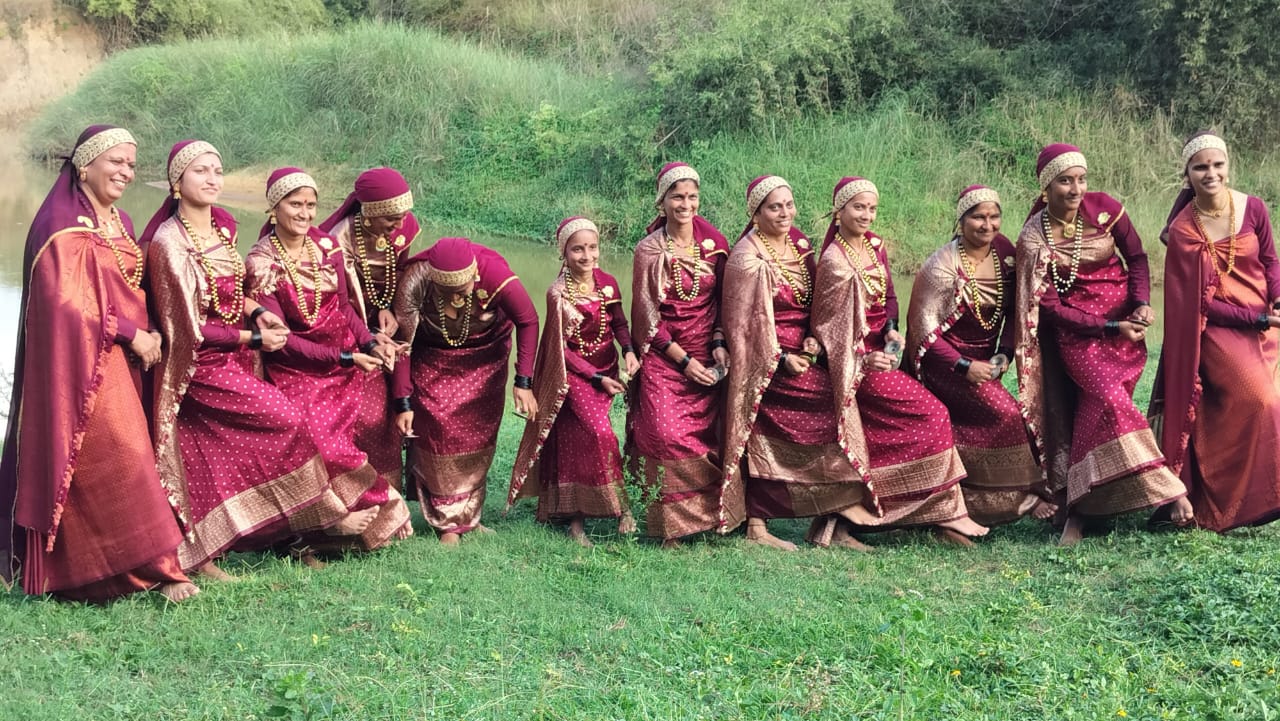
'Ummathat – The Rhythm of Kodava', was screened in the 'Indian Panorama Non-Feature' section of the 56th edition of IFFI in Goa. (Supplied)
Synopsis: Purely a passion project by director Prakash Kariappa K, and produced by his wife, K Yeshoda Prakash, the documentary was supposed to be just an archival project, but later they decided to send it to festivals, starting with IFFI.
One of UNESCO’s “definitely endangered” world languages, so much so that even natives of Karnataka, to which this eponymous language and culture belong, are principally unaware of it, Kodava, had its debut at the ongoing 56th IFFI Goa, via a documentary, ‘Ummathat – The Rhythm of Kodava‘, in the ‘Indian Panorama Non-Feature’ section.
Purely a passion project by state award-winning director Prakash Kariappa K, and produced by his wife, K Yeshoda Prakash, herself a National Best Kannada film awardee, under their home banner, Swasthik Entertainment, it was supposed to be just an archival project, but later they decided to send it to festivals starting with IFFI.
“We’re both surprised and sad to find out that no such previous documentary, let alone comprehensive or not, exists at all,” Prakash and Yeshoda said, when South First caught up with them for a chat.
Q. How significant is this milestone for both the Kodava film industry and its culture?
A: We are immensely happy that our Kodava documentary has found a place in this prestigious section. We’re hoping that showcasing our specific indigenous tribe and culture will lead to healthy conversations among those keen to learn about unique cultures, especially about Kodagu, the smallest district in Karnataka, which is the land of Kodavas, who have contributed nationally variously to sports, defence, arts, etc.
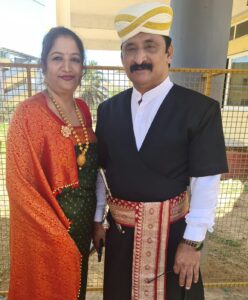
Yeshoda and Prakash Kariappa K. (Supplied)
We hope this movie will interest relevant film personnel, technicians, and researchers. The 53 years of the Kodava film industry have produced 30 movies so far. This entry might encourage more.
Q. Both you and your wife are state and national film awardees, respectively. Why bring in a co-director?
A: Bollajira Yamuna Aiyappa is an MA specialising in Kodava language with a deep understanding of the culture, and also a Ummathat dancer herself. Our project required communicating and coordinating with over 100 female dancers, and we felt it would be best served to onboard her as co-director.
Q: Are the origins of Ummathat, mentioned as symbolising “the divine feminine”, explained in the film?
A: The name is widely believed to come from ‘Uma’ – another name for Goddess Parvati – and ‘aat’, which means dance in the Kodava language. It’s also thought to come from “Ummath Poov“ aka, ‘Angel’s Trumpets’ (Brugmansia) used by our ancestors as an instrument during the dance, which was later replaced with copper/silver cymbals. The dance begins by invoking Kaveriamma’s (Mother Kaveri) blessings, sun and moon, before every performance; the circle formation represents the womb and the cycle of life. The dance is a worship depicted through the feminine body.
Q: The film begins with a symbolic Ummath Poov leaf shot. Was it scripted or improvised later? Was it in accordance with ‘Kodavame‘, the Kodava sacred text, that promotes harmony with nature and respects ancestral values?
A. I had lived and breathed this project for 1.5 years of its making, since its inception. Yes, Kodavas love and respect nature since ancient times, and it was also a factor. The opening leaf-shot was in accordance with our original storyboard.
Q. What resources did you use for research to reach the authenticity? Did you refer to the Pattole Palame?
A. We did indeed begin with Pattole Palame. Compiled by Nadikerianda Chinnappa by 1922, it, after all, is the most authoritative and extensive ever written record of Kodava folklore, songs, and customs. And right from the initial stage, we consulted with Rani Machaiah, the only Padma Shri Kodava dancer and a living ‘Ummathat’ legend.
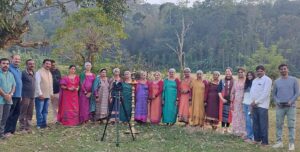
Cast and crew of ‘Ummathat – The Rhythm of Kodava’. (Supplied)
We also roped in M Shilpa Nanjappa, a state awardee in Bharatanatyam, who doubles up as the narrator of the dance forms. She focused on the authentic portrayal of ‘abhinayas’. Both their presences themselves being the authentication, refined our film by further correcting pronunciations, explaining mudras and demonstrating forgotten sequences, to maintain actuality of the dance forms, all throughout.
Q: Why was there no on-screen interview of Rani Machaiah?
A: We’d have really loved to, but her advancing age; she’s almost 80 and health concerns were a deterrent.
Q: In the process of researching and filming the 13 Ummathat dance forms, were you surprised by any historical or cultural revelations?
A: A striking insight was how Kodava culture beautifully balances energies – men perform warrior dances with swords and guns, while women perform Ummathat, celebrating the life-giver. While filming, we were moved by the community’s deep passion for preserving our ancient dance form. Both are equally sacred and essential to any Kodava gathering. We also discovered how the dance reflects the community’s famed hospitality, largely led by women. Many of its gestures mirror the grace, warmth, and dignity with which Kodavas welcome guests, making Ummathat not just a dance but a living expression of their identity.
Q. Why were the dances staged and not based on live footage?
A: There were two brief actual footage, including one in front of a temple. We staged the dances mainly for logistics purposes, including the availability of dancers.

Ummathat is widely believed to have derived from ‘Uma’ – another name for Goddess Parvati – and ‘aat’, which means dance in the Kodava language. (Supplied)
These dances take place in certain festivals and celebrations, at different times of the year, amidst a huge, uncontrollable crowd, and we knew it would be difficult to shoot them the way we wanted, without any distractions.
Q: You shot in the interiors amidst nature. How did you choose the sites? What were they, and what were the challenges of filming there?
A: Being a Kodagu native, born and raised, I was already aware of all the locations suitable for our documentary. We filmed at Kutta, Mutlu, and Thanthipala and the like places. Challenges chiefly were in coordinating over 150 dancers from across Kodagu and other places to get them to the spot. We also navigated sudden rains, inaccessible routes, which stretched our schedule a bit.
Q. Did your army background help you with the discipline?
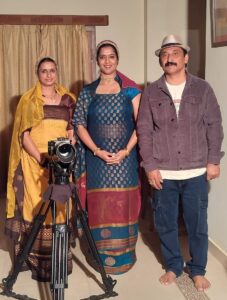
Bollajira Yamuna Aiyappa, M Shilpa Nanjappa and Prakash Kariappa K. (Supplied)
A: I’m primarily a man of discipline, which I’ve been able to maintain thus far.
Q: Being a Kodava Sahitya Academy Awardee for Best Novel in 2024 and with a total of 11 novels in Kodava and Kannada languages, has this experience given you any literary ideas?
A. Yes, it has given me an idea for a novel which highlights the deep roots of Ummathat. That will be the best justice I can do post this project.
Q: How are you planning to get a return from this film? How is the Karnataka Government supporting your endeavours? What are your distribution plans?
A: IFFI is our debut screening. We’ll try to leverage the opportunity as best as possible by interacting with national and international delegates to discuss distribution or collaboration possibilities.
We also have full faith in the Karnataka government as we have received support from them in the past and are sure will receive the best support in future as well. As said earlier, it’s a passion project, and we’re happy to be in the service of our culture.


