
Published Dec 12, 2025 | 1:15 PM ⚊ Updated Dec 12, 2025 | 1:15 PM

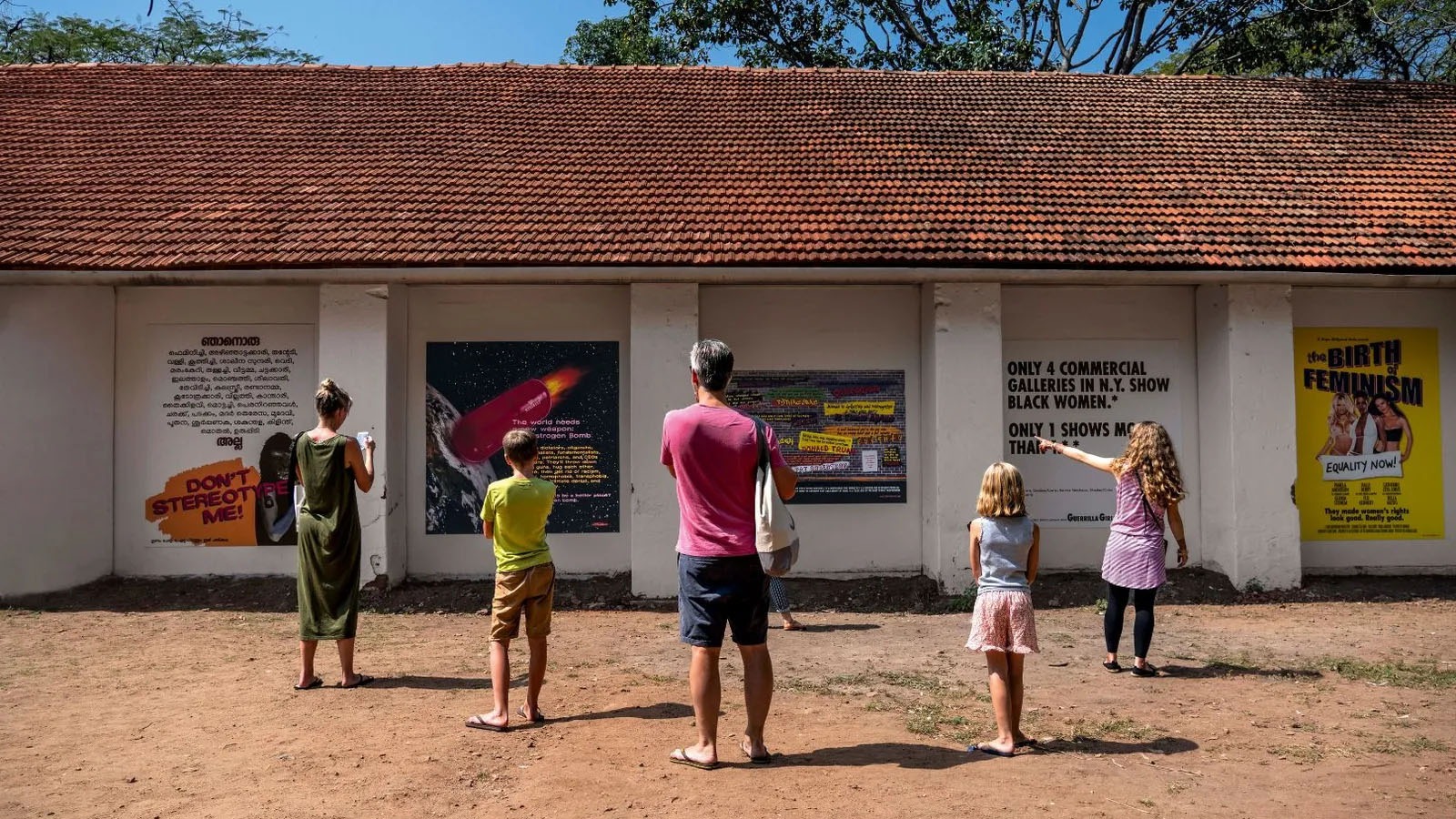
Kochi-Muziris Biennale.
Synopsis: The opening of the sixth edition of the Kochi-Muziris Biennale (KMB) on 12 December reinforces this identity of Kochi, often called the Queen of the Arabian Sea. Kochi, once a point where distant worlds exchanged goods, ideas and stories, becomes the ground on which new conversations unfold. Founded in 2012 and widely known as the People’s Biennale, KMB enters its sixth edition with renewed energy and an expanded sense of geography, while also overcoming various odds.
Kochi is not just a port city, but a global village that embraced the world long before the phrase became familiar. The opening of the sixth edition of the Kochi-Muziris Biennale (KMB) on 12 December reinforces this identity of the historic place often called the Queen of the Arabian Sea.
Over the next 110 days, India’s largest contemporary art event will transform Kochi into a layered cultural map. Sixty-six artists and collectives from 25 countries will present their work across 22 venues and seven collateral projects, turning the city into a place where worlds meet, mingle and grow.
Curated by artist Nikhil Chopra with HH Art Spaces, Goa, this edition is titled “For the time being”. The phrase carries both urgency and pause, an invitation to stay with art, linger in its conversations and accept the impermanence that shapes our lives.
Chopra describes the Biennale as a living ecosystem rather than a single central spectacle. “Each element shares space, time and resources, and grows in dialogue with the other,” he said.
Kochi, once a point where distant worlds exchanged goods, ideas and stories, becomes the ground on which new conversations unfold. By beginning from this rootedness, the Biennale moves away from the idea of a finished event and embraces an evolving and responsive form.
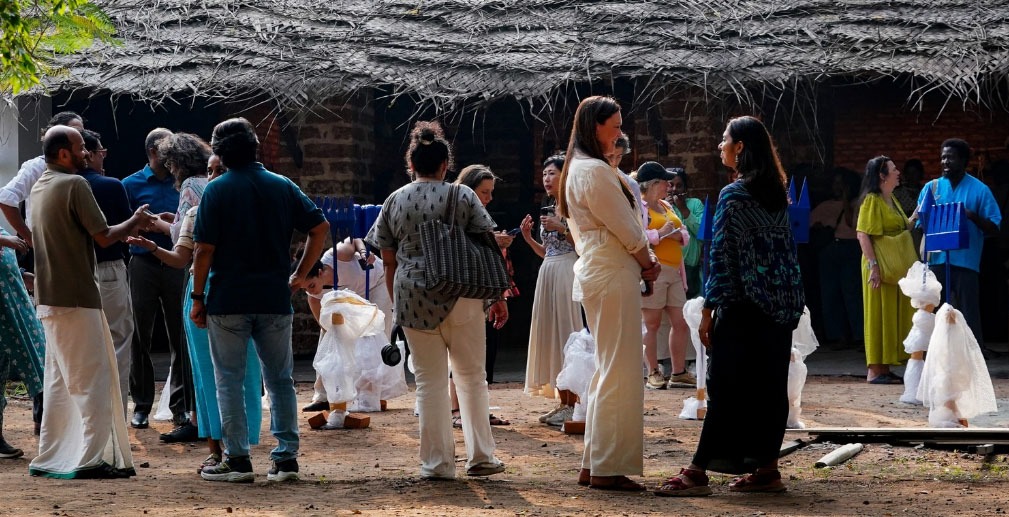
From the Biennale venue.
Founded in 2012 and widely known as the People’s Biennale, KMB enters its sixth edition with renewed energy and an expanded sense of geography, while also overcoming various odds. Although its heartbeat remains in Fort Kochi and Mattancherry, this year marks a significant shift. A majority of the exhibits are located outside the iconic Aspinwall House.
Willingdon Island, with its commercial bustle and layered history of labour, migration and trade, emerges as a major site. Visitors will follow a broader circuit this time, one that mirrors Kochi’s spirit of openness and change.
This expansion signals the Biennale’s desire to decentralise its physical and symbolic core, to allow art to breathe in new spaces and to bring different parts of the city into a shared experience. The route travels through old warehouses, heritage structures, community spaces and the well-known Durbar Hall Gallery in central Ernakulam.
The Kochi Biennale Foundation (KBF) notes that visitors will need at least three days to take in the full experience.
KMB President Bose Krishnamachari sees this shift as a natural step in the Biennale’s journey. “Kochi is a living confluence of cultures and faiths,” he said.
“It has become a temporary university of contemporary art. Each edition is built on collaboration between artists, curators, volunteers and the local community. This sixth edition deepens that spirit by opening new spaces where art can converse with the city.”
Kochi’s cosmopolitan character is centuries old. “Cosmopolitanism has always been as natural to this land as salt is to its air. Winds and waves have brought pearls, clay and ideas to this Queen of the Arabian Sea. The Biennale continues that history by making Kochi a place where global conversations can take root,” he added.
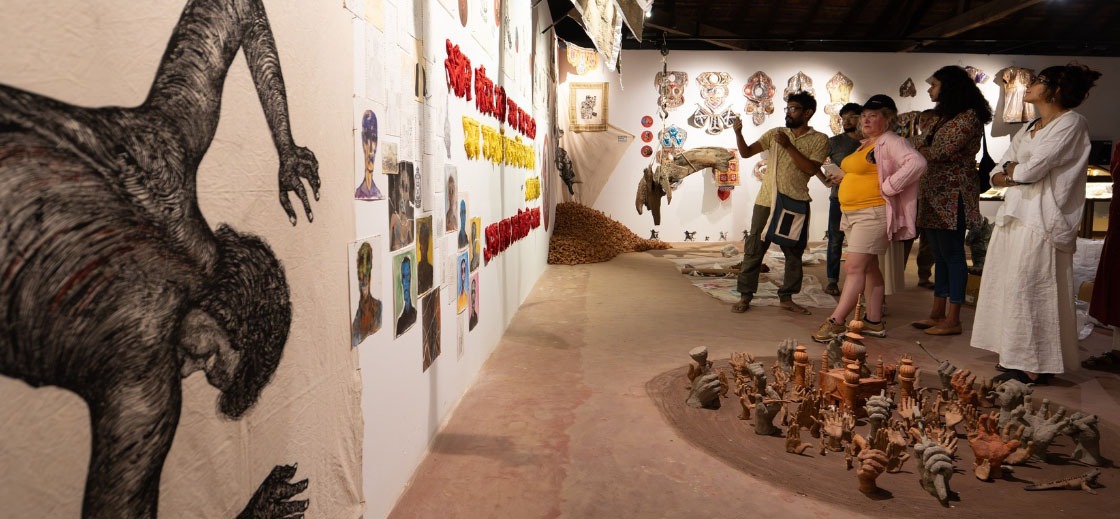
Kochi-Muziris Biennale.
For Chopra, the theme, “For the time being”, positions the Biennale as a gathering suspended in time. The city itself becomes an extension of the body, a vessel of memory, movement and materiality. “Kochi is stitched together by rivers, canals and backwaters,” he said, “and by sediments shaped through colonial incursions, maritime trade, migration and communal life. To imagine an exhibition here is to work with a history of movement.”
This idea shapes the curatorial approach. Process is embraced rather than concealed. Many artworks will grow, shift or unfold over time. Performances, installations and time-based works occupy waterfronts, warehouses, historic structures and public spaces. The Biennale becomes not just an event but a continuum of encounters.
KMB-6 will be inaugurated by Kerala Chief Minister Pinarayi Vijayan at Parade Ground, Fort Kochi, at 6 pm on 12 December, followed by a public concert by Shanka Tribe featuring Neha Nair, Resmi Satheesh and Shahabaz Aman.
Alongside the main exhibition, KMB-6 includes three major verticals that deepen its engagement with education, community and collective practices. The Invitations Programme, launched in 2022, honours institutions and collectives shaping cultural life in the Global South.
Groups from Brazil, Kenya, Palestine, Haiti, Trinidad and Tobago, India, Sri Lanka, Panama and Jakarta present work across seven venues. Chopra describes it as a space where institutional memory meets improvisation and where archives and communal energies converge.
The Students’ Biennale 2025-26, opening at VKL Warehouse in Mattancherry, brings projects from more than 175 art institutions across India. Curated by Angaa Art Collective, Chinar Shah, Khursheed Ahmad, Secular Art Collective and others, it highlights practices emerging outside market pressures and focuses on nourishment, peer learning and collective imagination.
EDAM, curated by Aishwarya Suresh and KM Madhusudhanan, surveys contemporary practices rooted in Kerala and its diaspora. Thirty-six artists and collectives present works across Bazaar Road in Mattancherry. A special installation, Vivan Sundaram’s Six Stations of a Life Pursued (2022), is shown at Cube Art Space.
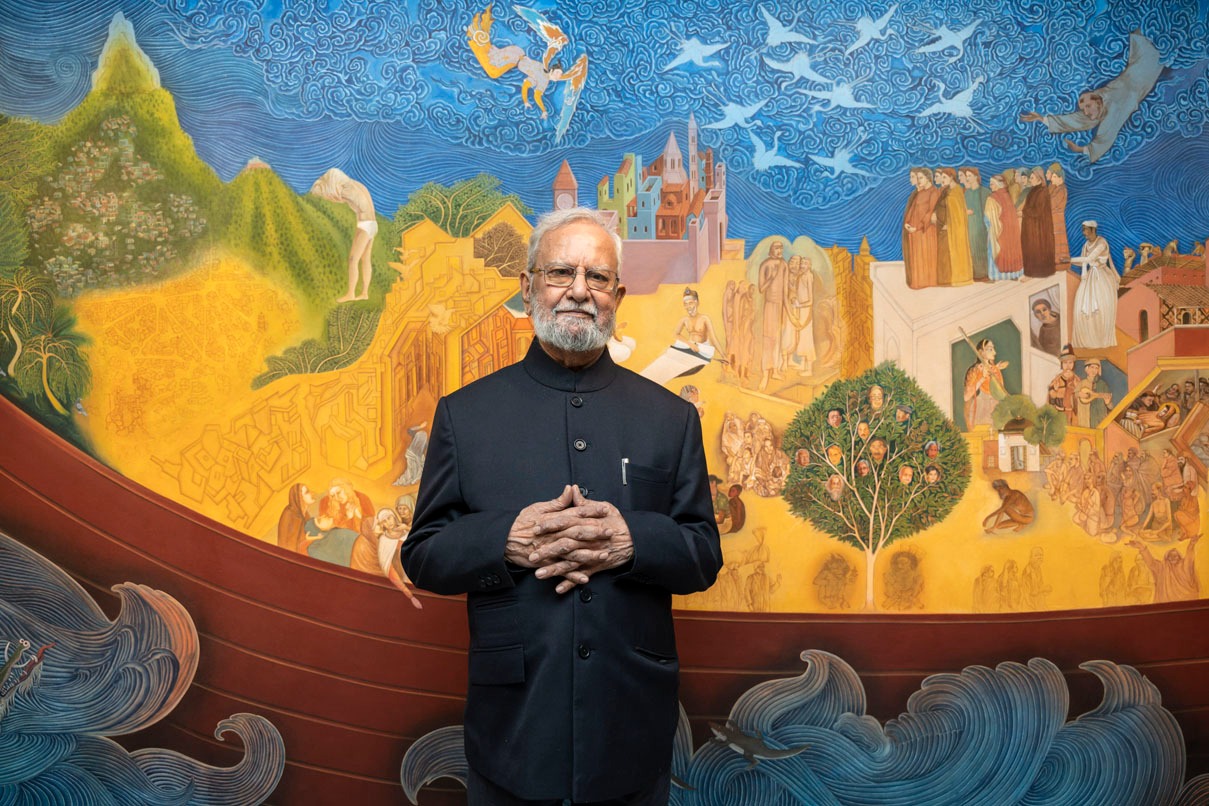
Gulam Mohammed Sheikh.
“These artworks confront the darkness of wars, oppressions, violence against women and caste divisions that affect the world we live in,” said Madhusudhanan.
Aishwarya Suresh framed EDAM as an exploration of the letter, both as personal correspondence that carries atmosphere and intimacy and as the alphabetic building block of language. The show moves between the personal and the abstract, the written word and the unspoken gesture.
One of the most significant collateral exhibitions this year is the Kiran Nadar Museum of Art’s major presentation on Gulam Mohammed Sheikh, at Durbar Hall.
This expansive survey of the artist, poet and pedagogue brings together more than a hundred works across painting, drawing, printmaking, digital collage, books, ceramics and large structures such as the well-known Kaavad: Traveling Shrine: Home.
Reimagined from Sheikh’s KNMA retrospective earlier this year, the exhibition highlights his deep engagement with memory, place and storytelling. It offers Biennale visitors an opportunity to experience one of India’s most influential artistic voices in all its richness and multiplicity. “Sheikh and his works present a world that is never singular,” said the curator. “They invite us to experience many worlds existing within worlds.”
Krishnamachari noted that the Biennale is held together by a spirit he calls a friendship economy. Collaboration, generosity and humility form its core. He acknowledged the contributions of government bodies, embassies, students, young curators and the local community.
“We owe everything to the people of Kochi, who imagined and nurtured this People’s Biennale from the beginning,” he said. The unseen labour of production teams, architects, students, documentarians and volunteers forms the foundation of the event.
If the Biennale is a field of ideas, Kochi is the living ground that nourishes it. Willingdon Island becomes newly visible as a site for contemporary art. Fort Kochi and Mattancherry continue to echo memories of trade, craftsmanship, migration and labour.
The boundaries between art and city blur. Warehouses become backdrops for installations, narrow lanes carry the hum of performances, and waterfronts turn into stages for time-based works.
Krishnamachari described the venues as peeled skins and weathered bodies that breathe memory. This porousness shapes the curatorial language. Instead of emphasising a single centre, KMB-6 invites fragmentation and simultaneity, forming a map that expands and shifts with each visitor’s path.
The movement, as the curators said, is from I to us. The Biennale becomes a reminder of shared labour and the time and emotion that shape collective expression.
As KMB-6 prepares to welcome visitors, it stands at a moment of expansion in every sense. It is built on trust, shaped by community and guided by the belief that art can create space for care, conflict and conversation.
Chopra said, “The Biennale invites us to be present, to stay a little longer and to witness the world and its possibilities through the journeys of artists.” Krishnamachari added, “Art opens paths for peace, care, love and celebration. The Biennale awaits you with open arms.”
As Kochi opens its gates to the world, one truth becomes clear: The Kochi-Muziris Biennale is more than an exhibition. It is a living moment, a confluence of bodies, histories and imaginations; not only for the time being, but for all the connections it sets in motion.
(Edited by Muhammed Fazil.)


