


Published Mar 02, 2026 | 2:01 PM ⚊ Updated Mar 02, 2026 | 2:01 PM


A poster of Kerala Story 2.
Synopsis: The evolution of beef consumption in Kerala includes layers of cultural negotiation. Meat dishes, including beef, gained prominence through social change: urbanisation, migration, and the growth of a vibrant restaurant scene. In many ways, accepting and enjoying beef as food reflected a broader shedding of caste and communal prejudices, especially among younger urban populations.
Kerala occupies a distinctive place in India’s socio-cultural landscape: a small state with outsized achievements in literacy, human development and social cohesion, underpinned by a long history of religious coexistence. Yet this lived reality is being recast by popular culture products such as The Kerala Story 2: Goes Beyond.
The movie’s trailer and promotions have drawn sharp criticism for projecting a communalised
and misleading image of the state. By portraying Kerala as a terrain of coercion, forced conversion and sectarian strife, the film misreads and misrepresents a social fabric historically anchored in pluralism and interfaith respect.
Kerala’s history has been shaped by trade, cultural exchange, and religious synthesis for over
two millennia. Long before colonialism, its coast was part of the Indian Ocean trading world that linked South India with Arabia and East Africa. Muslim traders settled along the Malabar Coast from the 7th century onwards, integrating into local society.
Jewish and Christian communities also claim roots in Kerala, stretching back centuries before European colonialism. These diverse communities coexisted alongside Brahminical Hinduism, creating a social ethos that valued negotiated coexistence over rigid exclusion.
This pluralistic orientation was reflected in everyday cultural practices. Even as India as a whole has experienced inter-religious tensions and segregation in certain eras and regions, Kerala’s urban and rural landscapes have generally exhibited a higher degree of inter-community interaction and tolerance. As respected studies of Indian society show, religious tolerance is widely affirmed as a national value, but Kerala consistently stands out for its lived multiculturalism and social integration.
These lived realities have been reinforced in contemporary times by Kerala’s political culture.
Successive governments, whether led by the Left Democratic Front (LDF) or United Democratic Front (UDF), have emphasised secularism, civil rights, and socio-economic development as central to governance. The state remains largely free of communal riots and sectarian violence.
The first Kerala Story film (released in 2023) courted controversy by making sensational claims about largescale trafficking and conversion, figures that were widely scrutinised and criticised for lack of factual basis. These claims entered public discourse long before they were legally or empirically verified, contributing to political polarisation (mostly except in Kerala).
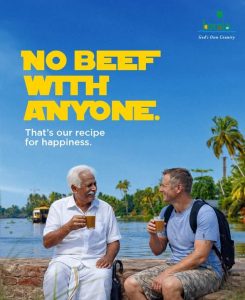
Recipe for happiness.
In many discussions around that film and its sequel (The Kerala Story 2: Goes Beyond), such narratives have been framed as reflecting a broader “civilisational threat” to Hindu identity — even as these assertions are at odds with on-ground realities in Kerala.
The sequel’s online trailer, for example, has drawn attention not for its storytelling but for a
single scene depicting a woman being force-fed beef, framed as a form of humiliation. Social
media responses from Malayalis have been overwhelmingly sarcastic and critical, with many
pointing out that consuming beef is not taboo in Kerala — it is an everyday choice, not an
instrument of coercion.
Kerala’s political leadership, including the ruling party and opposition, has publicly denounced
the sequel as fabricated and dangerous. In response to what many saw as a divisive narrative,
the Kerala Tourism Department rolled out a social media poster asserting, “No Beef With
Anyone,” underlining the state’s identity as a place of harmony, inclusiveness, and coexistence.
The intent was clear: to shift the narrative from divisive portrayals to one grounded in Kerala’s
lived values.
No account of Kerala’s social fabric is complete without its food culture, particularly the everyday presence of beef. Far from the caricatures that cast it as a marker of religious stigma or communal tension, beef has long been embedded in Kerala’s shared culinary life across communities.
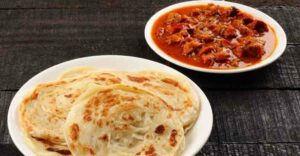
The popular beef roast and parotta dish in Kerala. (iStock)
Historical and culinary scholarship trace this to early exchanges with West Asian traders and the diffusion of diverse food practices, culminating in the now-iconic beef and parotta — a dish embraced widely, irrespective of religious identity.
The evolution of beef consumption in Kerala includes layers of cultural negotiation. Meat dishes, including beef, gained prominence through social change: urbanisation, migration, and the growth of a vibrant restaurant scene. In many ways, accepting and enjoying beef as food reflected a broader shedding of caste and communal prejudices, especially among younger urban populations.
Unlike in much of northern India, where debates over beef frequently become politically charged due to cow-veneration movements, Kerala’s historical experience with cattle and meat did not produce such rigid taboos. Indeed, unlike regions influenced by cow protection movements linked to Hindu nationalist politics, Kerala’s culinary choices evolved pragmatically, based on availability, taste preferences, and cultural exchange.
Food habits in Kerala are thus not markers of communal identity so much as expressions of
individual choice: fish, pork, mutton, chicken, or beef — all coexist vibrantly in the state’s
kitchens. The controversy evaporates when viewed through this lens; beef is not an exclusionary symbol, nor does its consumption signify religious politics. It is simply part of a rich and inclusive cultural repertoire.
So what, then, is the real Kerala story? It is not one of coercion or communal division. It is the
story of a society where religious, cultural, and dietary diversity is a lived fact; where Christians, Muslims, Hindus, and others have shared festivals, neighbourhoods, markets, and meals for centuries; and where secularism is not just a constitutional ideal but a routine lived experience.
Kerala’s legacy is one of negotiated coexistence and pragmatic cultural synthesis. That legacy
is far more enduring and real than any sensationalised reel narrative. And in this real story, beef is not a weapon — it’s a dish enjoyed roasted with coconut, spices, and porotta, shared across communities without rancour or communal stigma. That shared enjoyment is itself a testament
to Kerala’s deeper ethos: food as a bridge, not a battleground.
(Views are personal. Edited by Majnu Babu).


