

Published Dec 25, 2025 | 8:00 AM ⚊ Updated Dec 25, 2025 | 8:00 AM


Rajender is one of only two photographers still capturing photos the old way at the Buddha statue in Hyderabad.
Synopsis: Each picture is priced at ₹40, and on a good day, Raju can make up to ₹4,000 in income per day. “The locals don’t come, it’s just the tourists,” he notes. And when they stop, he knows just what to do. A short adjustment, one click. The printer hums, slowly ejecting a glossy sheet.
By the time they reach the towering statue of the Buddha at Hyderabad’s Lumbini Park, most visitors will already have taken out their phones.
Some click selfies, others call out to family members to move into the frame. Some back away to fit more of the statue, others argue about angles and light. Very few walk past without slowing down at all. Even fewer respond to the calls of the photographer, promising instant prints.
There are two of them, standing at either corner of the entry staircase, cameras in hand.
Each time there is an influx of visitors with the arrival of the ferry, one of them calls out. The call is steady and practised, folding into the general noise of the space.
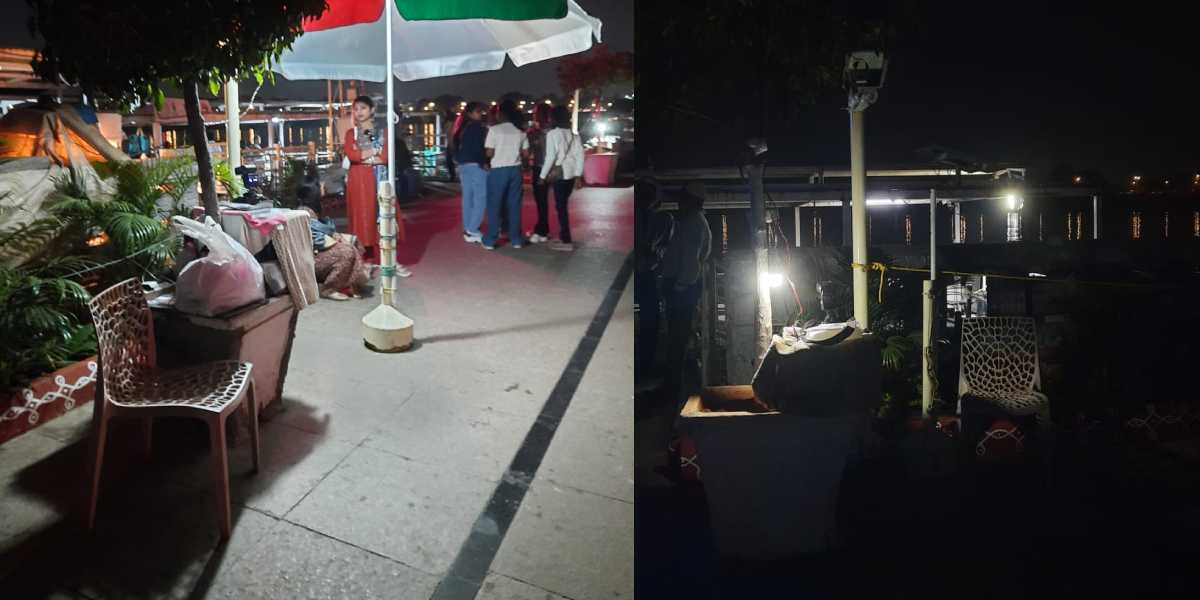
Raju’s printing set-up in a corner of Lumbini Park.
At tourist landmarks such as the Buddha statue, instant-print photographers operate in an uneasy middle space. Rajender, alias Raju, has been at his spot for twenty years now. “2005 May,” he recalls with a smile.
He has a small printer set up to one side, on a table with a plastic chair next to it. Between customers, his camera rests atop the printer.
Over a thousand people visit the site every day, but only a hundred stop to get a picture clicked, he tells South First.
Each picture is priced at ₹40, and on a good day, Raju can make up to ₹4,000 in income per day. “The locals don’t come, it’s just the tourists,” he notes.
And when they stop, Raju knows just what to do. A short adjustment, one click. The printer hums, slowly ejecting a glossy sheet. He puts it in a plastic bag and hands it over. Sometimes, the customer has already drifted into the crowd, and he has to go after them, photo in hand.
It is a job that Raju learnt on the ground. He started clicking photos because someone he knew was already doing it and suggested he join. No training, no background, but he stayed. “I’ve settled into this field now,” he adds.
Back then, he says, the work felt more reliable. Fewer people carried good cameras in their pockets. Today, though the crowd is still there, the pauses are shorter.
“It’s gone down a lot,” says Raju. “Now phones only have up to 20 pixels.”
His own camera is 15 pixels. The comparison matters to customers. Phones promise control—filters, edits and retakes. People arrive confident that they already have what they need for a good photo, and rarely consider the second option that stands at the entrance.
What he offers tourists, though, is a souvenir. They are his target, and it is a crowd that changes with the season. December brings people from Punjab and Kashmir. January sees visitors from Bangalore.
“April, May, everyone comes,” Raju says. But March is different. It is the off-season. When asked if the money is enough then, he does not elaborate. “You have to adjust.”
Raju has two young children in Pallavi Model School, Boduppal, and a wife at home. The cost price and selling price usually balance out, he says, which is why he is able to run his business.
He is soon approached by a woman in a heavy saree. Someone helps her put on an extra chain. She laughs as it is slipped on. “Photo acha aana chahiye bhaiya.”
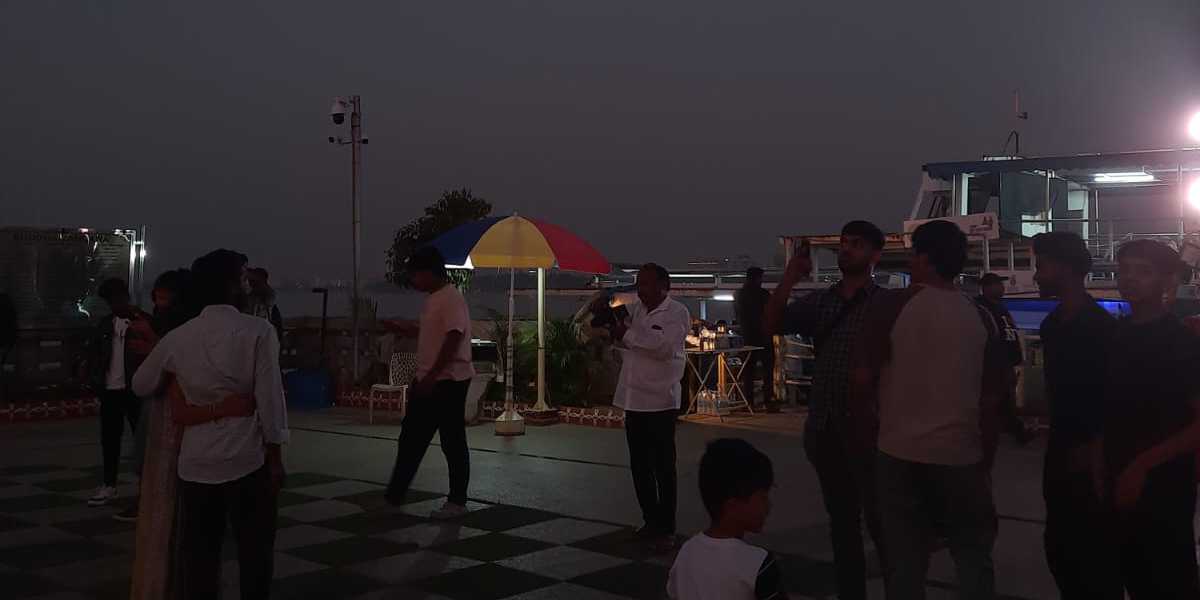
Raju (in white, with a camera) clicks a photo of a couple one late evening.
Raju waits until she is ready. He clicks the photo and starts up the printer. The group gathers around to watch the machine do its work. As the image slowly appears, nobody is looking at their phones.
Behind such brief moments is a fragile monetary situation. Raju must pay the tourism department ₹15,000 to set up his stall.
It is a fixed price, regardless of how the month goes. The materials are another constant expense. A pack of photo sheets costs ₹2,500 and yields roughly four hundred prints.
Much of the work is waiting. Standing in the heat, watching people approach and hesitate. Calling into the crowd. Most people do not even turn to look. They have their phones.
The job has survived changing cameras, rising costs and shrinking attention spans. It survives on tourists, on the small fraction of locals that still care about physicality. It has survived the off-seasons and the pandemic.
Despite everything, about a hundred people still stop each day, wanting something physical. Proof that they were here, together, under the statue.
(Edited by Dese Gowda)


