

Published Dec 19, 2025 | 12:12 PM ⚊ Updated Dec 19, 2025 | 12:12 PM

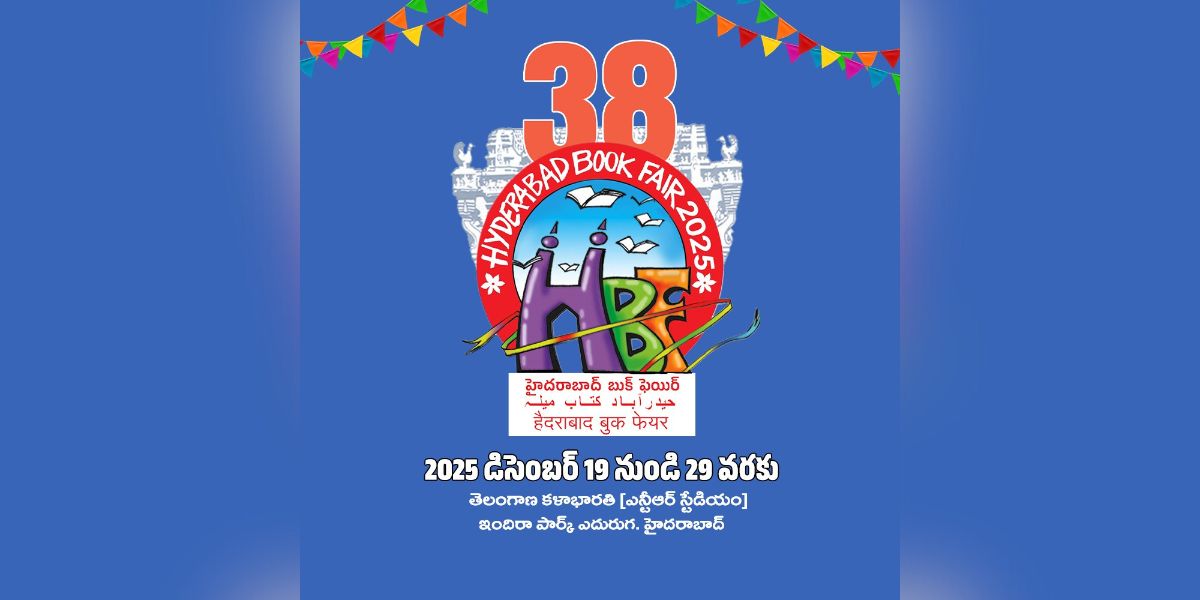
The Hyderabad Book Fair.
Synopsis: Several people are of the opinion that the practice of reading books is dwindling. However, contrary to popular belief, the number of book publishers is increasing day by day. The book sales worth crores of rupees during the 10-day Hyderabad Book Fair are a testament to that. It is also possible that the particular books complainants want to see sold, or want to see read, have lost demand.
The festival that comes to Hyderabad year after year is returning once again, starting Friday, 19 December, and continuing for 10 days. It is a festival of letters. A festival of ideas. A festival of books. A festival of information. A festival of knowledge. A festival of meetings, gatherings and encounters. A festival of celebration. A feast for the eyes.
In the cycle of time, every festival arrives once a year. Long ago, human groups turned many occasions into festivals — when they succeeded in hunting, when they won victories over other groups, when they recognised changes in nature, when they began agriculture and wanted to remember the crop cycle, when they wished to recall some memory, or commemorate a leader or a hero. Such countless combinations of occasions and celebrations became festivals.
In days when there were no travel conveniences, festivals were created to enable the gathering of relatives and friends from distant places, for collective celebration, for exchange and sharing, and for pleasure and recreation. Fundamentally, these were cultural, human, natural and collective festivals.
Over time, dominant powers that began to swallow this natural, organic culture, along with established religion, superstitions, meaningless customs, rituals, and practices, removed the elements of natural collectivity and innocence from festivals and changed both their form and essence.
To that extent, the naturalness of festivals declined, while expense, ostentation, display, pomp, exhibitionism and drudgery steadily increased.
No matter how much religion may envelop everything, the human culture of coexistence continues uninterrupted. In festivals, people have never abandoned collectivity, togetherness, and celebration. That is why, even though it has nothing to do with religious rituals or prescribed cultural festivals, people like to call the book festival a festival.
In Hyderabad, every year at the end of December, in the pleasant cold, it takes place as a festival of warm, intimate human gatherings amid books that ignite warmth in the mind.
Readers and non-readers alike, people of diverse tastes, ages, languages, regions, and ideologies, for ten days, without barriers or inhibitions, roam freely in the world of letters like breezes, rainbows, dragonflies, butterflies, doves, and fawns.
In fact, Hyderabad has had this multilingual, pluralist, cosmopolitan tradition for a very long time, for centuries. For at least 300 years, this city has been the capital of people speaking diverse languages. It has welcomed all languages, cultures, and literatures.
As a continuation of that historical legacy, what began as a small stream in the city 38 years ago has now grown into a mighty river, a sea of books — the Hyderabad Book Fair.
Once started with a few dozen bookstalls in the premises of a small school or college, the Book Fair has now expanded to more than 350 bookstalls. Lakhs of visitors come. Books worth crores of rupees are sold. Not just one genre, not just one language, not just one writer, not just one publisher — the book festival shows, before our very eyes, how much diversity there is in human society.
This book festival is, in itself, a marvel.
And yet, even amidst great celebration, there are some discordant notes. Even in the greatest happiness, certain memories of sorrow intrude. However wonderful one may think the book festival is, some questions remain about the reading culture in our society itself.
There are many who grumble and complain that the culture of reading books is declining in this generation; many who say that because the use of mobile phones and electronic devices has increased among students and youth, they are no longer reading books. In these complaints, there are some truths and some misconceptions.
From one angle, it is indeed true that the number of Telugu readers is not what it should be. Telugu books are not being printed in as many copies as they ought to be. When the Telugu-speaking population across the two states together is over 10 crore, and if at least six and a half crore are literate, there are not even 6,000 titles being printed in Telugu, let alone six lakh.
The combined circulation of all Telugu daily newspapers has not crossed 50 lakh copies. In the past, any given book used to be printed in 1,000 or 2,000 copies; now, due to modern technology, only 50 or 100 copies are being printed. That is, in Telugu society, there is a situation where not one in a 100, not one in a 1,000, not even one in a lakh buys and reads books.
This is indeed a matter that calls for serious concern and discussion. However, this picture also has another side. In a society that buys and reads books so little, at the book festival held in Hyderabad once a year, on average, at least one lakh people come every day just to look at books. Exact figures cannot be stated, but by the end of 10 days, book sales worth at least several tens of crores of rupees will take place.
There is yet another angle to be noted. Across the two Telugu states together, there are at least 20 large publishing houses. There are at least 100 medium-sized publishers. Along with several hundred small publishers, there are also many individuals who print their own books independently.
All of them together publish at least 1,000 titles every year (each ranging from 100 copies to 2,000 or 3,000 copies). That means, at least three books enter the Telugu book market every single day.
In Telugu alone, an annual investment of at least three to five crore rupees is being made in the book publishing sector. Even if we assume that about 20 percent of this is distributed free to relatives, friends, and fellow writers, the remaining investment is necessarily an investment that expects returns.
If there were no returns, if at least the invested amount did not come back, this flow of investment and this scale of publishing would not be increasing day by day in this manner.
That means, statements like “people are not reading books,” “there is no time,” or “who reads books anymore” are only seeing one part of the overall picture.
In reality, there is investment in the book publishing sector; the sector is expanding, which means book sales and purchases are taking place. In the last two or three years alone, at least 20 new publishing houses have emerged in Telugu.
At least 50 widely popular book authors have appeared, most of them in their twenties, just entering adult life, educated in English medium schools, working in software jobs. (Although there is a criticism that this new generation of writers and publishers is paying excessive attention to book marketing, that can be treated as debris carried along with floodwaters and set aside.)
However, it is possible that the particular books complainants want to see sold, or want to see read, have lost demand. Today, the book publishing field has spread extremely widely.
Independent genres, subjects, themes, writing styles; writers and readers from sections that were long illiterate or kept away from reading and writing; translations from other languages; scientific and technical writing; ideological works — these are all appearing in abundance.
Earlier, readers had a very small basket of choices. Supply into that basket was very limited. The basket always seemed to be emptying quickly, with very high demand.
However, now, baskets have multiplied to an extent that observers cannot even recognise them, and the supply into them has increased. We do not even know whether those baskets are being emptied or not.
There is yet another dimension to this picture. The reasons most readily cited for the decline in reading culture are mobile phones, television with numerous channels, including OTT platforms, electronic devices, the many distractions of modern life that consume human time, and especially travel time.
As a result, the question “Where is the time to read?” is heard very frequently. However, in the US and Europe, where the use of technology and electronic devices is far greater than here, the book publishing sector continues to thrive daily.
In the US and European countries, libraries are increasing enormously, and individual book purchases are rising. In public transport vehicles, wherever one looks, people can be seen reading books.
Judging by electronic devices that have penetrated life, other distractions, or travel time, reading time should have declined more there than here. But the reality is the opposite.
That means we must recognise that there are other reasons behind the decline, or the insufficient growth, of reading culture in our society, and we must explore and address them. We cannot avoid accepting that there is definite scope for reading culture to be much stronger than it is now.
The book festival already stands as an indicator of the respect that society has for books. One step further, efforts must be made to nurture and expand a culture of reading in society.
We must explore ways to promote reading culture within families, groups, and society at large.
Although audio-visual forms are more attractive because of their colours and dynamism, they constrict human thinking, provide everything in a ready-made form, and impose limits on thought and creativity. The nature of books and printed letters, on the other hand, gives ever-greater scope to human imagination, creativity, and thought, and elevates human beings.
This understanding about the nature of books must be propagated. We must expose the fact that local self-government institutions are collecting hundreds of crores of rupees from the public in the name of library cess but are not actually spending it on libraries and book purchases, and strive for the revival of libraries.
If conditions are created for the widespread establishment of libraries — from school libraries to public libraries — reading culture in society will receive a tremendous boost.
The very meaning of akshara (letter) is that which is indestructible. A book filled with letters is also indestructible. Book festivals such as these strengthen that belief — and they must.
(Views are personal. Edited by Muhammed Fazil.)


