

Published Nov 24, 2026 | 9:00 AM ⚊ Updated Nov 24, 2026 | 9:00 AM

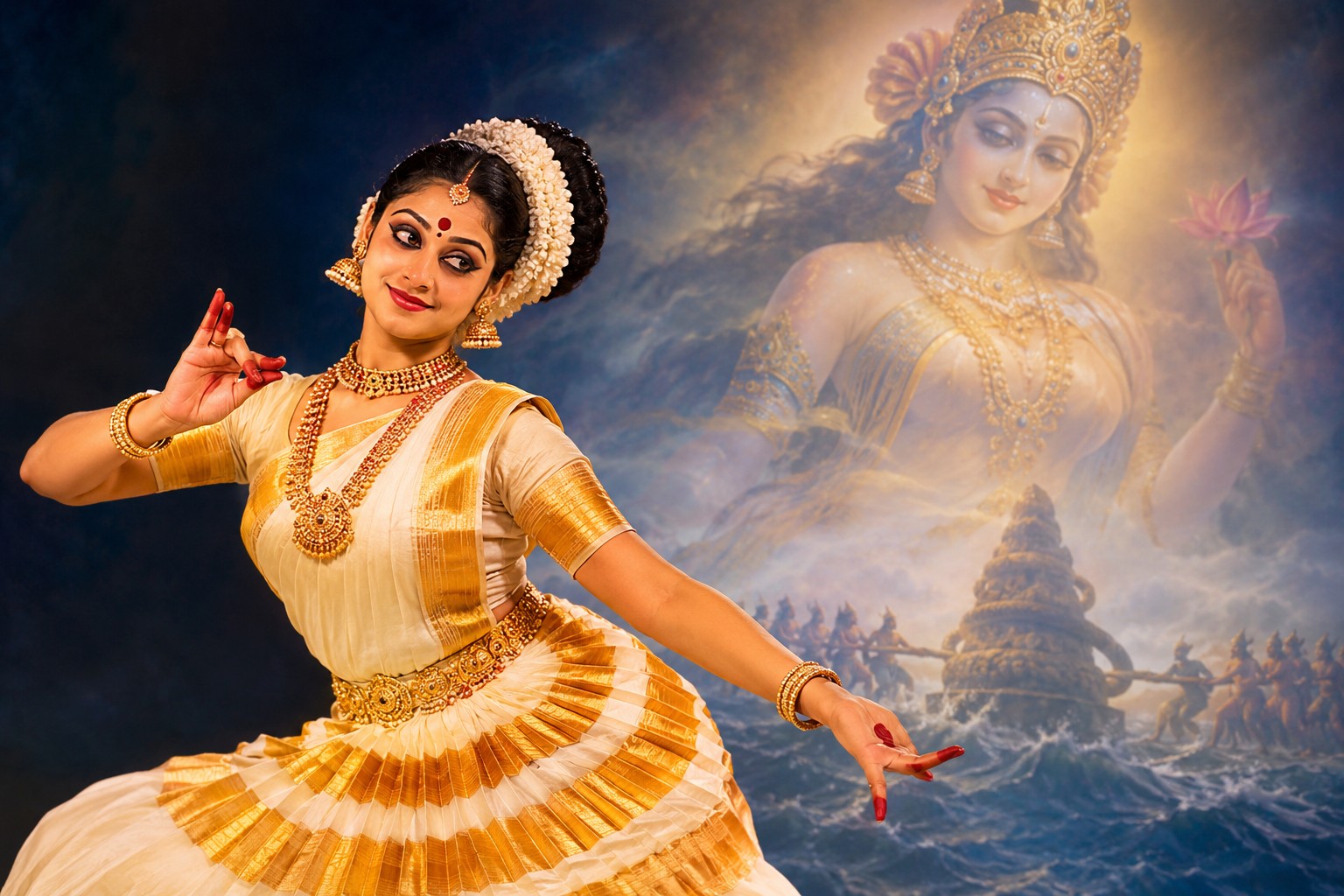
Mohiniyattam camouflages a woman in her prime as the epitome of puritan femininity. (AI image)

Synopsis: Teviticci is a portmanteau of three words: Tevar, Adi and Acci. Tevar means “God,” Adi means “foot,” and Achi means “woman”; it literally means the woman offered to God, the one at the feet of God. From “the woman at the feet of God,” a servant of the deity, the word is now deemed a derogatory, casteist slur.
Mohini was the avatar Vishnu assumed to help the Devas obtain Amrita (the elixir or nectar of immortality) from the Asuras during the Churning of the Great Ocean of Milk. Vishnu’s transformation into Mohini highlighted the deity’s ability to elude people through camouflage and illusion.
The aattam named after this, Mohiniyattam, is also a form of camouflage; beneath it lies the spectacle of the ritual dance performed by the Devadasis, or Teviticcis, of Kerala.
Mohiniyattam, or the “Dance of the Enchantress,” is a polished version of the devadasiyattam that was prevalent in Kerala. In hindsight, although the Sanskrit term “Mohini” has another meaning (“to charm”), the role Mohini assumed has always been to delude, and that serves the purpose.
It serves the societal purpose of repressing the cultural memory of Kerala’s Devadasi tradition.
While Chakyar Kuthu and Nangyar Kuthu, ancient forms of temple theatre, still prevail, Devadasiyattam has been pushed by puritans into the hole of erasure, and the name of its performers (Teviticci, a Malayalam synonym for Devadasi) has become a gendered slur.
Teviticci is a portmanteau of three words: Tevar, Adi and Acci. Tevar means “God,” Adi means “foot,” and Achi means “woman”; it literally means the woman offered to God, the one at the feet of God. From “the woman at the feet of God,” a servant of the deity, the word is now deemed a derogatory, casteist slur.
This writing is a recounting of how a regional art form from Kerala, Devadasiyattam or Kuthiyaattam, a ritual dance to please deities, was dissected to form a dance that bound women to white clothes and restricted stances, leading to the death of their self-expression.
Also Read: Kerala Kalamandalam condemns racist remarks by Mohiniyattam dancer Sathyabhama
Traces of the first Teviticcis of Kerala show a history of rich, influential, and respected women, even though many women from lower castes were surrendered as offerings to God, likely because of poor economic conditions or as a proto-sacrifice to satiate the deity.
From the days of Vikramaditya Varaguna, epigraphic evidence shows the presence of Devadasi culture in Kerala. The inscription from Thirunanthikkara (AD 892), during the rule of Vikramaditya Varaguna, indicates the Thiruvadicharthu of a royal lady: Murukan Chendhi, the daughter of the lord of Thenkanadu, was consecrated as a Devadasi.
The consecration of a royal lady, along with land donations to the temple, suggests that assuming the Devadasi position was a divine honour. The Chokkur inscription (AD 932), during Kotharavi’s rule, also indicates the monetary power held by Devadasis in Kerala, as it records that Chithirayil Nangyar (a Devadasi of the temple) donated land to the temple.
An inscription by Baskararavi (AD 996) refers to Sridhara Nangachi as Thribhuvana Mahadevi, a title bestowed on South Indian queens at the time. It records a land donation and an annual paddy payment to the temple. Another inscription from the Arur Mahadeva temple (AD 1646) records the rights of Devadasis to serve as the god’s female attendants in the Pallivetta. Other inscriptions show that when the Naivedya (offerings to the God) was divided among temple servants, Devadasis also had a claim. Kings endowed temples with the funds needed for celebrations, including Kuthu and Kuthiyaattam.
Also Read: Biryani egalitarianism in Kalamandalam
The downfall of the Devadasi system began with the Chola-Chera war, after which Devadasis had to succumb to their superiors (in caste and power) to remain relevant. From the beginning of the Bhakti movement, Brahmins gained momentum as propagators of the religion and began monetising it. After the Chola-Chera war, Brahmins gained power, and their exploitation of Devadasis deepened. The Brahmins’ objectifying gaze upon these women, along with their wrongs and lust, transformed the Devadasis’ position in society.
In the nineteenth century, Swati Tirunal tried to revive the art form by bringing it into his court, appointing teachers, and adding Padams. After his passing, his successor had no interest in such an artistic renaissance and dismissed the dancers from the court. Devadasiyattam, once an offering to God, was made illegal by rulings in the Madras Presidency. The British viewed Devadasis as commonplace harlots and deemed the practice impure. The British rebranded Devadasis as “nautch girls.”
Also Read: Muslim girl performs Kathakali, signalling a shift in Kerala’s art scene
In Madras, an anti-nautch movement was launched, forcing women to serve only their homes and nation. Devadasis were thrown out of their homes and sent to urban rehabilitation centres that sought to domesticate them. Domestication was enforced, and any resistance that emerged—even for a personal cause—was punished and silenced. At this juncture, Mahakavi Vallathol and Mukunda Raja set out to revive Devadasiyattam.
They revived it in adherence to the Kacheri Sampradayam, and thus Mohiniyattam was born.
Korattikara Krishna Panicker and Kalyanikuttiyamma were instrumental in attracting people to learn a dance deemed lowly, helping make the appropriation easier and smoother. As mentioned earlier, the rules of Mohiniyattam are not guidelines for a performer, but a murder of expression. This is further substantiated by instructions to avoid lifting the feet above the knee, not widening the stance beyond two finger-lengths, and the mandatory white colour of the costume. Mohiniyattam camouflages a woman in her prime as the epitome of puritan femininity, catering to a primitive puritan concept that rejected a woman’s right to expression.
Such movements, orchestrated by the school of thought that puritans implanted in the minds of the colonised, showed their desperation to erase a much more progressive history. The colonisers’ need to accelerate the decay of regional and local arts was meant to homogenise Indian society, making people forget their roots and identity so they would look only toward their future under colonial rule.
Any remnants of yesteryear would remind the colonised of their identities, which could spark mobilisation. Instead, regional and local religious histories were gathered under the umbrella term “Hinduism,” as we know it today.
The course of action implemented to help India overcome this postcolonial identity crisis can be loosely termed “strategic essentialism.” Gayatri Spivak coined the phrase, though she later admitted it was being misused.
Extremists have used strategic essentialism as an excuse to appropriate cultural and religious tenets under a Brahmanical label. In postcolonial India, strategic essentialism has been used to acquire regional and local art forms, literature, and even gods, plunging the subaltern—the very group for whom the term was coined—into an identity crisis.
Also Read: Kerala Kalamandalam welcomes students of all genders
Once Devadasiyattam was rebranded as Mohiniyattam, the former was vilified as vulgar and unrefined. The same upper-caste groups that once participated in the Devadasi tradition erased their historical complicity and projected blame solely onto lower castes. This Brahmanical gentrification robbed these communities of their artistic legacy and, in return, gave them a social identity shorn of dignity, respect, and historical agency.
This is how the name Teviticci, once uttered with a divine tone, came to be deemed derogatory: as it was no longer associated with the Savarnas and became connected solely to the lower strata of society. History treated it as it has always treated any phenomenon that deviates from the norm—calling it the “other” and deeming it derogatory.
Mohiniyattam, by camouflaging a woman of basic needs and dreams into a domesticated, “pure” woman, has misused strategic essentialism to help the Savarnas smuggle Devadasiyattam away from its roots and communities.
Recently, Kalamandalam Satyabhama’s statement citing a “fair complexion and attractive visage” as prerequisites for dancing was a racial and casteist jab at the growing inclusivity in our society.
Thankfully, dancers like RLV Ramakrishnan, who possess the ardent love and discipline required to teach and perform the art form, resisted imposing femininity as a prerequisite for learning the dance. Hence, while trying to recapitulate intersectional feminism in India, let historians not forget the history of Devadasis, Teviticcis, and Nangis, who came from all backgrounds to become powerful figures, only to be deemed impure by the colonisers, their morals whitewashed and lost to the past.
(Edited by Fayisa CA).



