

Published Jun 18, 2026 | 8:00 AM ⚊ Updated Jun 18, 2026 | 8:00 AM

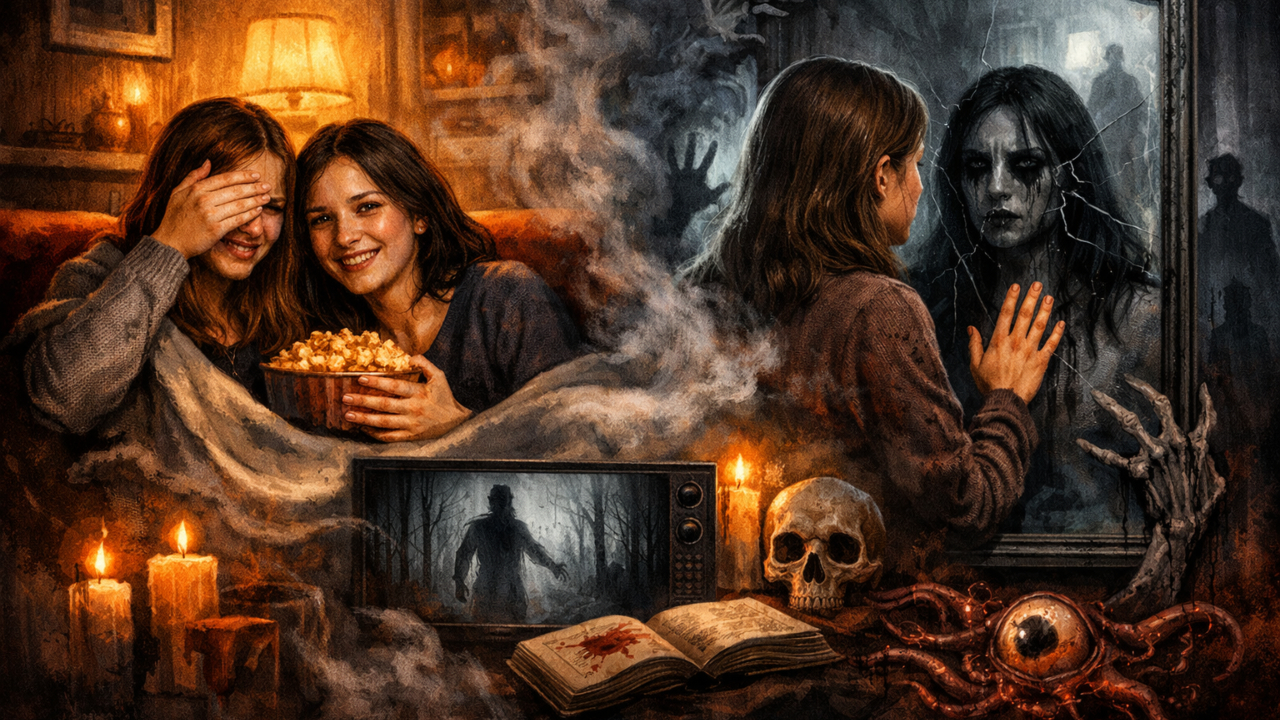
AI-generated representational image.

Synopsis: Why do people seek horror in an already frightening world? Beyond scares and monsters, horror offers a controlled way to experience fear, process anxiety, build social bonds, explore difficult emotions, and confront taboos. For many, the genre provides comfort, self-understanding, and a rare sense of control over fear.
The screen goes dark. A door creaks. Then a woman materialises out of nowhere, eyes white, skin bloodless, mouth open in a shriek that fills the room. Hani, a 19-year-old commerce student, holds her breath. A second later, she is laughing.
“That’s the fifth one,” she announces, entirely unbothered.
In a world already carrying its share of dread, deadlines, illness, grief, and the slow accumulation of things beyond anyone’s control, why do people voluntarily walk into more of it?
For many, horror gives them something the real world rarely does: a controlled way to experience fear.
For Hani, horror delivers something she struggles to name but immediately recognises. She compares it to eating something spicy, painful in the moment, irresistible nonetheless.
“I know it’s probably not the healthiest,” she tells South First, “but it’s just irresistible.”
When her friends discover she watches horror, they mock her. Some ask the question she has heard many times: why seek out dread when the real world already provides enough?
Hani does not have a simple answer, but she knows what the experience gives her.
“It gives me the kick,” she says.
Rin, a horror illustrator, articulates what lies beneath that feeling. She describes horror as her “safe place”, a space where she can cry, yell and feel unease without consequence.
“I can cry and yell, and people around me will turn a blind eye,” she says.
She also values the ability to stop. “If a scene is way too heavy for me, I could just close my eyes or walk away,” she explains. “But I can’t do that in an exam.”
That choice, to engage or step back, is what separates horror from the fears that follow people through ordinary life.
In Danse Macabre (1981), Stephen King argued that horror allows people to feel relieved, to sense they still have a shot at life, however difficult it may seem.
Also Read: House of horror: Massacre that shattered Kerala town’s sense of safety
When Hani reflects on why she loves horror, she does not reach for plot summaries or favourite scenes. She reaches for people.
She has always watched horror with others, friends gripping her arm, family members screaming from the next cushion, everyone laughing between scares and reaching for popcorn with hands still trembling.
The film itself is almost secondary.
What she carries afterwards are memories: her mother covering her eyes, a friend shrieking at a scene they both saw coming.
Tania, a 21-year-old humanities student, recalls something similar. She once found herself locked in a horror-themed escape room with a group of friends.
“It was so scary,” she says. “But after that one shared experience, we became so much closer.”
Shared fear does something that shared pleasure rarely manages. It strips away the distance people maintain around each other.
When everyone in a room startles at the same moment, they reach for each other, laugh at the absurdity of being frightened by something they chose to watch. The experience builds a memory that belongs to the group rather than to any one person.
Horror does not only draw people toward others. For some, it turns them inward, toward feelings they have not found language for elsewhere.
Erin, a 20-year-old science student, does not watch horror for the scares. She watches it for what the scares represent.
She points to The Haunting of Hill House, where the horror functions less as a supernatural threat and more as a psychological portrait. The ghosts embody grief, avoidance and the weight of family trauma.
“I love my horror best when it’s something internal,” she adds, “when the characters are not fleeing something supernatural, but rather their own mind.”
For her, the genre captures a fear she recognises from her own life, not the fear of death, but what she describes as “the fear of dying, despite still breathing.”
Mainstream storytelling rarely names that fear. Horror names it regularly.
Other genres resolve emotional struggle through dialogue or revelation. Horror externalises it, turning it into something with a shape, a sound and a presence that pursues characters through corridors.
That translation from the invisible to the visible is what makes it bearable to watch, and sometimes easier to recognise in oneself.
Watching characters navigate fear that mirrors her experience does not increase Erin’s anxiety.
It eases it.
Also Read: ‘Bhargavinilayam’ to ‘Dies Irae’: Content-driven horror genre remains a favourite in Malayalam
Neeha, a 20-year-old arts student, arrived at a similar understanding from a different direction.
For a long time, she watched horror waiting for the next scare. Then she encountered the mini-series Something Very Bad Is Going to Happen, which built its dread through language and atmosphere rather than violence.
That shift changed what she looked for entirely.
She found it in body horror, a subgenre that uses the physical form as a site of anxiety and transformation.
“Popular media centres around so many ‘normal’ people and concepts,” she says. “When I feel not so normal in my own body and life, horror helps me feel validated.”
Mia Jose, a freelance illustrator whose work uses body horror to examine cultural taboos, explains why this resonates so widely.
Speaking to Homegrown, she said that horror and folklore mark what a society places outside its acceptable limits.
“People on the margins,” she told South First, “have always found companionship in the monsters created by horror.”
For Neeha, that companionship is precise. The genre reflects back experiences of difference and alienation that most other forms of storytelling ignore.
Neeha has also noticed what the genre reveals about her own responses.
She can watch scenes of physical violence without flinching but struggles to sit through imagery involving unusual textures or unconventional bodies.
“I’m trying to open myself up for those experiences,” she states.
Horror does not only show people what frightens them. It shows them what they have decided, without ever quite deciding, they would rather not face.
People seek horror precisely because the world is frightening. The attraction is not the danger itself, but the ability to encounter danger under controlled conditions. Real fear arrives without structure, without warning, and without resolution. Horror offers the same intensity with one difference: people choose it.
For Hani, that means watching it with people she loves. For Rin, it means having the option to look away. For Erin, it means finding language for fears she could not otherwise name. For Neeha, it means sitting with the parts of herself she has not yet understood.
Perhaps that is horror’s real appeal: not fear itself, but the rare chance to decide when, how, and why we face it.



