

Published Dec 29, 2025 | 12:57 AM ⚊ Updated Dec 29, 2025 | 12:57 AM

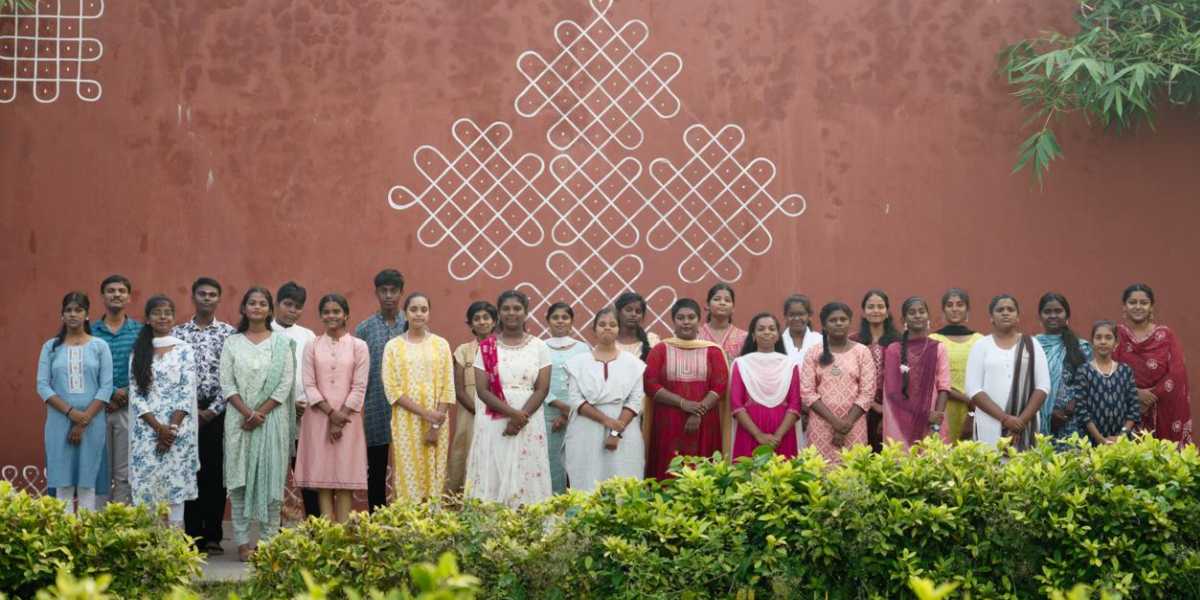
Synopsis: The Chennai Children’s Choir has, for a decade, served as an inclusive space for the underprivileged, bringing together children and young adults from diverse backgrounds each week to learn music in a setting built on care, discipline and inclusion. The success of the endeavour lies not in how often the choir performs, but in its consistency. Week after week, year after year, the energy has not faded, and gathering such a large and diverse group on most Sundays for a decade is no small task, yet this group has stayed the course.
At first, the young voices are hesitant.
The children of the Chennai Children’s Choir (CCC) gather at the Mahalakshmi Temple Welfare Association in Krishnapuri, Chennai. After losing a few weekly sessions to school exams, they are back, laughing with each other, snapping cheerful selfies and sharing stories from school.
The space is modest but alive. Typical function hall plastic chairs are pushed to the side and stacked in towers. A keyboard and a guitar wait nearby for their cue.
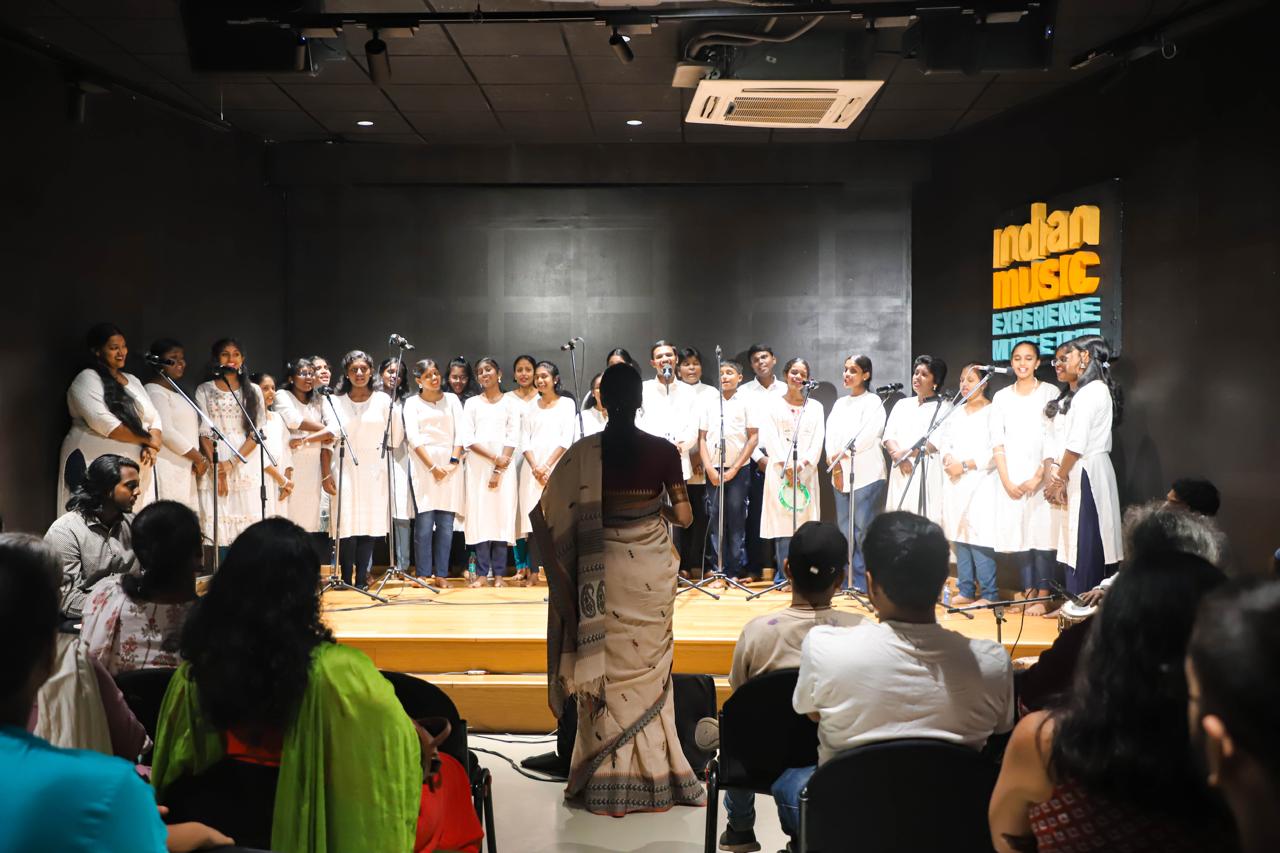
Chennai Children’s Choir
There is noise, but it feels gentle around the edges, the kind that comes from a familiar routine.
When Manjula Ponnapalli, their conductor, steps forward, the room settles back into rhythm. The group is set to rehearse Prayer for Peace, their recent production built over months.
The chatter dies down, phones are put away. Taalam begins to tap across knees. The choir is ready to sing again.
Started in 2015, the choir is the brainchild of Sriram V, founder of the NalandaWay Foundation. The foundation itself has been around for 20 years, and the choir for 10. “Our focus has been to look at teaching the arts, music, dance, theatre, any performing and visual arts to children and adolescents, to improve their well-being,” says Sriram.
The idea took shape after the Chicago Children’s Choir performed at the Jaipur Literature Festival in 2013. “How can we create something like a world-class choir for underprivileged children, but at the same time make that a very inclusive one?”
The first auditions drew a crowd of nearly 800 children, a handful of whom formed the original group. The initiative has since evolved into what it is today, a talented group of 23. They have done over 50 performances in Chennai, a few in Bengaluru, and one at the Kennedy Center in Washington DC.
The success of the endeavour lies not in how much the choir performs, but in its consistency. Week after week, year after year, the energy has not faded. Gathering such a large and diverse group on most Sundays for a decade is not easy, but this group has stayed the course.
Every week, the children return. Some come and go, some stay long enough to have grown up with the choir. Rakshita is one such student.
Now pursuing her MSc, she moves with the confidence of someone who has grown with the choir, through ten full years. She finds a sense of home in it, a safe space where she can explore music without the pressure of turning it into a career.
“From the little girl who joined us, she has always been a person who stands first to help others,” says Manjula, appreciative of her growth.

Chennai Children’s Choir.
Her presence also points to something else. The CCC has moved beyond age.
Technically, it is a children’s choir. Over time, the organisers realised it had become a safe space, and allowed members to continue even after the age of 18. The result is a gently uneven mix of school students and master’s students singing side by side.
The idea is to bridge this gap. The younger children find role models in their seniors, while the older ones feel a sense of responsibility. In this relationship, they become a family. There are always gaps in a family. Bridging them all may not be possible, but rising above them is.
Ask Manjula how she teaches, and the answer is simpler than one might expect: repetition and care. The linguistically diverse set list that the ensemble sings demands sustained training, with some inevitably difficult pronunciations.
The same phrases are sung again and again until they settle into muscle memory. Manjula points to an inherently human response when she says, “When we keep on repeating the same thing to reach that technical excellence, they get bored. For them it is singing 110 times again and again, but these children always cooperate.”
The children at the CCC are eager to learn. Given love and care, they will learn anything.
They listen attentively, repeating back the explanations given to them. Speaking about why this matters, she says, “If Rabindranath Tagore has written Ekla Chalo Re in his times, in what way can we relate that song today? That is something which we try to make them think about so that they own the song also.”
At the CCC, due importance is given to the message they carry to the world. “Every time they perform, they inspire others,” says Sriram.
Chennai Children’s Choir
This is evident in the songs they choose, and in their effort to ensure the singers understand the words they sing.
The many voices behind the music
The choir’s journey has always been shaped by togetherness. “The growth of the CCC has been possible because of the contributions of many wonderful people who have been instrumental in its journey,” says Manjula.
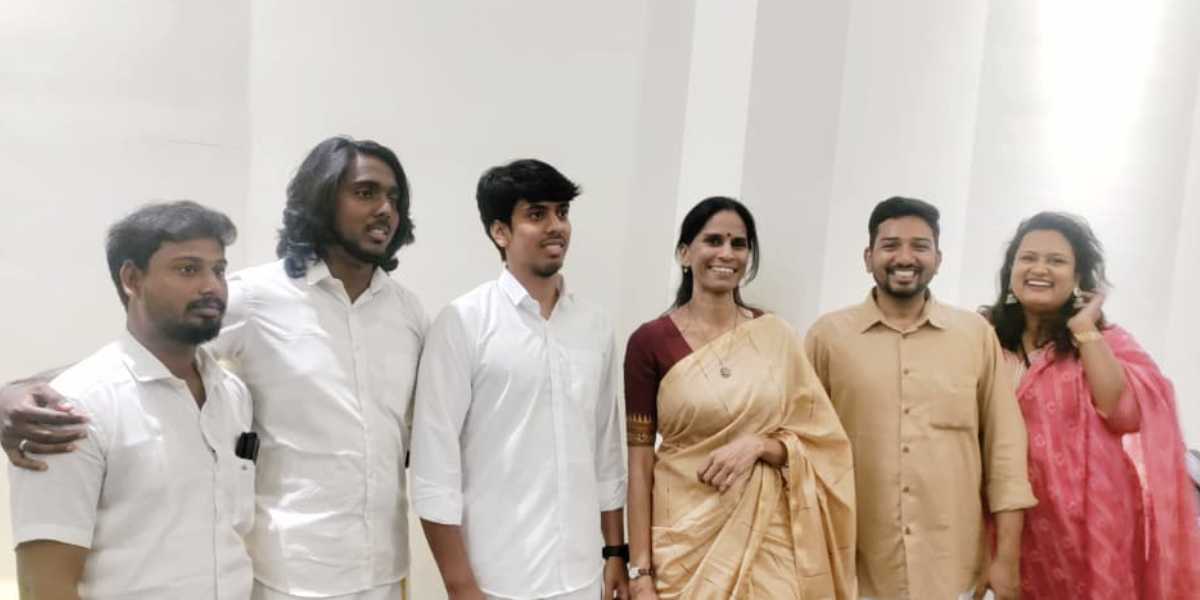
Vedanth Bharadwaj, who has been involved since the formative years, helped build the choir’s repertoire and train its singers. Kalpana Muthukumar works closely with the team on coordination and planning. The musicians on guitar and keyboard, Imamuddin and Aaron Prabaharan, are also vital to rehearsals and performances, guiding the children.
The team is careful about creating a safe space for all.
“As an organisation, we are very conscious that we are not advocating anything religious. Indian music is traditionally connected to religion and language, but we look at it as music, not prayer,” says Sriram. “From Raghupathi Raghav Raja Ram to Bulleh Shah, Ghalib to Meera. They are learnt by children who are Hindu, Muslim, Dalit. Each one is learning all of it, and nobody is even making the distinction. Music overrides these segregations that we, as humans, have created.”
Rehearsals, like any room full of children, are bound to be a little chaotic. This Sunday, three boys drift into distraction and chatter as the clock ticks on. One of them is called to the front. He fiddles with the hem of his shirt, his pout slowly turning into a shy, sheepish smile as he is gently teased by his teacher. Just like that, the tension dissolves, and they are back to singing.
In these small exchanges lies the spirit of the choir. No one is singled out, no one is left behind. The children act as a group, adjusting to the collective pace. Learning when to lead, when to follow and when to simply listen is all part of the process.
Swati, who has been singing with the group for about four to five years, comes from a background that values the arts and captures this spirit well. She and her brother, Kaushik, are both keen to explore. Swati says in Telugu, “It’s nice when everyone comes together to sing.”
Some singers have been here since the beginning, some for years and some for just about a month. Auditions for the eighth batch concluded in early October, welcoming another group of young singers.
Meanwhile, the seniors tweak their production, adding and removing elements as they go. One such addition is an introduction by one of the boys, Sravan, to one of their Hindi songs. As he delivers his line for the first time, the room fills with applause from his peers. A smile of pride spreads across his face.
It may be a small moment, but it is met with encouragement rather than judgement. What begins with hesitation turns into confidence, simply because the space and the people make it safe to try.
There is no front row or back row in this choir. Everybody is equal in their learning, and every voice is heard. “They sing sargams better than the songs,” she says, smiling. “They sing with ease, don’t even know that it is a complex thing!”
As the rehearsal winds down, the chairs remain stacked, the instruments are packed away and the children slip back into chatter. What lingers is the echo of a room where every voice matters, exactly as it is.


