


Published Jan 28, 2026 | 12:19 PM ⚊ Updated Jan 30, 2026 | 6:44 PM

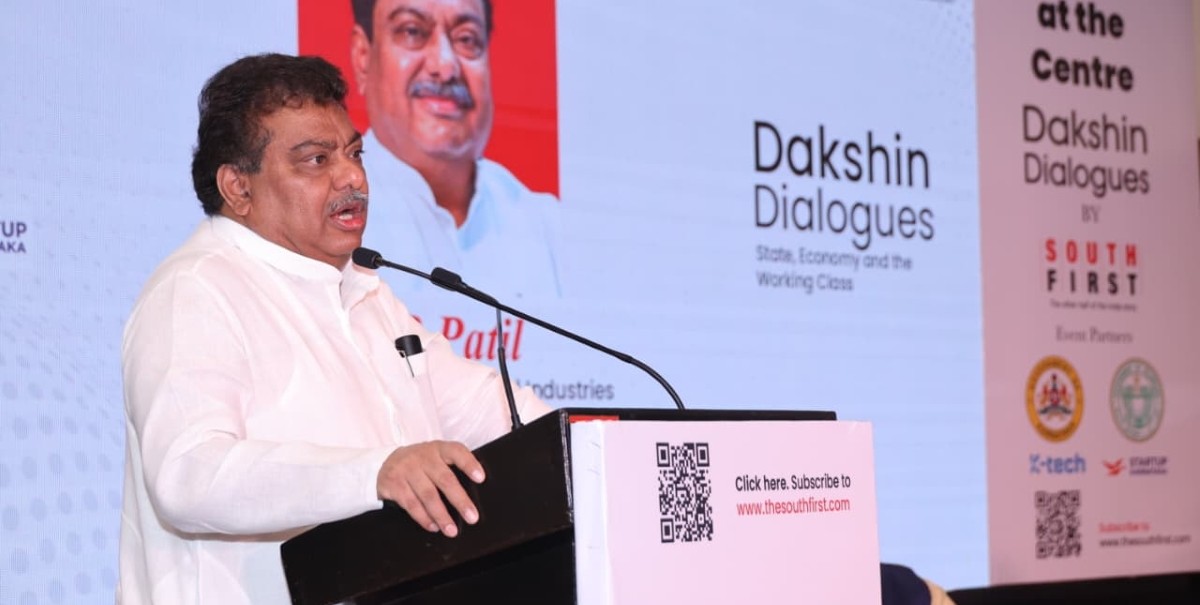
Karnataka Minister MB Patil at Dakshin Dialogues 2026.
Synopsis: Karnataka Minister of Commerce and Industries, MB Patil, inaugurated Dakshin Dialogues 2026 in Bengaluru. He discussed concerns and solutions regarding India’s working class, as well as new ideas, innovations, and achievements from a southern perspective.
Karnataka Minister of Commerce and Industries, MB Patil, inaugurated Dakshin Dialogues, the annual thought conclave of South First, on Wednesday, 28 January, in Bengaluru.
He delivered the inaugural address, discussing concerns and solutions regarding India’s working class, as well as new ideas, innovations, and achievements from a southern perspective.
Here is the full transcript of his speech.
The theme of the conclave, economy and working class, is particularly relevant at a time when India’s growth story is intertwined with questions of employment, equality, income security, and access to welfare. As the structure of work changes, public policy must evolve with it.
The south is the growth engine of India. South India has outperformed the national average in economic growth, recording a growth rate of 6.2 percent in 2023–24, compared to five percent in the rest of the country. The region is also leading in per capita income growth at five percent, compared to about 4.2 percent nationally. Collectively, the southern states now carry one-third of India’s GDP. The South has emerged as a national leader in advanced manufacturing, IT, renewable energy, electronics, aerospace, and defence, shaping India’s transition to higher-value, technology-driven industries.
In Karnataka, since the Global Investors’ Meet 2025, we have received investment commitments of around ₹10.27 lakh crore. I am happy to share that fifty percent of it, ₹4.7 lakh crore of the commitments, has already been converted. For the first time in the history of Karnataka, such a strong conversion is happening. After the Global Investors’ Meet, we received an additional ₹1.1 lakh crore in investments, reflecting sustained investor confidence in Karnataka.
Comparing Karnataka’s manufacturing sector with Tamil Nadu; we were in manufacturing earlier also, like in steel, cement, and of course aerospace and defence. In aerospace and defence, 65 percent of India’s total contribution comes from Karnataka. Globally, we are recognised as the third-largest ecosystem when it comes to aerospace and defence.
And electronics — you know the story of Foxconn, which changed Bengaluru’s ecosystem with $2.7 billion of investment and manufacturing of 20 million iPhones. They have employed around 50,000 people, and among them, 80 percent are women.
Now, Karnataka has given thrust to manufacturing. We had Uthpadana Manthana, wherein 82 CEOs and heads of various manufacturing companies participated and a roadmap was created. We have been working on the roadmap. In future, Karnataka will be a manufacturing hub of the world.
In the recent Davos visit — Davos is mainly for engagement. It is to know people, discuss with them, tell about your ecosystem, tell about your talent, tell about your state’s incentives, etc. We used to go there and sign MoUs with Indian companies. We did not sign MoUs from companies here, since it is being done here. This time, we consciously decided not to sign MoUs with Indian companies. I saw the press releases, and some media reported that Karnataka signed ₹13,500 crore, but if we had done like other states, we would have got ₹5 lakh crore or ₹10 lakh crore. Davos is a place to know the trends and future areas, and how the world is doing, and what new things are happening globally.
Karnataka has also emerged as a major centre for employment generation, starting new sectors from manufacturing to electronics to startups and as an economic platform. At the same time, we recognised that new forms of work are bringing in new policy questions about social security, workplace issues, and long-term livelihoods.
The state has taken a range of policy decisions to promote the welfare of the working class people, focusing on social security, access to public services, and work stability across sectors. The Karnataka Social Security and Gig Workers Act was formed in 2025 to ensure a formal framework for social security and welfare of platform-based gig workers, create a welfare fund, and ensure safeguards by aggregators.
In our 2025–30 Industrial Policy, we have included incentives for employment, especially for women workers. In Davos, we also discussed sustainability, climate change, poverty, and other issues. For sustainability, we have given a special incentive of 10 percent. That is how Karnataka is working for the welfare of the planet and employees, including women. We are coming up with various housing models with dormitories and other facilities. For the safety of women, Foxconn has said they are soon going to inaugurate two blocks of residential spaces and ensure the security of female workers.
The Shakti scheme enabled free bus travel for women and helped them secure more jobs. The state has maintained a future plan for the development of a strong workforce by enabling upskilling aligned with the needs of the industry. The State Skill Development Policy 2025–32, with an outlay of ₹4,432 crore, was recently announced.
While a dynamic economy is essential for development, job security and welfare programmes remain crucial in providing income support and stability, particularly during periods of economic stress and transition. Initiatives like NREGA have played important roles in sustaining rural livelihoods and as a safety net, offering employment and social protection.
Dakshin Dialogues is bringing together economists, policymakers, administrators, workers’ representatives, and industry voices in one space. Such conversations are essential to reach a balance. I hope the discussions today will contribute meaningfully to ensuring policies that support both economic dynamism and social security, and that growth remains inclusive and sustainable.
Dakshin Dialogues is the annual thought conclave of South First. Government of Karnataka, Government of Telangana, K-Tech and Startup Karnataka were event partners for Dakshin Dialogues 2026: States, Economy and the Working Class.


