


Published Jan 28, 2026 | 5:30 PM ⚊ Updated Jan 30, 2026 | 6:43 PM

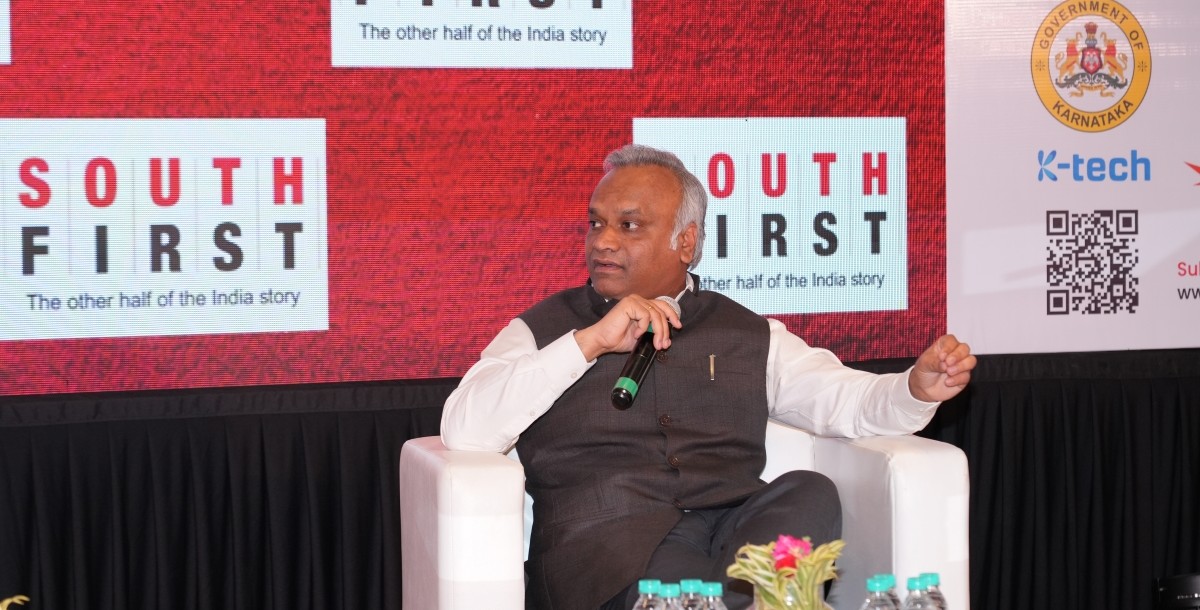
Priyank Kharge in conversation with economist Rathin Roy at the fourth edition of Dakshin Dialogues in Bengaluru.
Synopsis: If we are in Amrit Kaal, if we are in Viksit Bharat, why 2.5 lakh Indians are relinquishing their citizenship every year? Relinquishing, not even migrating. Every year, 2.5 lakh people are giving up their citizenship and living abroad. And why is it that the people, screaming from rooftops, telling you to avenge history and be nationalistic, are American or Londoners?
“Small interventions, small budgets, but high impact on economics and jobs.”
That is the wager Karnataka is making as it tries to spread growth beyond Bengaluru, where nearly two-fifths of the state’s GDP is concentrated.
In a conversation with economist Rathin Roy at the fourth edition of Dakshin Dialogues in Bengaluru, Karnataka Minister for Rural Development, IT and Biotechnology Priyank Kharge spoke at length about the state’s push to build district-level growth engines, use welfare to restore purchasing power, and reskill workers for a changing economy, and why he believes decentralised growth is now essential to India’s next phase.
Edited excerpts follow.
Rathin Roy: Karnataka has done extremely well economically. But, my own state of Telangana, we have a similar problem: that “extremely well” tends to be confined to just three or four districts.
So the challenge, and I know that I certainly, and Revanth Reddy Garu, are very, very concerned about this, is: what are your ideas to disperse growth across Karnataka, to broaden it?
Priyank Kharge: Oh, well, it’s a very difficult question to answer, because every state has two or three growth hubs, growth anchors. Like how, in Telangana, it is Hyderabad; in Karnataka, it is Bengaluru.
So I was reading this survey, an Economic Survey report, which attributed 39.9 percent of the state GDP’s contribution to only one district, that being Bengaluru. The next closest is Dakshin Kannada; that’s around 5.4 percent. Look at the gap.
And between the second and the third, it is 3.4 percent. Again, a 2 percent gap, from 5.4 percent to 3.4 percent. So Kalaburagi, from where I come, contributes 1.9 percent. Bengaluru Rural also contributes 1.9 percent!
So, you see, this is something that struck me. I went to the Honourable Chief Minister, I showed them these stats, and I said that, look, if we do not have economic accelerators across the state, our intention of delivering a $1 trillion economy, or the nation delivering $5 trillion, will not happen.
So we put our heads together. I had a lot of consultations with a lot of individuals, and we came up with a programme that will ensure quick interventions across districts to increase their contribution to GDP by 0.15 percent, 0.25 percent. I’m not aiming for my district to go from 1.9 percent to 3.5 percent.
I’m saying, how can I make it 2.15 percent? Small interventions, small budgets, but high impact on economics and job delivery.
So it could be through tourism, it could be through a policy intervention, it could be through IT-BT, it could be through any department, working on the demography and geography of the region.
So we created a programme, we created a programme of late, called the Local Economic Acceleration Programme, the LEAP programme. That is right now limited only to my department. And when I showcased it to the Cabinet, everybody loved it, and now it’s becoming a Karnataka-wide programme, irrespective of department.
So how can I ensure that the coastal region becomes an engine of growth through a policy intervention of, let’s say, ocean farming? So no-cost, low-cost, or policy interventions, this is the mindset we are trying to see.
And just imagine, that if my top 10 districts start delivering 0.15 percent, that is around 1 percent extra growth, and I will become the fastest-growing state in the country. I’m talking only about 10 high-growth districts.
So smaller milestones, not like Viksit Bharat, Amrit Kaal, 75 years later, how we will look.
Nothing like that. It is something that is tangible, milestones, tangible benefits that people can see. So this is something that the government is extremely serious about, and that’s how we intend to have these smaller growth engines across the state.
Rathin Roy: You’ve, in a sense, answered my second question. One thing I’ve written about it, is that a problem in India is that governments all over the country, not just the central government but also state governments, have transformed into what I’ve been calling, in my work, compensatory states.
Because development has been so narrow, you go and provide 80 crore Indians food. The things that people should be able to buy with money in their own pockets, the government is providing for them almost as charity.
So my second question was, what would be the model to move away from this? But I think you’ve answered it halfway. You might want to say something more, because if you do this, that means money in people’s pockets.
Priyank Kharge: I’m assuming you’re talking about the five guarantees?
Rathin Roy: Five guarantees are good, but that should be a safety net.
Priyank Kharge: I would not want to comment on the India landscape. But what happened across Karnataka during COVID, and I mean all of us, whether it’s the southern states or other states, were victims of [the Union Government’s] bad policymaking and bad economics.
So demonetisation, followed by unscientific lockdowns and opening up the economy whenever you want it. Then come bad economic policies with other countries. You don’t follow diplomacy; you just go and hug people. You don’t get money or investments like that. Your FDI inflows are not as expected.
You’re making India digital, India skilled, everything is highly incentivised. You’re spending more money on advertising than on this. You’re not able to curb the drop of the rupee; you’re not able to strengthen it. Just last month, we spent $12 billion to ensure that the rupee stays below 90 in relation to the US dollar.
All this has had a cascading effect on the state. As you rightly pointed out, purchasing power has come down. That is why we decided to come up with this social safety net, which will empower people.
And where is the money going? It’s coming back to the government. It’s not a completely freebie or revdi, as they say. There is now an independent report that has come out. Because of the Shakti programme, more women are getting into the labour force and more people are getting employed.
In my own district, more than 90 percent save more than 1,500 rupees through this scheme alone. Overall, they’re saving. Even if they’re very bad at maintaining household economics, they’re still saving around 6,000 rupees. If you’re very good, you go up to 9,000 or 10,000 rupees.
And where are they using it? They are using it for better nutrition, education, and to pay EMIs they took during COVID.
So while we are providing this social safety net, 52,000 crore rupees that I’m spending on the five guarantees, my other job is to ensure that I get investments.
We are number one in FDI this time, not Maharashtra. We are absorbing the highest migration into the state. We are creating employment, although we are being shortchanged by the central government in the financial devolution of taxes. Number one in investments, number two in GST, number one in FDI.
In spite of that, for every 100 rupees we give, we get back only 13 rupees. I’m not saying give us 90 rupees. I’m saying give us back at least 30 rupees.
What are we going to do with it? We’re going to build better infrastructure and create more jobs. I’m not against Uttar Pradesh, Madhya Pradesh or Bihar getting money. If they’re paying 100, they’re getting back 282, 288 or, in some cases, 333.
And what are they doing with that money? If they’re building hospitals, infrastructure and schools, no problem. Hospitals, sure, no problem. But what are you doing with it?
So while our job is to ensure social security, we also need to ensure enough investments come in so that we create enough jobs and move people up the social value chain.
That is something the Government of Karnataka is extremely keen on and determined to do through the Local Economic Acceleration Programme and new policies required for job creation and investments.
Rathin Roy: Telangana took up the free bus scheme that Karnataka did. I’ll give you an interesting piece of information. As you’re saying, free buses empower women to go to work, and many of them save money. You know how they are using that money? It’s such a logical economic thing to do.
They bought a mixer-grinder. Many of them, and the research has been done on this, my students have done it, buy the mixer-grinder because when they get up in the morning, it’s a patriarchy: they have to make breakfast for their husbands and children.
This saves them time, and they can go out and make even more money. So these things sometimes have economic benefits, but when you did it, it was looked at only as a safety net. This will be a pleasant surprise. It actually brought economic benefits.
Priyank Kharge: See, that was the situation then. Basically, when [the Union government] is not even acknowledging that the experiments you did were a failure, when you are not ready to acknowledge that price rise is a problem, when you are not ready to acknowledge that unemployment is the highest since Independence, and when you are not ready to acknowledge that investments are trickling down.
If you acknowledge the problem, then you look for a solution. Hyper-nationalism is costing the country a great deal, both outside and within the country. And yes, hyper-nationalism is a problem right now. Nationalism never was a problem.
Just look at how things are going on. Australia, some states there, are banning Indian students because of what’s happening. Some European countries are issuing warnings about allowing Indians in, and governments are not even addressing the problem.
If we are in Amrit Kaal, if we are in Viksit Bharat, tell me why 2.5 lakh Indians are relinquishing their citizenship every year? Relinquishing, not even migrating. Forget those being caught illegally at borders, the so-called donkey route. Forget them.
Every year, 2.5 lakh people are giving up their citizenship and living abroad. And why is it that the people screaming from rooftops, telling you to avenge history and be nationalistic, are American or London citizens?
What are our National Security Advisor’s children doing? What citizenship do they have? Both of them are British, but he wants revenge.
What about our Minister of External Affairs? Ambani’s son, I believe, is moving out. I don’t know.
Anyway, the point I’m trying to make is this: this kind of hyper-nationalism has a very significant impact on the social and economic life of the middle class, the lower middle class and the BPL. The sooner we acknowledge this, the better.
Rathin Roy: So don’t you think the time has now come for politicians, especially dynamic ones like yourself from the four southern states, to get together and put a list of these serious questions before the public and the government, because Parliament, they put it across even in Parliament?
Priyank Kharge: We have gone and met the Prime Minister individually. All the states have gone. In fact, we were the first state to go and protest in Delhi.
The entire Cabinet and all the MLAs went and protested in Delhi, saying that you need to give us our share of dues. Imagine, they denied us the funds that were coming. We protested, we had to go to the Supreme Court. The Supreme Court said, “What the Kannada government is asking for is its fair share. You give it to them.” Almost 2,000 crores we got.
So imagine, like I said, they are completely blind. They don’t want to acknowledge the problem.
Take the Jal Jeevan Mission. It is a 50 percent state and 50 percent central scheme. Last year, 5,000 crores were supposed to come from the central government. Only 571 crores came.
I have paid 15,000 crores of the central government’s share so that the projects do not stop here. And Prime Minister Narendra Modi’s photo is plastered everywhere, but he owes me 15,000 crores.
Then there are 2,500 crores in my RDPR department that have not been given under the Fifteenth Finance Commission, which they are legally and constitutionally bound to provide.
Mr Nikhil Dey is over here. He knows the problems that the panchayats are going through. So yes, after all, like you rightly said, we are one nation.
We will contribute to the development of other states. We should, it is our responsibility. But at the same time, let them be as progressive as us. You cannot punish us for following the law.
You cannot punish us for being good citizens of the country. You cannot punish us for following every policy of the Government of India ever since Independence.
How come we all had the same opportunities back then, but we performed better? Because we gave impetus to education, to skill-building, to industries and to services. So yes, it is unfortunate.
Like you said, we are questioning them repeatedly. The Chief Minister has met the Prime Minister multiple times. The Revenue Minister has met the Finance Minister. We have gone together to meet the Finance Minister.
Rathin Roy: We should actually have only challenges, but for Karnataka, because you’ve been lucky and you’ve developed what I would call prosperous jobs at least in Bengaluru and these areas.
There are two challenges going forward. Once you attain the high income level that you have, the next step is to improve productivity and improve wages. Are you thinking about how you will be able to do this, given the Government of India stepping back? How do you do this at the state level?
Priyank Kharge: We have a programme within my department, at least for my sector, called the Nipuna Karnataka. It is probably India’s biggest reskilling and upskilling programme, where we are talking to over 200 industries and industry bodies to figure out future skills.
We want to have the most skill-ready human resource in the world. We are no longer catering only to the Karnataka ecosystem; we are catering to the global ecosystem because of the advent of global capability centres.
People are looking for skill sets that match global standards. If you do not bring this within the higher education department, follow it up with a skill-gap analysis and fulfilment of that, we will lag behind.
Considering that we are the anchor, we have more than 50 percent of all GCCs. We have aerospace, agritech, everything here. We are tech-agnostic across verticals in Bengaluru.
If we do not have a solid base of skilled and talented human resources, we will fall behind. We are very wary of that fact, and we are talking to industries. We are telling them: you give us the course material, you give us the syllabus you need for training; we will pay 50 percent, you pay 50 percent.
This is the first time they are using their CSR fronts and corporate development fronts in this way. The idea is to make our individuals more productive than they ever were. That is something industry bodies have really liked.
If my numbers are right, we have close to 130,000 people in the pipeline for being skilled, and that is only through three companies.
Audience question: First of all, GBA elections, after many years, are happening. Bengaluru is the tech capital, and BEL developed EVMs, a great contribution to the country in terms of electoral governance policy. From EVMs to ballot papers, why are we going back in time? Just your thoughts on that.
Priyank Kharge: I agree with you that the EVM was introduced by us. Every technology has pros and cons. When people started doubting it, forget what I or my party have to say about it now, the current ruling dispensation had earlier written a book on EVMs saying they were a threat to democracy.
Over the last ten years, many things have entered the public domain that raise several questions. We do not know how the previous batch two EVMs were disposed of. There is a specific process for disposing of EVMs. We do not know where the batch three EVMs are. There was a detailed story in Frontline about missing EVMs.
Recently, in Haryana, during panchayat elections, a person went to the Supreme Court saying he believed he had won the election. The Supreme Court stayed the result and reviewed the EVMs. After the review, the result was changed. The person who was declared the winner lost, and the one who went to court won.
As a student of science, and as someone from a tech capital, why are we progressive? Because we are curious and because we ask questions. That is the first thing you are taught in science: doubt.
Even with respect to EVMs, what are we asking? Two or three simple things. One, how do you technically upgrade these machines? Why not have an ethical hackathon, supervised by a Supreme Court judge, in Bengaluru? Do not give it to any political party. Do not give it to Congress, BJP or JDS.
We are saying, call the Indian Institute of Science. Call the hundreds of research and development centres here. Have an ethical hackathon. If something is found, we will rectify it. If nothing is found, that is good.
But a recent Supreme Court case reversed an election, and the Election Commission has become a black box. Whatever we ask, we get no answers. So how do I trust the system?
It is not just Priyank Kharge asking questions. Citizens are asking questions. A complaint was filed by the State Election Commission here. A 22,000-page charge sheet has been filed on alleged vote rigging. Fourteen times, the Government of Karnataka has written to the Central Election Commission asking for technical details, including IP addresses. There has been no response.
Whose responsibility is it to maintain transparency? Is it mine, or is it the ECI’s? When citizens ask questions, and when the commission’s own officers raise concerns, but there are no answers, how will people trust the system?
Technology is always meant for good. AI can be used for good. But technology can also be misused. We are asking simple questions.
In my official capacity, I have written saying that the Government of Karnataka is ready to host an ethical hackathon, and asking why it is not being done. Once that happens, we are fine. If our questions are answered, we have no problem.
The issue is that we are not getting answers, and people are questioning the system.
Dakshin Dialogues is the annual thought conclave of South First. Government of Karnataka, Government of Telangana, K-Tech and Startup Karnataka were event partners for Dakshin Dialogues 2026: States, Economy and the Working Class.
(Edited by Majnu Babu).


