


Published Jan 28, 2026 | 3:44 PM ⚊ Updated Jan 30, 2026 | 6:43 PM

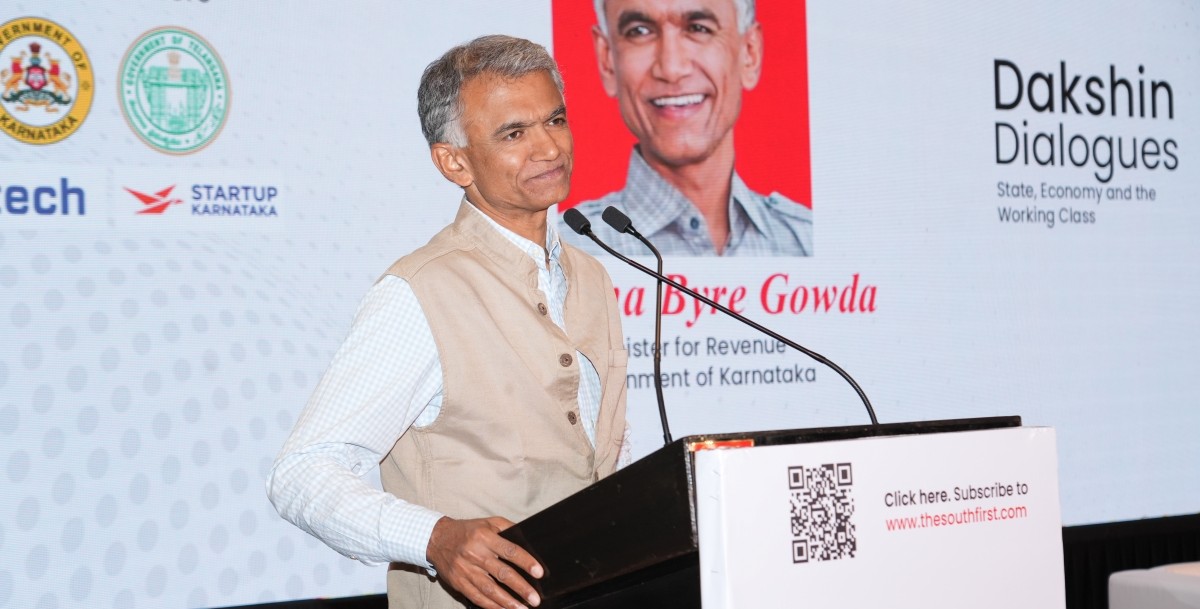
Minister Krishna Byre Gowda delivering keynote address. (South First)
Synopsis: South India speaks a different language, not just in linguistic terms. “Their needs are different, the dynamism is different. If that is not reciprocated, there is a marginalisation of the south.
Any attempt at homogenisation amounts to a direct assault on South Indian identity, culture, and interests, Karnataka’s Revenue Minister Krishna Byre Gowda said at the fourth edition of South First’s Dakshin Dialogues, currently underway in Bengaluru, on Wednesday, 28 January.
Citing the imposition of cultural uniformity, the erosion of democratic practices, and a shrinking share of funds allocated to southern states, Gowda argued that the region has long been sidelined in national policymaking.
“Over the last decade, we saw the reversal of all the progress we have made over the previous decades. A firm belief has taken root and has become the driving philosophy of the current dispensation – we have to be a homogenous society,” Gowda stated while delivering the keynote address.
This philosophy, Gowda said, is borrowed from other societies and applied to India without regard for its complexities.
“They (the current dispensation) are reading a lesson and applying it to our context in the wrong way. Hence, a lot more language and culture issues are coming up,” Gowda said.
The minister said that while South India has historically embraced diversity, attempts at cultural homogenisation are increasingly being imposed from outside the region.
“I am a Hindu. In the village I come from, we have our own ways of practising Hinduism. But now, we are told that this is the only way to practice, a certain way,” Gowda alleged.
Pointing to Karnataka’s linguistic diversity, he noted that Kannada, Tulu, Kodava, and multiple dialects of Konkani, are widely spoken across the state.
“I believe in respecting all of them. All of them should not only survive but thrive. Not because I wish it so but because everybody has a right to do so,” Gowda stated.
He stressed that the only way to hold societies together longer is by respecting every region and its sentiments, not by imposing ideas of homogenisation.
“Homogenisation may seem like a good idea. But we have always been diverse. South is the epitome of that diversity,” Gowda declared.
The minister then flagged how governors of three southern states (Tamil Nadu, Kerala and Karnataka) “flouted” democratic practices in their elected governments last week.
Karnataka Governor Thaawar Chand Gehlot refused to read out the government-drafted speech on the first day of the joint session of the state legislature on 22 January. It came a day after Tamil Nadu Governor RN Ravi walked out of the Assembly yet again, while Kerala Governor Rajendra Vishawanath Arlekar made several edits of his own to the government-drafted speech, omitting sections critical of the Union government.
“At every stage, laws are being flouted. They respond that they can and will do what they want; what can anyone else do about it?” Gowda said.
He then referred to how Karnataka moved the Supreme Court in 2023-24 after the central government failed to provide relief to the state’s farmers under the National Disaster Response Fund (NDRF) amid drought in the state.
“The Attorney General and Solicitor General said in court that they would resolve the issue. But the court asked why such issues were coming to them,” Gowda said.
He reiterated that South India speaks a different language, not just in linguistic terms. “Their needs are different, the dynamism is different. If that is not reciprocated, there is a marginalisation of the south,” Gowda said.
The minister also said that southern states routinely lose out when financial resources are allocated.
“Any way the cake is sliced, the Southern states always end up losing. Why? Because we are more dynamic than others,” Gowda said.
He said that factors such as better per-capita income and Human Development Index are often cited as reasons for reduced financial allocations for southern states.
“But why is it better? It is because we are investing in our human resources, infrastructure, and institutions. We are an open society. None of it comes without effort or investment,” he said.
While supporting the idea of equitable development, Gowda argued that the needs of contributing regions cannot be ignored. “You can’t throttle the neck of a goose laying a golden egg. The south is that. They are a huge gross net contributor in terms of technology, startups, etc.,” Gowda said.
He warned that continued disregard for southern states could alienate their people. “There will be a disconnect with the national building project, and that is not in the national interest,” Gowda stated.
Calling for a more inclusive approach, he said a stronger Union can only be built through dialogue and mutual respect.
“Our nation-building is built on negotiation and building consensus. The approach of might is right doesn’t work for a country like ours,” he said.
Dakshin Dialogues is the annual thought conclave of South First. Government of Karnataka, Government of Telangana, K-Tech and Startup Karnataka were event partners for Dakshin Dialogues 2026: States, Economy and the Working Class.
(Edited by Majnu Babu).


