


Published Jan 28, 2026 | 3:20 PM ⚊ Updated Jan 30, 2026 | 6:43 PM

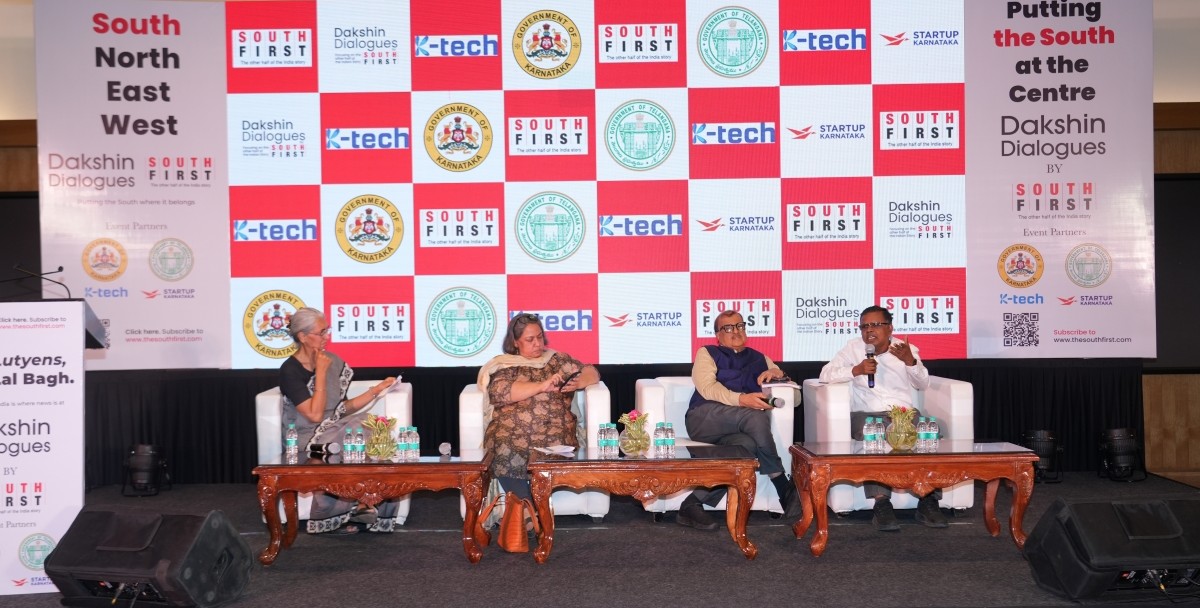
Panelists at a discussion on "South: The Growth Engine of India and its Challenges." (South First)
Synopsis: The fourth edition of Dakshin Dialogues, currently underway in Bengaluru, threw up a proposal for a common platform where southern states could regularly come together to jointly discuss their economic, administrative and developmental challenges, learn from each other’s experiences, and articulate shared concerns in a coordinated manner.
Even as disquiet is growing across southern India over what many see as fiscal neglect and policy centralisation by the Centre, an unexpected idea surfaced in Bengaluru on Wednesday, 28 January, one that seeks not confrontation, but collective conversation.
The fourth edition of Dakshin Dialogues, currently underway in Bengaluru, threw up a proposal for a common platform where southern states could regularly come together to jointly discuss their economic, administrative and developmental challenges, learn from each other’s experiences, and articulate shared concerns in a coordinated manner.
Former Union Cabinet Secretary KM Chandrasekhar mooted the idea during a panel discussion titled “South: The Growth Engine of India and its Challenges”.
Rather than framing southern unity in narrow political terms, Chandrasekhar underlined the need for sustained engagement across sectors — from governance and fiscal management to social policy and innovation — especially when accusations of a “one-size-fits-all” development model and political marginalisation of the south have gained traction.
The panel brought together Uma Mahadevan Dasgupta, Additional Chief Secretary to the Government of Karnataka, and Jothi Sivagnanam, member of the Tamil Nadu State Planning Commission. Kanchan Kaur, Professor of Practice at MAHE, moderated the session.
The conversation ranged widely, but repeatedly returned to questions of federal balance, centrally sponsored schemes, and the political rhetoric around “double-engine governments”.
At a time when India’s federal compact appears increasingly strained, senior administrators and policymakers from the south are raising a quiet but consequential warning: the region risks losing its collective voice unless it learns to speak together.
Chandrasekhar rooted his argument in not political confrontation but in practical federalism.
Southern states, he noted, share broad commitments to health, education and human development, yet follow different paths to growth — and face very different stresses compared to the North.
Water scarcity in Bengaluru, high pollution elsewhere, divergent demographic trends and development models all demand policies tailored to regional realities.
Yet the mechanisms meant to accommodate this diversity — from the Inter-State Council to the NITI Aayog’s promise of “Team India” — have steadily weakened.
Even Finance Commissions, constrained by rigid terms of reference, are seen by southern states as falling short on equity, he observed.
What Chandrasekhar proposed was neither a political bloc nor a divisive front, but a continuous forum for dialogue, learning and collective assertion.
Sporadic meetings before Finance Commission consultations are no longer enough, he stated.
Tamil Nadu’s success in industrialisation, Kerala’s strengths in health, education and services, and Karnataka’s advances in higher education offer clear lessons — if only there is a structured space to exchange them.
Backing this idea, Uma Mahadevan pointed to emerging challenges such as providing health and education services to large migrant populations who now underpin southern economies.
She also argued for a southern institution anchored in the region itself — one that studies not just failures, but successes, from welfare schemes like Tamil Nadu’s Dr Muthulakshmi Maternity Benefit Scheme to service delivery models that actually work.
The south, as Chandrasekhar put it, is uniquely positioned to drive meaningful change — but only if it chooses to think, learn and speak together.
What unites the diverse economies of South India today is not just higher social indicators, but a shared unease about how that success is being handled within India’s evolving federal framework.
As economist Jothi Sivagnanam argued, the South’s growth story was not accidental.
Decades of sustained investment in health, education and social welfare created a pool of skilled, healthy human resources well before the 1990s economic reforms.
When liberalisation opened the doors to private and global capital, the south was ready, he pointed out.
This people-first trajectory—often described as the Dravidian model of development—echoes eminent Economist Amartya Sen’s long-held argument that spending on health and education is not a fiscal burden but a long-term investment in human capital that ultimately drives economic growth.
The contrast with much of North India, where basic deficits in health and education persist, remains stark.
Yet, as Chandrasekhar pointed out, this success has not insulated the South from growing fiscal strain.
Southern states contribute disproportionately to the national exchequer but increasingly feel they receive less than their fair share, constrained by limited political clout, tighter borrowing limits and rigid centrally sponsored schemes designed for vastly different realities.
Kerala’s struggle to utilise funds under one-size-fits-all programmes like the Jal Jeevan Mission illustrates this mismatch, he opined.
While voices like that of Dasgupta acknowledged that such schemes can ensure minimum standards in lagging regions, the south’s strength has been its “plus-plus” approach—layering state-specific innovation and resources on top of central schemes to meet local needs.
The worry is that weakening federal forums and growing centralisation risk blunting precisely this model that has delivered some of India’s most durable development gains.
What emerged from the dialogue was less a routine critique and more a series of calibrated warning shots about the direction India’s federal compact is taking.
Chandrasekhar flagged the political normalisation of the “double engine” slogan as constitutionally troubling, arguing that openly privileging states ruled by the same party at the Centre strikes at the principle of equality among states.
In a federal system, he stressed, such language should never become casual shorthand.
He warned that the next flashpoint will be delimitation.
If the total strength of the Lok Sabha remains at 543, Kerala and Tamil Nadu stand to lose eight seats each, while Uttar Pradesh could gain 11 and Bihar 10—a shift that would significantly dilute the south’s share of political authority.
This redistribution, he argued, ignores structural differences: southern states are far more urbanised, with nearly 48% of populations in cities in Kerala and Tamil Nadu, compared to 22% in Uttar Pradesh and just 11% in Bihar, creating development challenges of a very different order.
Chandrasekhar also recalled how federalism was once institutionally nurtured through bodies like the National Development Council and the Inter-State Council, and how NITI Aayog was conceived under the banner of “Team India” to bring states together.
That spirit, he said, is now giving way to deeper political splits—an unhealthy trend with long-term consequences for the south.
Adding political bite, Jothi Sivagnanam cited the Tamil Nadu Chief Minister MK Stalin’s sharp rebuttal to the Prime Minister’s “double engine” pitch, dismissing it as a “dabba engine”—a rusted bin that does not work.
Beyond the humour, he argued, lay a serious point: even where “double engine” governments exist, outcomes have not matched the promise.
More fundamentally, he said, a Prime Minister suggesting that states aligned with the ruling party at the Centre will receive greater support is squarely anti-federal.
Social justice, he concluded, must precede and power economic growth—an equation the Union government appears to have reversed, with little to show for it.
What unfolded in the dialogue, with Dasgupta fielding criticism and defending schemes like Shakti, underscored something deeper than a policy debate.
Dasgupta argued that social development and economic resilience are not sequential stages, but mutually reinforcing processes.
Growth alone, she noted, has never been sufficient; per capita incomes, human development indicators and sharp regional imbalances matter just as much—an uncomfortable truth Karnataka itself acknowledged as early as the 1990s through official documents.
Schemes such as Shakti are often dismissed as freebies, but framing free public transport for women that way misses the point, she stated.
She said over 500 crore trips in two years across nearly 25,000 buses have enabled women to access education, healthcare and livelihoods—from garment factories to MGNREGA sites, even small-scale entrepreneurship like fish vending.
Women’s travel patterns, she observed, are marked by multiple daily responsibilities rather than a single commute, making such mobility critical. Better access translates into healthier workers, reduced absenteeism and stronger workforce participation.
That logic extends to education, too.
She pointed out that Karnataka’s universal higher education scholarship for girls—₹30,000 annually for those from government schools—has seen 1.8 lakh applicants.
By keeping girls in classrooms and expanding their choices, such investments quietly reshape both social outcomes and the economy’s long-term resilience.
The discussion placed the spotlight squarely on the responsibility of the young generation in shaping the nation’s future, cautioning against the dangers of forcing uniformity in the name of unity.
India’s strength, it underlined, lies in its diversity, and attempts to submerge it inevitably lead to friction.
Young people, as Chandrasekhar stressed, must resist being drawn into narrow political traps and instead learn to think collectively, as a nation, focused on shared growth rather than competition among states or communities.
Citing examples like Vietnam and South Korea, which surged ahead despite difficult histories, the discussion pointed to the urgency of informed civic participation.
Participation, however, as Dasgupta pointed out, must be rooted in knowledge.
Youth were urged to read, understand how governments function at all levels, and engage actively—by voting, holding leaders accountable, or taking leadership roles themselves.
Only an informed and united youth, working through civil society and civic engagement, can drive inclusive development and secure a better future for all.
Dakshin Dialogues is the annual thought conclave of South First. Government of Karnataka, Government of Telangana, K-Tech and Startup Karnataka were event partners for Dakshin Dialogues 2026: States, Economy and the Working Class.
(Edited by Majnu Babu).


