

Published Nov 25, 2026 | 3:02 PM ⚊ Updated Nov 25, 2026 | 3:02 PM

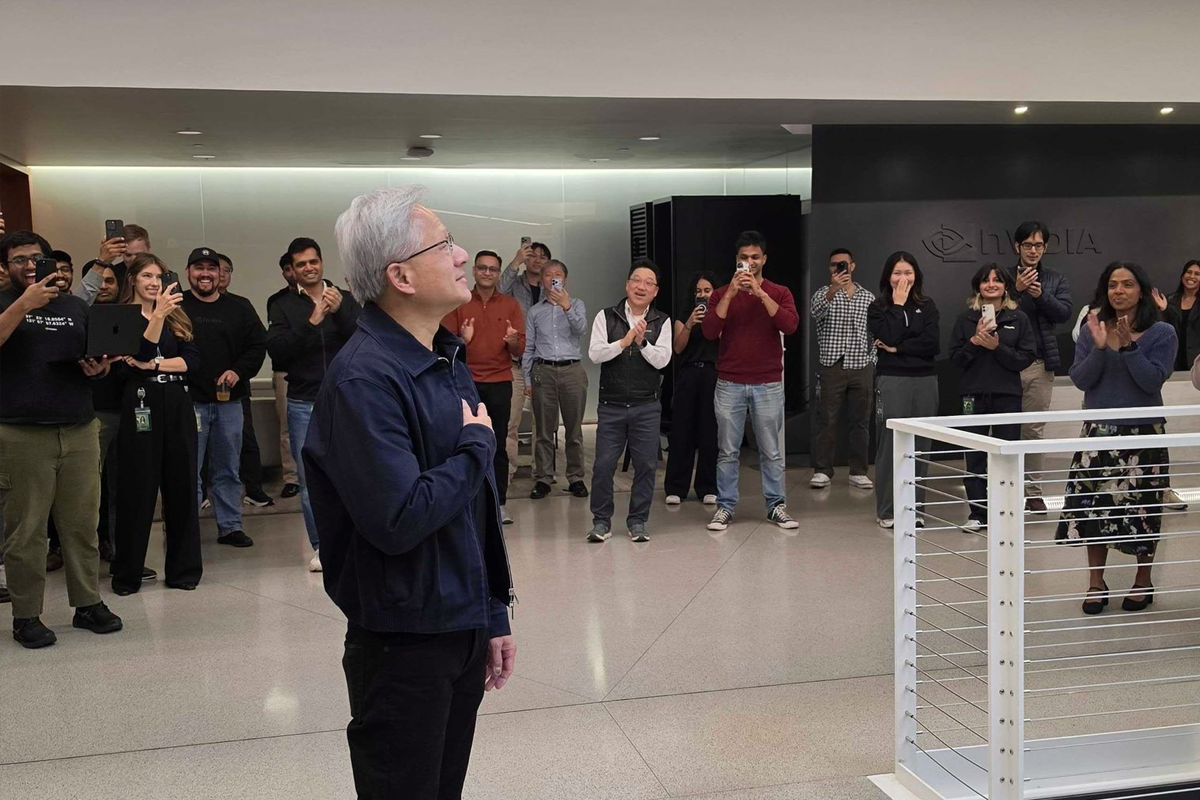
The 63-year-old Jensen returned to the company's Santa Clara headquarters on Monday, where cheering employees packed the atrium to greet him.

Too big to fail.
The term surged into mainstream public consciousness following the 2008 financial crisis, which roiled the world and wiped out $19.2 trillion in household wealth in the US. Back then, it referred to banks.
In the latest AI-driven US stock market frenzy, it is being used to describe some of the leaders of the ‘Magnificent Seven’ — Alphabet, Amazon, Apple, Meta Platforms, Microsoft, NVIDIA, and Tesla. Chief among them is Nvidia’s Jensen Huang, who made an Alice-in-Wonderland-like return as CEO of the company he co-founded on Monday.
This was just 11 days after the 63-year-old was forced to step down on November 12 following reports of two alleged affairs — the first with a suspected Chinese spy and another with a junior employee at Nvidia.
And what a return it turned out to be! Not only did his staff give him a rapturous welcome, but the stock market also thundered its agreement, adding almost $1 trillion to Nvidia’s valuation.
This was precisely what US President Donald J. Trump wanted to see after a tumultuous few days for AI stocks.
The departure of his friend Jensen, whose company’s chips power the AI boom, had seen people raise existential questions about Artificial Intelligence. Trump was said to have been rattled by the fall in tech stocks on November 20.
The President did not want to wait any longer. With help from his Veep JD Vance, he embarked over the weekend on what any other president would have dismissed as Mission Jensanity, seeking to restore the market’s confidence.
And once he succeeded, he went all over Washington to proclaim his latest crowning glory, even indulging in a meme that had a doctored image of Jensen Huang waving a red bra to mark the Nvidia CEO’s return from the cold.
The words the President trumpeted after pulling off the ‘great escape’ summed up his feelings: “The country needs Jensen’s leadership at NVIDIA in order to ensure the success and prosperity of not only the company, but the American economy.”
And what of the alleged Chinese spy Jensen had an affair with? Swat that aside, will ya, Trump was telling the world.
He was categorical in saying there was no security risk involved and his friend was instead a “national treasure”.
It was the presidential stamp of approval for a man who could move stock markets like nobody before him. It was praise for a man who was too big to fail.
Two comments captured the enormity of the move President Trump had made.
“It’s the stock market first,” Julian E Zelizer, presidential historian at Princeton University, told the New York Times. “National security seems secondary.”
Edward Fishman, director of the geoeconomics centre at the American think tank Council on Foreign Relations, was equally scathing.
“An individual CEO has just demonstrated that the interests of his company can trump US national security,” he said.
How crucial are Jensen Huang and the growth of Artificial Intelligence to the US stock market and economy? Let us look at a few numbers first.
Goldman Sachs had estimated that Alphabet, Amazon, Meta, Microsoft, and Oracle were set to spend $800 billion or more on data centres, chips, and other AI-related infrastructure in 2026. This marks a 94 per cent rise in AI spending over 2025.
The bank also observed that the ten largest AI stocks accounted for about 50 per cent of the S&P 500’s gains during the current year.
The Brookings Institution, in September 2026, meanwhile, predicted that investment in AI build-out would surpass $10 trillion in the seven years between 2025 and 2032.
The artificial intelligence boom “may be one-and-a-half to three times bigger, as a percentage of GDP, than was true in other technology booms,” Roger W Ferguson Jr., a distinguished fellow for international economics at the Council on Foreign Relations, was quoted as saying.
AI, then, is oxygen for the stock market and the Trump establishment. Take it away and the unseemly side of a US economy battling a cost-of-living crisis, unaffordable homes, a jobs crisis and anger among the general public against data centres emerges.
It’s not just the fortunes of the US economy that ride on it, if the International Monetary Fund (IMF) is to be believed.
“We have a world economy that is standing on one leg on the AI leg. If this leg wobbles, that can lead to financial stability troubles,” IMF Managing Director Kristalina Georgieva told CNBC in November.
Jensen Huang, the central banker of AI, is key to this narrative.
Others, taking a less charitable view, have called him the central banker of circular financing. The IMF has pegged circular financing in the AI industry at $1 trillion.
“Proliferation of circularities, such as vendor financing and reciprocal investments or commercial transactions, means growing dependence on the ability of major AI businesses to increase revenues rapidly or raise funds to honour as much as $2.5 trillion in commitments,” world-renowned financial expert Satyajit Das has noted.
Nvidia is seen as the biggest driver of such financing. When Huang left, many experts saw his departure as exacerbating the risks posed by his funding model.
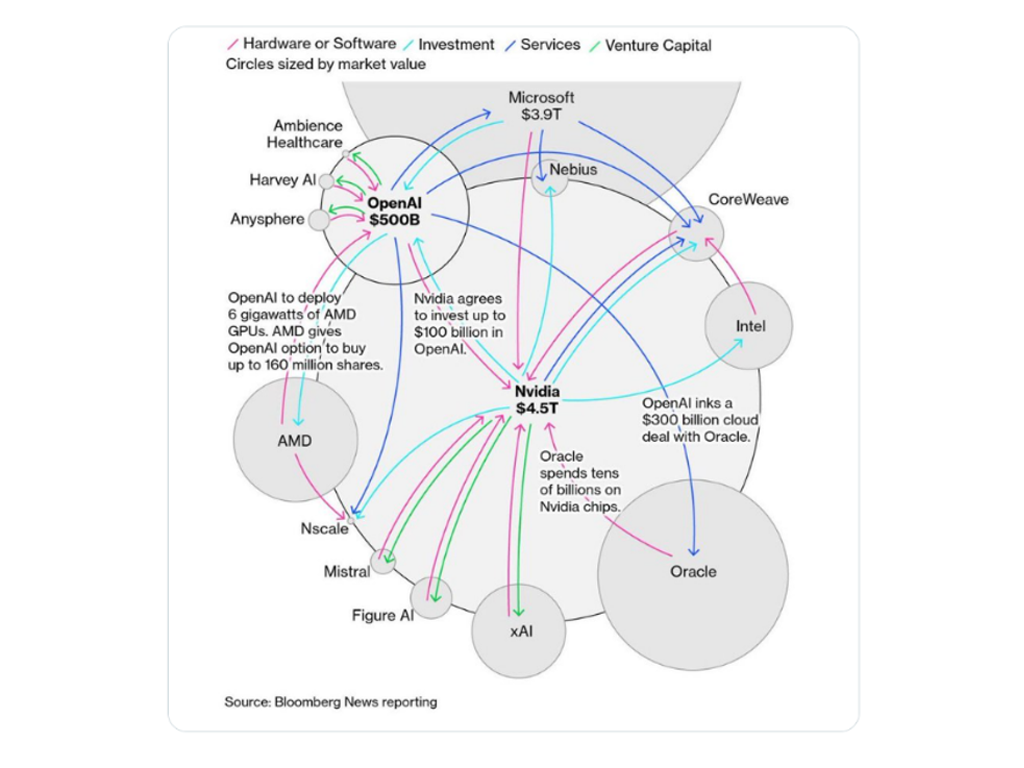
(Photo | x.com/ianbremmer)
It was one big reason why his return was greeted with that tidal wave of relief by the markets.
There was also the outsize soft power that Nvidia commands because of its chips powering over 70 per cent of the AI industry. As an early mover and the visionary behind his company’s strategy, Huang exercised enormous clout. He was also the dealmaker who made it happen.
Finally, there was the lack of a succession plan at Nvidia, which was run as a Jensen Huang company, with as many as 60 direct reportees to him. As Robert Armstrong caustically observed in a Financial Times piece, “If Jensen Huang had been a better CEO before he was overtaken by a scandal, he’d still be out of a job.”
All of these factors combined to add to the “key man” risk posed by him.
As Mohamed A. El-Erian noted, “Jensen Huang news is yet another reminder of something I said a couple of weeks ago: He is no ordinary CEO, Nvidia is no ordinary company, this is no ordinary sector, and this is no ordinary time.”
He went on to add that while Huang’s return “answers one set of questions, it raises another set that, similarly, ranges from the narrow (Nvidia’s governance process) to the broad (implications for markets, presidential put, government intervention, national champions, etc.).”
The return also raises questions about how one man could allegedly violate a company’s code of conduct, have relationships with a suspected Chinese spy and a junior employee, and emerge relatively unscathed. The New York Times reported how Huang told employees that it was sometimes “appropriate to forgive” while warning that it would not be “appropriate” or “tolerated” for them to follow in his footsteps.
Interestingly, WIRED magazine had reported in October 2025 that Huang had hired Heller, a PR firm that had handled past sex scandals, to take charge of his communications. Another instance of thinking ahead of the game, was it?
And finally, the biggest question of them all — how far should the US President have gone, particularly when Trump happens to be an investor in Nvidia himself? There were reports that Trump gained up to $15 million from Huang’s return.
The scale of the intervention was such that the President even called Lori Huang “a very, very, very good wife” and said the couple had “worked it out”.
As Tina Brown wrote, “what makes all this so wretched is that it’s a reminder, once again, that Trump’s elevation of rank shamelessness still reigns.” For the sake of all of us, she called upon Lori to “hand Jensen his ass” for the repeated and flagrant transgressions he had subjected his wife to.
Also Read:
Google says 30 Cloud jobs were cut in India, denies large-scale layoffs in Bengaluru



