

Published Oct 16, 2026 | 7:00 AM ⚊ Updated Oct 16, 2026 | 7:00 AM

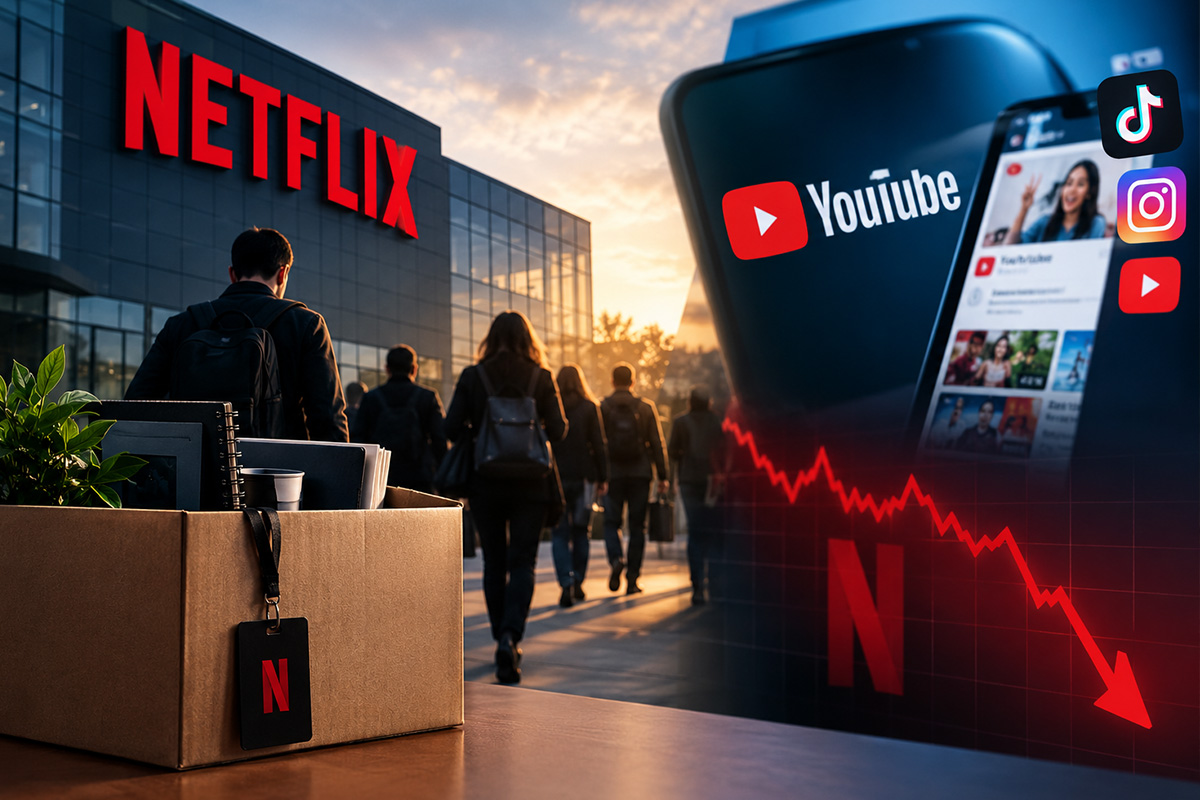
Image used for representational purpose. (AI generated image)

Netflix’s decision to lay off 6% of its employees, about 1,000 of a 16,000-strong workforce, marks the biggest round of job cuts at the 29-year-old company. The previous biggest cull saw 450 jobs being axed in 2022.
“Our mission — to entertain the world — is ambitious, and delivering on it requires us to be disciplined about where we prioritise our people and resources,” Co-CEOs Greg Peters and Ted Sarandos wrote in an email sent to employees following the decision.
The two maintained that “our business is strong and growing, and we remain on track to deliver our full-year forecast.”
The sackings come amid a roughly 40% fall in Netflix’s share price since last year.
Free-to-watch, user-generated content on platforms such as YouTube, TikTok and Instagram is posing a significant challenge to the streaming giant.
YouTube is, in fact, Netflix’s biggest rival now.
According to ratings agency Nielsen, YouTube commands 14 per cent of all television viewing time in the United States compared with Netflix’s share of 7.8 per cent. Netflix had an 8.8 per cent share of the overall pie in the States last year.
Globally, too, YouTube had overtaken Netflix when it comes to average daily usage.
An analysis conducted by the Digital i agency across 20 international markets found that average daily usage per YouTube user account rose from 87.2 minutes in 2024 to 99.1 minutes in 2025. A Netflix account’s average daily usage, meanwhile, fell from 100.5 minutes to 93.4 minutes.
“Overall, we’re not growing as fast as I want us to, and we’re working on making that move faster,” Ted Sarandos admitted at a conference hosted by Bloomberg on October 1.
A user on X pointed the finger of blame at AI too.
“This is the same company that in March of this year paid $587 million in cash to acquire Ben Affleck’s AI company InterPositive. So, @netflix – you don’t have money to retain working-class individuals, but you have money to buy an AI company that replaces them?” the user who identifies himself as Cinema News posted.
There was further reflection on social media.
“How about Netflix has one CEO?” asked Gabriel Richards, founder and CEO of Endertech.
“How many jobs could be saved by using the salary and bonus and benefits from letting one of their co-CEOs go?” he wondered.
Netflix, it must be noted, has been making good money. In the second financial quarter of 2026, its profits stood at $3.4 billion, up 9% year on year. Revenue in the quarter also grew 13% year on year to $12.56 billion.
It reported revenue of $45.18 billion and a profit of $10.98 billion in 2025.
But as Business Insider’s chief media and technology correspondent Peter Kafka wrote, Wall Street seems to be taking its cues from the streaming platform’s competition with YouTube.
Early in 2026, Google had revealed for the first time that YouTube clocked over $60 billion in revenue in 2025, way higher than Netflix’s tally. Add the watch time numbers, and you can understand why Wall Street is thinking the way it does.
“YouTube is not just cat videos anymore,” Sarandos famously told US lawmakers in February. “YouTube is TV.”
But then should building shareholder value and keeping shareholders happy alone drive companies in the creative business?
Jack Welch, who once championed “shareholder value”, recognised its pitfalls in 2009 and went on to bury it as the “dumbest idea in the world”.
“…[it is] a result, not a strategy…Your main constituencies are your employees, your customers, and your products,” Welch had added.
Despite clarion calls such as these, building shareholder value has never been out of fashion in the corporate world. As a Forbes article recently noted, the argument “simply hid behind better rhetoric”. In an ideal world, a disruptor like Netflix would have challenged the enduring hold of shareholder value and led the way instead in building trust within its own ranks. But after 1,000 layoffs in one fell swoop, will it ever?
Also Read:
‘No hikes’: Sridhar Vembu’s grim software jobs outlook and AI productivity prediction spark debate
A Bhasmasura we built: Can Artificial Intelligence go after its makers?
(Compiled and edited by R Rajesh Kumar.)



