

Published Jun 03, 2026 | 10:44 AM ⚊ Updated Jun 18, 2026 | 9:35 AM

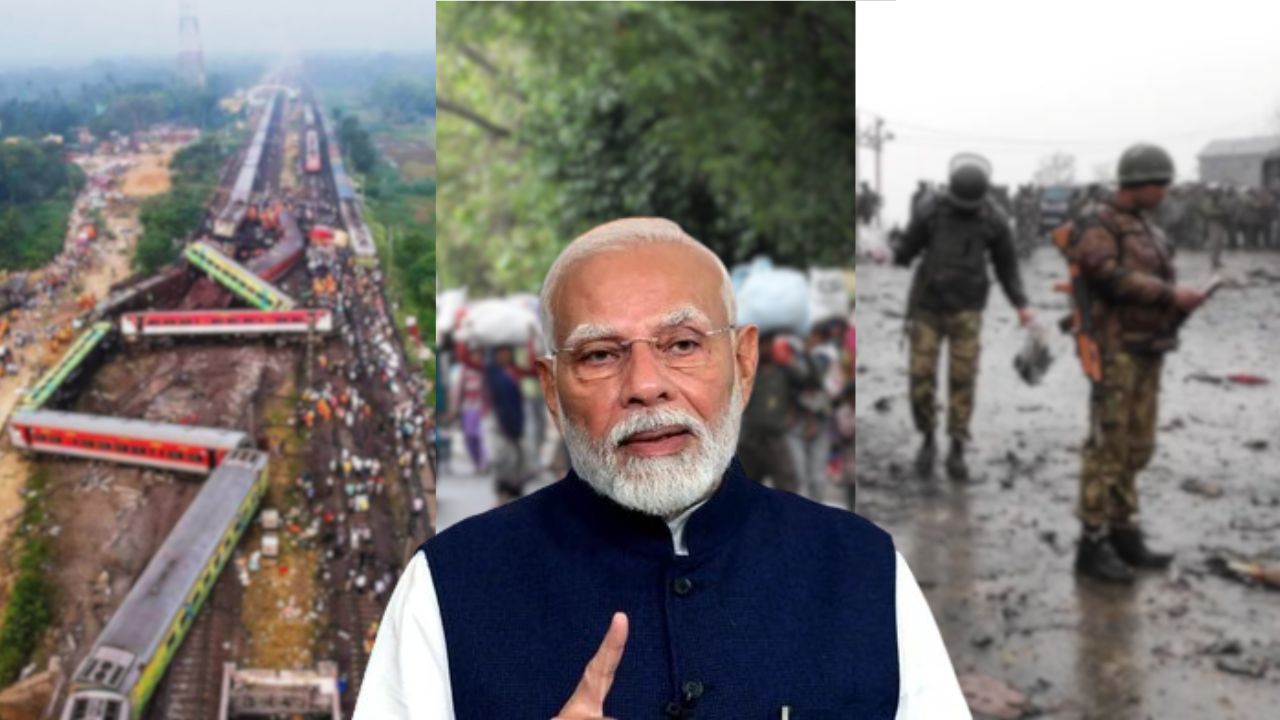
Even after several major mishaps over the past 12 years, no minister in the Modi government has taken responsibility.

Synopsis: The lapses in the handling of the 2026 NEET-UG examination and the CBSE Class XII board exams have put the BJP-led Union government under unprecedented pressure, with growing calls for accountability and the sacking of Education Minister Dharmendra Pradhan. The episode has prompted a rare acknowledgment of the issue from the Centre. In the past, whether in the aftermath of terror attacks, railway disasters, the handling of Covid-19, or other major crises, the Union government has often been accused of shirking responsibility for lapses, disasters, or damage caused under its watch.
The back-to-back lapses in the handling of the NEET-UG and CBSE Class XII board examinations over the last month have put the BJP-led Union government under, perhaps, the greatest scrutiny it has faced in the 12 years it has been in power.
First came a paper leak in early May that left over 23 lakh aspiring doctors and their dreams stranded after the conduct of the NEET-UG examination had to be scrapped entirely.
It was followed by sporadic complaints from Class XII students who noticed irregularities in the CBSE’s newly introduced On-Screen Marking system.
Within days, those complaints grew into a torrent, with teens creating new X accounts just to get the CBSE’s attention. The problems ranged from incorrect scoring and missing answer sheets in scanned copies to students being allotted scores based on answer sheets belonging to other candidates.
The gaffe has now led to growing calls for accountability from the Union government, the CBSE and the National Testing Agency (NTA).
In the case of the NEET paper leak, although Education Minister Dharmendra Pradhan acknowledged the lapses, he blamed “anti-social elements and the misuse of technology” for the leak.
However, it took Pradhan 10 days to even issue a statement on the CBSE gaffe. Even then, he defended the On-Screen Marking system as progressive, while saying that issues with the system would be fixed and that “a solution will be found”.
Paper leaks, however, are not a new issue. There have been nearly two dozen confirmed leaks since 2014. Yet it was only in the case of the 2026 NEET leak that the education minister publicly acknowledged a lapse. Pradhan, however, has not offered to step down despite growing calls for his removal.
Nor is this controversy the first instance in which the Union government has been accused of shirking responsibility for a major lapse or disaster, or for damage caused under the watch of the Union government and its ministers, without anyone being held accountable.
From terror attacks and train accidents to the handling of the Covid-19 pandemic and more, South First takes a look at previous instances and how the Union government responded.
Explained: The two cybersecurity controversies surrounding CBSE’s digital evaluation system
There have been several reported leaks of NEET-UG question papers in the past. The most high-profile instance before the current controversy occurred in 2024.
Initially, both the NTA and Education Minister Pradhan denied reports of a leak. However, later, the Bihar Police arrested an alleged organised gang accused of leaking the question paper a day before the examination. As the probe expanded, it was transferred to the CBI.
The CBI identified 155 students who had directly benefited from the leak, although only two of them scored more than 570 marks. Separately, police in Godhra, Gujarat, registered a case into an alleged leak in the state and arrested five people.
Yet, the examination was not cancelled. Even as investigations were underway, the NTA announced the results in June, 10 days ahead of schedule and on the same day as the results of the 2024 general election.
The results themselves sparked controversy. A total of 67 students secured perfect scores, while some candidates were awarded 718 and 719 marks, considered mathematically impossible under the examination’s marking scheme. The NTA maintained that around 1,563 candidates, including six top scorers, had been awarded compensatory marks for loss of time during the examination.
Following intervention by the Supreme Court, the NTA withdrew the grace marks and conducted a retest for the 1,563 affected candidates on 23 June 2024. Of them, 813 appeared for the re-examination.
Meanwhile, petitions alleging issues in the conduct of the examination were filed before several high courts and the Supreme Court. While the apex court refused to stay the declaration of results or the counselling process, it observed that the “sanctity” of the examination had been affected.
After weeks of hearings, the court ruled that there was no dispute that a paper leak had occurred and that 155 students had benefited from it. However, it found no evidence that the breach was widespread enough to justify a nationwide retest.
The leak was not an isolated incident. Between 2014 and 2024, there were 21 major paper leaks involving examinations such as NEET, CBSE board examinations and armed forces recruitment tests conducted by institutions under the Union government, according to an analysis by Newslaundry.
Yet there has been little institutional accountability, either from the bodies responsible for conducting the examinations or from the Union government.
On the afternoon of Valentine’s Day in 2019, 40 jawans of the Central Reserve Police Force (CRPF) were killed when a member of the Pakistan-based Islamist militant group Jaish-e-Mohammed rammed an explosives-laden vehicle into a convoy carrying security personnel on the Jammu-Srinagar National Highway at Lethpora in Pulwama district of the then undivided Jammu and Kashmir.
The attack was the deadliest in India since the 2008 Mumbai attacks, but it was not the first major attack targeting security forces in the perennially conflict-ridden region. Since at least 2015, there has been a series of attacks targeting security personnel.
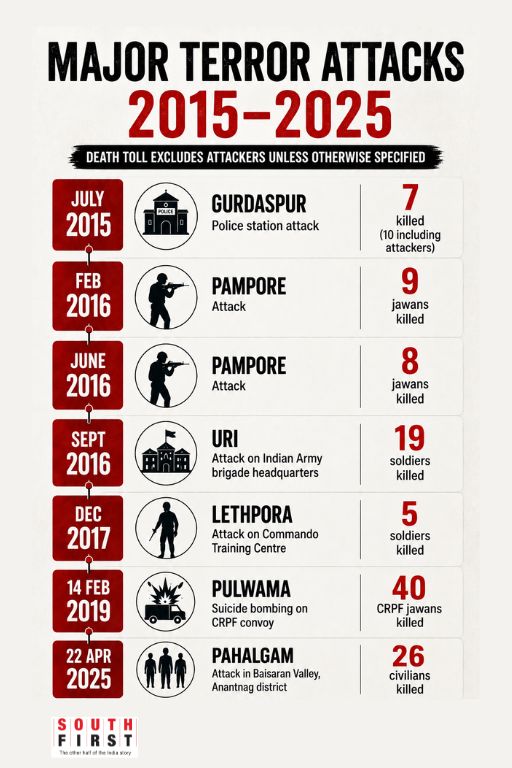
Major terror attacks in India from 2015 to 2025. (AI-generated image)
A police station in Gurdaspur was attacked in July 2015, killing seven people, including three civilians and four police personnel. Early in 2016, the Pathankot Air Force Station was attacked, followed by two attacks in Pampore in February and June that killed nine and eight jawans, respectively. In September that year, an attack on the Indian Army brigade headquarters in Uri killed 19 soldiers. In December 2017, five soldiers were killed in an attack on the Commando Training Centre at Lethpora.
Days before the Pulwama attack, the Union government received at least 11 intelligence alerts from the Intelligence Bureau and the Jammu and Kashmir Police warning of a possible attack, according to an investigation by Frontline.
Two days before the attack, Jaish-e-Mohammed had also reportedly hinted at an imminent strike in a video uploaded online. Yet, the CRPF’s requests for aircraft to transport personnel were denied, forcing the convoy to travel by road.
“Precisely, the agencies, and invariably the government, knew that a terror strike could be launched on the route of the security forces. The agencies knew that Jaish-e-Mohammad (JEM) terror commander Mudasir Ahmed Khan, who was later identified as the Pulwama mastermind, was working along with four foreign mercenaries on a ‘major fidayeen attack in the coming days’,” the Frontline report said.
Yet neither then home minister Rajnath Singh nor Prime Minister Narendra Modi took responsibility for ignoring the intelligence reports.
Five years after the attack, former Jammu and Kashmir Governor Satya Pal Malik accused Prime Minister Narendra Modi of shirking responsibility in an interview with The Wire.
Malik alleged that the attack resulted from “incompetence” and “laparvahi” within the system, particularly on the part of the CRPF and the Home Ministry.
Notably, Malik said that when he informed Modi of these lapses shortly after the attack over the phone (Modi was on a diplomatic tour and visiting Corbett National Park), the Prime Minister reportedly told him to keep quiet.
Six years after that attack, on 22 April 2025, 26 civilians enjoying the sights of the scenic Pahalgam valley in Anantnag district were gunned down by three armed militants belonging to The Resistance Front, a proxy of the Islamist terror group Lashkar-e-Taiba.
The group claimed responsibility for the attack twice, saying it was in response to the Union government’s controversial abolition of Jammu and Kashmir’s special status. The Union government responded by launching missile strikes reportedly targeting those responsible for the attack inside Pakistan. Dubbed Operation Sindoor, the strikes sparked a four-day conflict between the two nuclear powers.
The National Investigation Agency (NIA) and the Jammu and Kashmir Police arrested several suspects in connection with the attack in the months that followed.
More importantly, the government later admitted to a security lapse, revealing that Baisaran Valley had been opened to tourists two months ahead of schedule without security forces being informed, a factor that facilitated the attack. There were no security personnel present at the site on the day of the attack.
On 24 April 2025, the Union government convened an all-party meeting to brief opposition parties in the wake of the attack. But the Prime Minister was absent from the meeting.
The Congress demanded a special Parliament session to debate the attack and seek answers. Despite intense criticism from the opposition over the government’s handling of the tragedy, and calls for Home Minister Amit Shah to take “moral responsibility”, none has been forthcoming.
As of 2024, Indian Railways was the fourth-largest rail network in the world by size and remains one of the country’s most important modes of mass transport. In 2023-24 alone, it carried nearly 690 crore passengers.
Yet, the system has long suffered from persistent operational and management issues. Signal failures, track defects and rolling stock problems are common. More significantly, overcrowding has been chronic. Social media is periodically flooded with videos and images of packed trains and overcrowded stations.
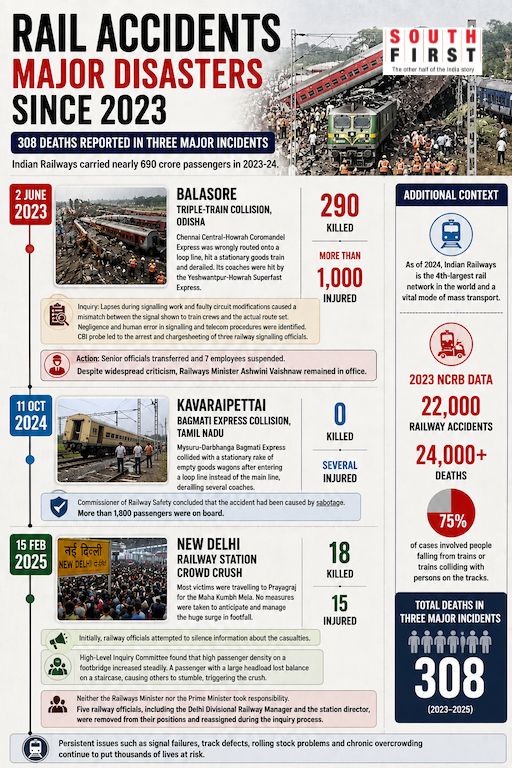
Major rail accidents in India since 2023. (AI-generated image)
These issues have come at a high human cost. Nearly 22,000 railway accidents resulting in more than 24,000 deaths were recorded in 2023 alone, according to the latest available data from the National Crime Records Bureau. Nearly 75 percent of these cases involved people falling from trains or trains colliding with persons on the tracks.
The last three years have also seen several major railway disasters.
The deadliest occurred on 2 June 2023, when three trains collided near Bahanaga Bazar station in Odisha’s Balasore district. The Chennai Central-Howrah Coromandel Express was incorrectly routed onto a loop line, where it struck a stationary goods train. Several derailed coaches spilt onto an adjacent track and were subsequently hit by the Yeshwantpur-Howrah Superfast Express.
Around 290 people were killed and more than 1,000 injured.
The Commissioner of Railway Safety concluded that lapses during signalling work and faulty circuit modifications caused a mismatch between the signal displayed to train crews and the route that had actually been set. The inquiry identified negligence and human error in signalling and telecommunications procedures. A subsequent Central Bureau of Investigation probe led to the arrest and chargesheeting of three railway signalling officials.
The Railways transferred senior officials and suspended seven employees following the accident. However, despite facing widespread criticism, Railways Minister Ashwini Vaishnaw remained in office.
A little over a year later, on 11 October 2024, the Mysuru-Darbhanga Bagmati Express collided with a stationary rake of empty goods wagons at Kavaraipettai, north of Chennai.
The train had reportedly received a green signal to proceed on the main line but entered a loop line instead, derailing several coaches. More than 1,800 passengers were on board. The accident caused several injuries but no fatalities.
The Commissioner of Railway Safety later concluded that the accident had been caused by sabotage.
Months later, on 15 February 2025, 18 people were killed and 15 others injured in a crowd crush at New Delhi Railway Station.
Most of the victims were travelling to Prayagraj in Uttar Pradesh for the Maha Kumbh Mela, which had drawn an unusually large number of passengers to the station. Despite the Modi government enthusiastically promoting the event, no measures had been taken to anticipate and manage the surge in footfall.
Initially, railway officials attempted to silence information about the casualties.
A High-Level Inquiry Committee appointed by the Ministry of Railways found that passenger density on a footbridge had steadily increased before a passenger carrying a large headload lost balance on a staircase, causing people behind to stumble. The resulting pressure in the overcrowded area triggered the crush.
Still, neither the Railways Minister nor the Prime Minister took responsibility for the disaster.
Instead, five railway officials, including the Delhi Divisional Railway Manager and the station director, were removed from their positions and reassigned during the inquiry process.
Also Read: Clamour for minister’s resignation but CBSE chairman, secretary transferred instead
Like several countries around the world, India imposed a nationwide lockdown in the early months of the Covid-19 pandemic to curb the spread of the virus.
Announced via a televised address by Prime Minister Modi on 24 March 2020, the restrictions came into force at midnight, giving the country only a few hours’ notice. Overnight, public transport came to a halt, while workplaces and businesses shut down or moved online.
India’s vast informal workforce, estimated at around 40 crore people at the time, was left in the lurch. Migrant workers bore the brunt of the restrictions.
Many who depended on daily wages suddenly found themselves without employment or income. Nor did they have the luxury of remaining in rented accommodation far from home.
But with rail and bus services suspended, many had little choice but to attempt to return to their villages on foot, trekking hundreds of kilometres across state borders, or by whatever means they could find. Images of the mass migration soon became an international story.
The Union government later announced relief measures, including a ₹1.7 lakh crore welfare package under the Pradhan Mantri Garib Kalyan Yojana, and operated Shramik Special trains to transport stranded workers.
Yet the scale of the disruption exposed the government’s lack of preparation for the consequences of the lockdown.
A 2021 study found widespread hardship among migrant workers. It reported ration shortages among 86 percent of respondents, financial distress among 82 percent, job losses among 86 percent, and anxiety over Covid-19 infection among 81 percent.
The study also found that many workers did not receive ration kits or financial assistance during the lockdown and concluded that government support fell short of what was required.
The Union government, meanwhile, told Parliament that it did not have data on the number of migrants who died or were injured while returning to their native places during the lockdown.
It maintained that it had taken numerous measures to provide migrant workers with financial assistance, food support and other benefits to mitigate the economic disruption caused by the pandemic and the nationwide restrictions.
Nearly a year after the lockdown came into effect, a novel strain of the virus ripped through the country, proving to be its most destructive.
After beginning its vaccination programme in early January, India saw its daily cases fall to a low of 9,000 in February. By the end of April, however, that number had grown to a staggering 3,00,000 per day. On 30 April alone, the number of new cases and deaths reached more than 4,00,000 and 3,500, respectively.
The proposed factors behind the spike are many: More infectious variants of the virus; inadequate preparations for a fresh influx of cases; the dismantling of temporary Covid centres as case numbers declined; lax enforcement of Covid-19 precautions at mass gatherings such as weddings, religious festivals, the Haridwar Kumbh Mela and Indian Premier League matches; and the conduct of state and local elections.
Moreover, the year-long restrictions imposed since the pandemic began had taken an economic toll, and the Union government was under pressure to ease them.
Whatever the cause, the human cost of the second wave was enormous, especially as the healthcare system soon began to collapse under the weight of the disaster.
Despite ample warnings since the beginning of the first wave, no institutional or state-level planning had been undertaken to ensure an adequate supply of liquid oxygen, a key component in treating patients, or of the cryogenic tankers needed to transport it.
At the height of the disaster, Prime Minister Modi urged suppliers to boost production. A large number of new production plants were announced soon after. Several foreign countries also sent emergency aid in the form of oxygen supplies, but it took more than a month for case numbers to begin to decline. Still, a short supply of cylinders proved to be a bottleneck.
Striking images of mass cremations on a daily basis showed the extent of the crisis. At the same time, the Union government’s daily case and death figures were challenged by on-the-ground reporting.
A few months after the crisis, in response to a question in Parliament on the number of patients who had succumbed due to a lack of oxygen, Bharati Pravin Pawar, then Minister of State for Health, caused an uproar by stating in a written response that “no deaths due to lack of oxygen have been specifically reported by States/UTs.”
The first major policy initiative of the Modi government, demonetisation of banknotes, announced by the Prime Minister in his now characteristic televised address, proved to be a major disruptor of India’s economy.
It not only reduced industrial production and slowed GDP growth, but it is estimated to have cost 1.5 million jobs. The prolonged shortage of newly minted cash hit the country’s vast informal sector particularly hard. It also led to a decline in agricultural wages and widespread losses for farmers.
Ten years on, the consensus among experts is that demonetisation was neither an effective means of targeting black money nor a successful policy overall.
But beyond its economic costs, the policy had an immediate human impact. Within a week of its implementation, the long queues at banks to secure new banknotes had reportedly caused at least three dozen deaths.
Some people died while waiting in line, while others reportedly died after being denied crucial medical care because they did not have the new notes to pay for treatment.
Another estimate put the death toll after a month at 83. By the end of December, it had crossed 100, according to yet another estimate.
Yet in March 2017, the Union government maintained that it had received no reports of such deaths. It was only in December 2018 that then finance minister Arun Jaitley acknowledged in Parliament that deaths had occurred as a direct result of the policy.
He maintained, however, that only four people had died, three of them bank personnel.



