

Published Feb 01, 2026 | 2:28 PM ⚊ Updated Feb 01, 2026 | 2:28 PM

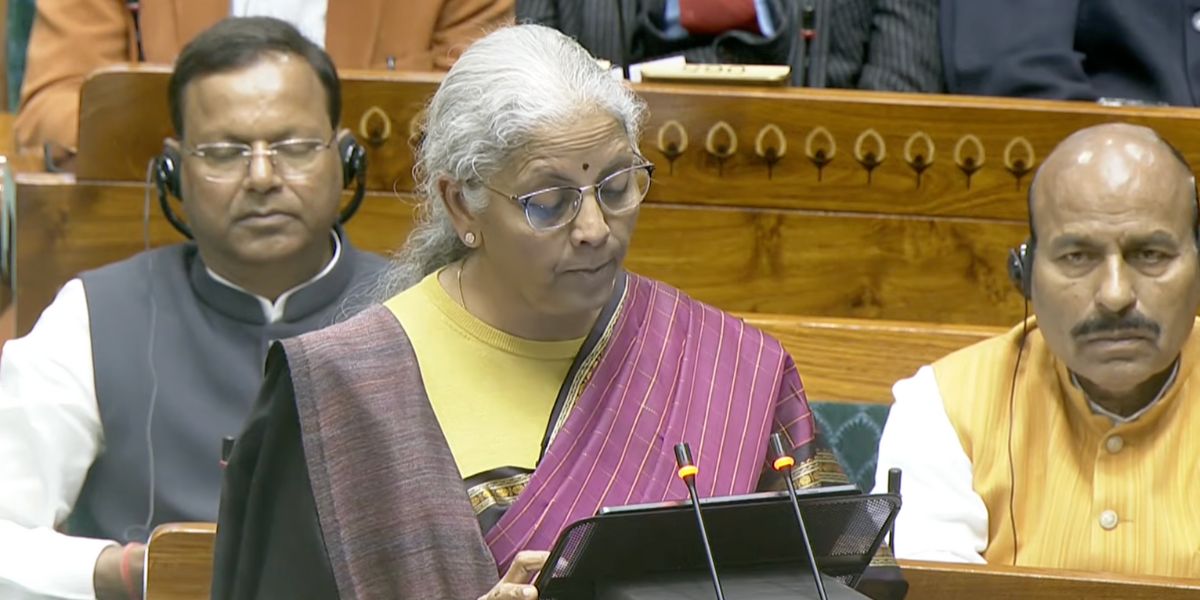
Finance Minister Nirmala Sitharaman presenting the Union Budget 2026.
Synopsis: Announcements related to welfare schemes, health and educational policies are likely to have a direct and visible impact on the common man, while those on improving facilities, rural incomes and job creation will have a long-term impact.
The Union Budget 2026-27 presented in Parliament on Sunday, 1 February, has made no changes to income tax rates or slabs after the mega announcement made a year ago.
Finance Minister Nirmala Sitharaman’s ninth consecutive Budget has attempted to provide an extra fillip to the Viksit Bharat vision.
Announcements related to welfare schemes, health and educational policies are likely to have a direct and visible impact on the common man, while those on improving facilities, rural incomes and job creation may have a long-term impact.
For small taxpayers, Sitharaman proposed a new scheme, which will have a rule-based automated process to obtain a lower or nil deduction certificate instead of filing an application with the assessing officer.
Depositories that accept Form 15G or Form 15H from the investor and provide it directly to various relevant companies will ease the burden on taxpayers holding securities in multiple companies.
For NRIs, the finance minister proposed raising the individual investment cap to 10 percent from the current 5 percent. The aggregate limit for such investors will increase to 24 percent from 10 percent.
Sitharaman also proposed steps to reduce the treatment costs of cancer patients. She proposed removing the basic customs duty on 17 medicines.
“To provide relief to patients, particularly those suffering from cancer, I propose to exempt basic customs duty on 17 drugs or medicines. I propose also to add 7 more rare diseases for the purposes of exempting import duties on personal import of drugs, medicines and food for special medical purposes used in their treatment,” she said.
The indirect tax proposals recommended reducing the tariff rate on all dutiable goods imported for personal use from 20 percent to 10 percent.
Below are the major tax reforms for the manufacturing sector:
Many of these proposals will have a direct impact on the common man.
Sitharaman proposed a slew of tax reforms for middle-class families.
Passenger facilitation
Transferring residence from abroad
Customs rationalisation/exception
TCS rationalisation
Foreign asset disclosure scheme
To ease the financial and compliance burden on the common man by rationalising indirect taxes, simplifying customs procedures, and reducing upfront cash outflows—thereby improving everyday welfare, healthcare access, and travel experience, the Budget proposed a slew of measures:
The government expects these reforms to lower the cost of living through reduced indirect tax incidence, provide affordable healthcare with reduced treatment and compliance costs, ensure simpler and smoother travel with clearer rules and digital processes, and usher in greater transparency and ease of compliance in indirect taxation.
The Budget included provisions to reduce the upfront financial burden associated with overseas education and improve access to education financing for students and families.
Rate reforms
Foreign asset of small taxpayers’ disclosure scheme
Lower upfront costs for students
Customs duty reforms
Lower deduction certificate
Dividend deduction ease
Foreign asset of small taxpayers disclosure scheme
Revised returns
The reforms aim to lower the compliance burden for senior citizens, improve income security, reduce dependence on intermediaries, provide greater peace of mind for retirees and increase accessibility to targeted treatment.
For the finance sector, the Budget proposed to raising the Securities Transaction Tax (STT) on Futures from 0.02% to 0.05%, and STT on options premium and exercise of options to be raised to 0.15% from rate of 0.1% and 0.125%, respectively.
Sitharaman also proposed to make duty-free fish catch by Indian fishing vessels in the Exclusive Economic Zone (EEZ) or on the high seas.
The Union Budget’s proposal to declare a tax holiday until 2047 for foreign cloud companies operating from data centres in India is expected to boost the country’s digital services ecosystem.
While announcing the proposal, Sitharaman said the tax holiday will be applicable only for firms routing their services to Indian customers through an Indian reseller entities.
“I propose providing a tax holiday until 2047 to any foreign company that offers cloud services to customers globally using data centres located in India. However, it will need to provide services to Indian customers through an Indian reseller entity,” she said.
Alcohol and tobacco products like cigarettes and pan masala will get costlier once the Budget comes into force.


