

Published Feb 01, 2026 | 3:09 PM ⚊ Updated Feb 01, 2026 | 3:09 PM

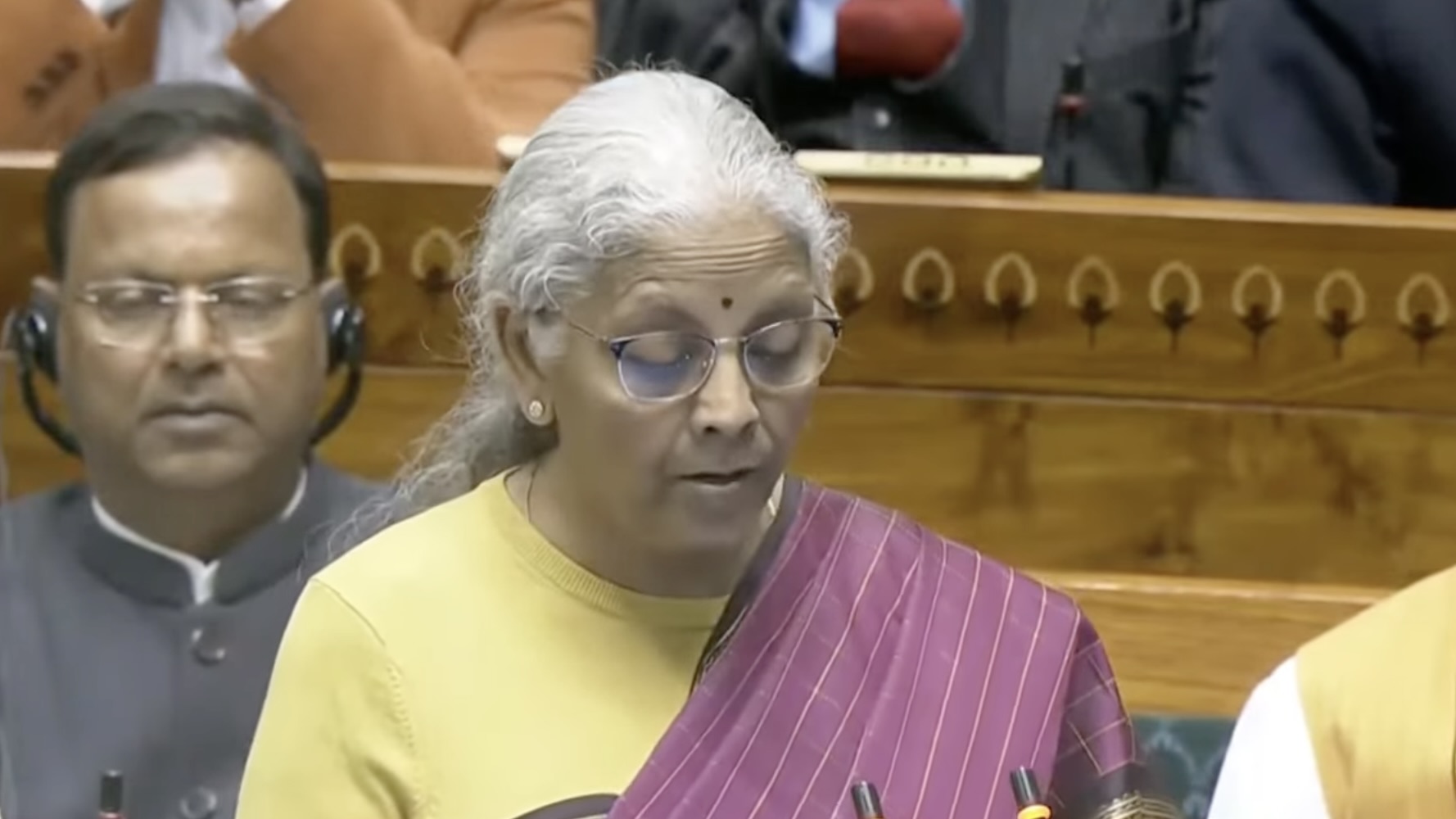
Union Finance Minister Nirmala Sitharaman.
Synopsis: Finance Minister Nirmala Sitharaman on Sunday announced a wide-ranging set of education initiatives in the Union Budget 2026–27, including a girls’ hostel in every district, new institutes for Ayurveda and design, and expanded support for creative and medical education. The budget links education more closely with jobs and skills through a new Education to Employment and Enterprises committee.
From setting up a girls’ hostel in every district to establishing new institutes for Ayurveda and design, Union Finance Minister Nirmala Sitharaman on Sunday, 1 February announced a slew of initiatives for the education sector while presenting the Union Budget 2026–27.
“Since we assumed office 12 years ago, the country’s economic trajectory has been marked by stability, fiscal discipline, sustained growth and moderate inflation. This is the result of conscious choices we have made even in times of uncertainty and disruptions,” she said.
The budget placed a strong focus on education, with announcements spanning medical education, animation and gaming, and astrophysics and astronomy, among other fields.
An ‘Education to Employment and Enterprises’ standing committee has been announced to explore potential for growth, employment and skill development.
“The Committee will prioritise areas to optimise the potential for growth, employment and exports. They will also assess the impact of emerging technologies, including AI, on jobs and skill requirements, and propose measures accordingly,” the minister said.
Citing a shortage of Indian designers despite the rapid expansion of the industry, Sitharaman proposed setting up a new design institute in eastern India to “boost design education and development”.
Sitharaman also said that Ayurveda has gained global acceptance and recognition.
“Exporting quality Ayurveda products helps farmers who grow the herbs and youth who process the products,” she said, while listing steps to meet rising global demand. One of these is the establishment of three new All India Institutes of Ayurveda.
The Centre will also support states in creating five university townships near major industrial logistics centres. These academic zones will host multiple universities, colleges, research institutions, skill centres and residential complexes.
Sitharaman further said that prolonged hours of study and laboratory work in higher education STEM institutions pose challenges for girl students. To address this, the Centre has proposed setting up one girls’ hostel in every district to improve safe access to education.
Noting that the animation, visual effects, gaming and comics (AVGC) sector is projected to require two million professionals by 2030, Sitharaman announced support for the Indian Institute of Creative Technologies in Mumbai to set up AVGC content creator labs across 15,000 secondary schools and 500 colleges nationwide.
Four telescope infrastructure facilities will also be set up or upgraded to promote astrophysics and astronomy.
The minister also announced a set of measures to reform medical education. The government will upgrade allied health institutions, with a goal of adding 1.5 lakh caregiver professionals over five years. These will cover 10 selected disciplines, including optometry, radiology, anaesthesia, OT technology, applied psychology, and behavioural health.
Another National Institute of Mental Health and Neuro Sciences (NIMHANS) will be established in North India to expand access to advanced mental health and neurosciences care. The Centre will also upgrade the National Mental Health Institutes in Ranchi and Tezpur.
Sitharaman further proposed setting up a National Institute of Hospitality by upgrading the existing National Council for Hotel Management and Catering Technology. The institute, she said, would act as a bridge between academia, industry and government.
In addition, a pilot scheme to upskill 10,000 guides at 20 iconic tourist sites has been proposed in collaboration with an Indian Institute of Management (IIM). The programme will run as a standardised, high-quality, 12-week hybrid training course.
(Edited by Dese Gowda)


