

Published Jun 12, 2026 | 2:27 PM ⚊ Updated Jun 12, 2026 | 2:52 PM

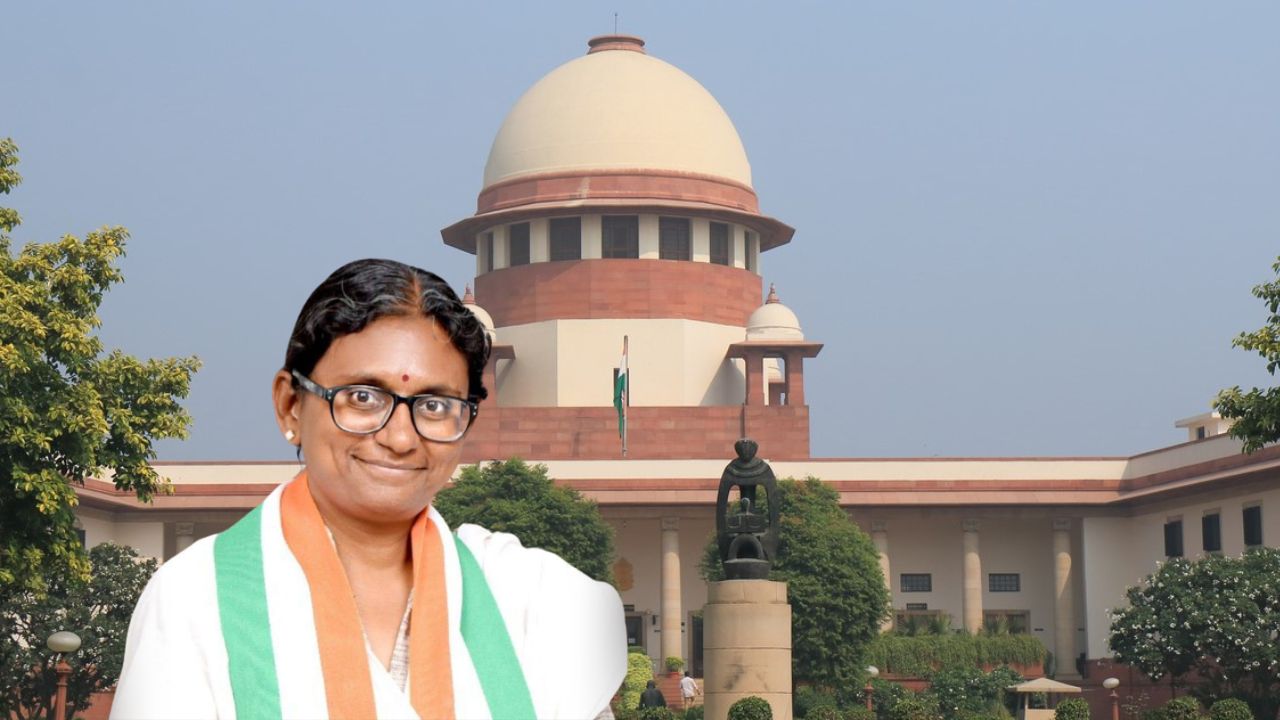
Supreme Court dismisses petition challenging rejection of Meenakshi Natarajan’s Rajya Sabha nomination.

Synopsis: The Supreme Court dismissed the petition moved by Congress leader Meenakshi Natarajan against the rejection of her nomination papers for the Rajya Sabha elections. A bench said that, according to the law, election-related petitions are not maintainable after the commencement of the election process.
The Supreme Court on Friday, 12 June, dismissed the petition moved by Congress leader Meenakshi Natarajan against the rejection of her nomination papers for the Rajya Sabha elections.
A Bench of Justice PK Mishra and Justice AS Chandurkar said that, according to the law, election-related petitions are not maintainable after the commencement of the election process.
“Whenever an attempt has been made to invoke the jurisdiction of this Court under Article 32, or that of the High Courts under Article 226, during the process of elections, this Court has repeatedly declined interference, having regard to the constitutional mandate contained in Article 329(b) of the Constitution,” the bench said, reported Bar and Bench.
However, the court left open the remedy of election petition and clarified that it had not observed anything on the merits of the case.
On Thursday, the ruling BJP in Madhya Pradesh had swept all three Rajya Sabha seats from the state unopposed, after the completion of the nomination withdrawal process left no other candidates in the fray.
Returning Officer Arvind Sharma declared BJP nominees Rajneesh Agrawal, Tarun Chugh and Mahesh Kewat elected and certified them as duly elected members of the Council of States.
The election was held to fill the seats falling vacant on 21 June following the completion of the terms of BJP MPs George Kurian and Sumer Singh Solanki, and Congress MP Digvijaya Singh.
Also Read: BJP wins all three Madhya Pradesh Rajya Sabha seats unopposed
Congress president Mallikarjun Kharge said that the apex court asked the party to go to the Election Commission first, then to the high court, and only thereafter approach the Supreme Court.
“However, this is a special case. The more time that is given, the longer this matter will be dragged out. That is why we wanted the Supreme Court to provide relief in this case. Nevertheless, since the court has said so, we will approach the high court accordingly. We believe that this rejection is illegal, immoral, and anti-democratic. What the government has done is wrong,” he said.
Khage claimed that such major actions do not happen without the approval or direction of Prime Minister Narendra Modi. “We believe that these steps are being taken deliberately as part of a larger conspiracy to weaken the Congress party and undermine democracy. In our view, these actions are aimed at harassing and suppressing the opposition.”
Ahead of the hearing, Natarajan had said that the alleged case on the grounds of which her nomination was rejected is not relevant, since the court has not yet taken cognisance.
She added that if Form 26 of the nomination had a column to list all private complaints against the nominee, she would have definitely listed them.
The court rejected the argument by senior advocate Abhishek Manu Singhvi, representing Natarajan, that it should interfere if the rejection of a nomination is ex facie illegal, manifestly arbitrary and demonstrably erroneous.
“If such a distinction were to be recognised, courts would be required to classify election disputes into two categories—first, those involving allegedly glaring or manifest errors warranting immediate intervention under Articles 32 or 226; and second, those where the aggrieved party must await the remedy of an election petition,” the bench said.
“To accept the petitioner’s submission would amount to reading into the constitutional scheme an exception which has not been provided by the Constitution itself. We are afraid that any interpretation permitting courts to entertain challenges to rejection of nominations in some cases, while relegating other candidates to the statutory remedy of an election petition, would be inconsistent with the settled constitutional position and ought not to be encouraged,” the bench added, while dismissing the plea.
Singhvi had submitted on Thursday that the Returning Officer rejected Natarajan’s nomination on the ground of suppression of a criminal case. He contended that there was no cognisance taken of the criminal case in question, and only a pre-cognisance summons as per Section 223 of the Bhartiya Nagarik Suraksha Sanhita (BNSS) has been served upon her.
According to him, as per Section 33A of the Representation of the People Act, only criminal cases where cognisance has been taken need to be disclosed.
Madhya Pradesh Congress chief Jitu Patwari alleged that the rejection of Natarajan’s Rajya Sabha nomination was an unprecedented development in Indian politics and raised concerns about the state of democracy in the country.
“The first case, the first such incident in Indian politics, where a Rajya Sabha nomination has been cancelled. This is currently a subject of discussion in the country. There is a deep-seated feeling in the minds of the common public: will democracy survive in this country, or is the nation heading towards autocracy and dictatorship? This is a significant event that reflects that entire line of thought,” Patwari said at a press conference.
Also Read: Desperate Congress goes all out to trace leak that sank Meenakshi Natarajan
On Wednesday, a delegation of 10 Congress leaders, including MPs KC Venugopal, Jairam Ramesh and Randeep Surjewala, had met the Election Commission (EC).
Congress General Secretary Venugopal said the delegation has had a detailed discussion with the Chief Election Commissioner and other Election Commissioners. He added that they presented the proper facts and figures.
Singhvi said that the criminal case on the grounds that the nomination of Natarajan was rejected does not exist, as the competent judge has yet to take cognisance. Singhvi said they have demonstrated beyond doubt that such a case does not exist.
The alleged case pertains to a complaint by a woman, A Srilata, who approached the Metropolitan Magistrate Court in Hyderabad on 20 August 2025. The complainant had named Natarajan as accused number four.
The court issued a notice to Natarajan on 17 September 2025, asking her to submit a response in person. In a counter-affidavit filed on 24 October, Natarajan’s lawyer denied the charge and alleged that the complaint was politically motivated.
Though the lawyer sought the dismissal of the case, the court did not entertain the request. The case is pending before the court.



