

Published Oct 05, 2026 | 3:09 PM ⚊ Updated Oct 05, 2026 | 3:36 PM

The Bench directed that Metro and rail facilities should function normally unless restrictions were required.

Synopsis: The Election Commission of India said on 26 September that the Supreme Court had approved the modified Form 6. On Monday, Chief Justice Surya Kant said the court had not approved “any modified Form 6”. The apex court was hearing a petition seeking the prosecution of Chief Election Commissioner Gyanesh Kumar, and other senior ECI officials.
The Supreme Court on Monday, 5 October, said it had not approved any modified version of Form 6, used to include the names of first-time voters in the electoral rolls during the ongoing Special Intensive Revision.
Chief Justice Surya Kant’s observation contradicted the ECI version that the modified Form 6 had the Supreme Court’s approval.
Following an expose by The Indian Express, the ECI said on 26 September that it will use the old Form 6 in “non-SIR” periods. In a press note, the poll also defended changes to the form to include new voters, saying the apex court had upheld them.
“Any modified Form 6 has not been approved by us. Let’s be clear. When the record is produced, we would like to see who has modified,” the Chief Justice said while hearing a petition seeking the prosecution of Chief Election Commissioner Gyanesh Kumar.
Following an expose by The Indian Express, the ECI on 26 September said it will use the old Form 6 in “non-SIR” periods. In a press note, the poll panel also defended changes to the form to include new voters, saying the apex court had upheld them.
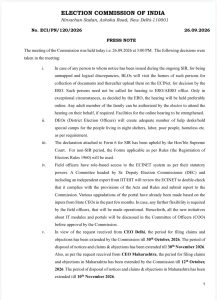
ECI’s 26 September press note.
“The declaration attached to Form 6 for SIR has been upheld by the Hon’ble Supreme Court. For non-SIR period, the Forms applicable as per Rules (the Registration of Electors Rules 1960) will be used,” the ECI statement said.
Changes to the new Form 6 declaration became controversial after The Indian Express report said two Election Commissioners, Sukhbir Singh Sandhu and Vivek Joshi, objected to the alterations, saying they required an amendment to the Registration of Electors Rules, 1960.
The new declaration mandated those wanting to register as new voters to state whether they or their parents were mapped in the previous SIR. The earlier Form 6 did not carry such a clause.
The Bench of Chief Justice Surya Kant, which also included Justice Joymala Bagchi and Justice V Mohana, was hearing Advocate Shailendra Mani Tripathi’s writ petition seeking to quash the 14 decisions the CEC had reportedly made unilaterally.
Also Read: Poll panel orders review of ECINet amid SIR row
The petition also sought the constitution of a retired Supreme Court judge-led independent Judicial Inquiry Commission/Special Investigation Team, assisted by cybersecurity and IT experts, according to LiveLaw.
Advocate Tripati also prayed for the court’s directions to the competent authority to register complaints and initiate prosecution under Section 32 of the Representation of the People Act, 1950, against CEC Kumar, Senior Deputy Election Commissioner Maneesh Garg, Director General (IT) Seema Khanna and other officials found responsible for breach of official duty.
Chief Justice Kant told Senior Advocate Menaka Guruswamy that the prayers in the petition appeared to be omnibus and “jumbled up”. Guruswamy said she was standing by the prayers.
The Bench issued notice on the petition and tagged it with a similar matter by petitioner Rakesh Kumar Singh challenging the ECI’s decision.
On Singh’s petition, the CJI’s Bench declined to pass an ex parte interim order suspending CEC Kumar on the basis of media reports.
“You have come here on the basis of a news report, which can be 100% correct, partially correct or partially incorrect. We cannot pass any order on the basis of a newspaper report,” the Bench said.
The court said it should first seek the Election Commission’s and other respondents’ responses to the allegation that Kumar made several unilateral SIR-related decisions.
(Edited by Majnu Babu).



