

Published Apr 29, 2026 | 6:50 PM ⚊ Updated Apr 29, 2026 | 6:50 PM

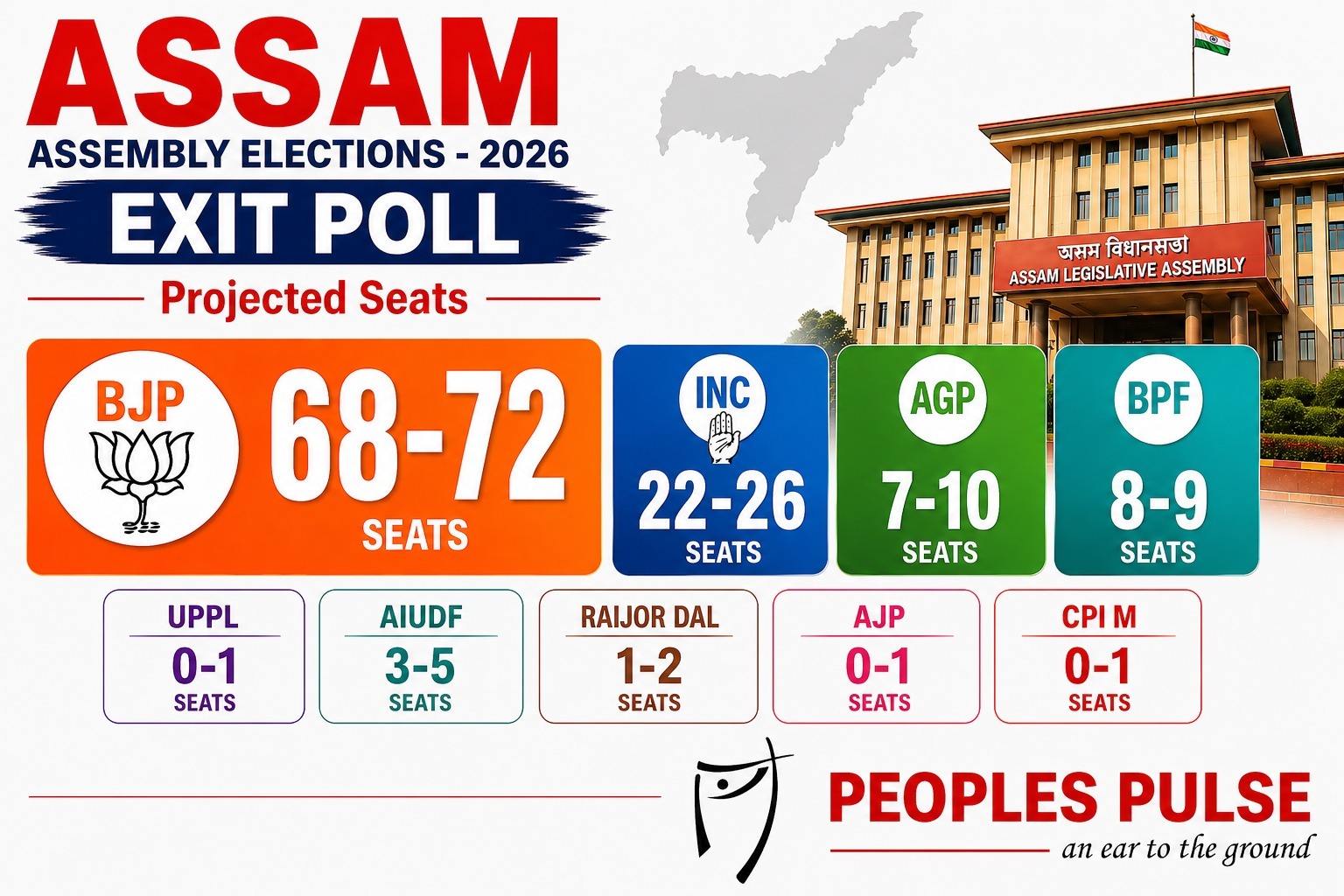
People Pulse exit poll indicates a comfortable majority for BJP in Assam.

Synopsis: The BJP is estimated to secure 38.6% of the vote, while Congress trails at 36.5%. However, this narrow gap in vote share does not translate into electoral parity. The BJP’s strength lies in its efficient vote distribution and strong regional consolidation, enabling it to convert votes into seats far more effectively than its rivals.
The exit poll conducted by Peoples Pulse Research Organization indicates a decisive mandate in favour of the Bharatiya Janata Party (BJP)-led North East Democratic Alliance (NEDA) in the Assam Assembly elections-2026.
The survey suggests that the state is witnessing a clear preference for continuity, with the BJP likely to secure a third consecutive term and form the government independently.
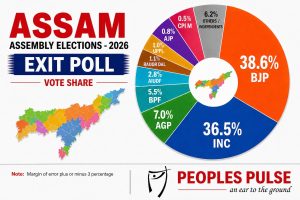
As per the Peoples Pulse Exit Poll findings, the BJP is projected to win between 68 and 72 seats in the 126-member Assam Legislative Assembly, comfortably crossing the majority mark on its own.
This strong performance reflects a combination of leadership appeal, governance perception, and an effective electoral strategy. In contrast, the Indian National Congress (INC) is expected to secure between 22 and 26 seats, indicating a limited electoral presence that falls significantly short of challenging the ruling party.
The strength of the NEDA alliance further reinforces this advantage. Alliance partners such as the Asom Gana Parishad (AGP) are projected to win 7–10 seats, while the Bodoland People’s Front (BPF) is expected to secure 8–9 seats.
Together, the NDA’s tally is likely to approach the 90-seat mark, signalling not just a victory but a stable and decisive mandate. Other parties, including AIUDF, Raijor Dal, UPPL, AJP, CPI(M), and independents, are expected to remain on the margins with limited influence on the overall electoral outcome.
Peoples Pulse exit poll captures the pulse of Assam’s electorate. Dr. Rajan Pandey, Political Analyst and Director of People’s Pulse Research Organization, compiled the Exit Poll report. As part of its comprehensive election study, Peoples Pulse Research Organization had earlier conducted two tracker polls in Assam.
The first tracker poll was carried out during November–December 2025, followed by the second tracker poll in March 2026. Building on these findings, the organization conducted the exit poll across all 126 Assembly constituencies covering 35 districts of Assam. A total of 5,000 respondents were interviewed through face-to-face interactions, ensuring a robust and representative sample of the electorate.
Interestingly, the vote share projections reflect a closer contest on the surface. The BJP is estimated to secure 38.6% of the vote, while Congress trails at 36.5%. However, this narrow gap in vote share does not translate into electoral parity. The BJP’s strength lies in its efficient vote distribution and strong regional consolidation, enabling it to convert votes into seats far more effectively than its rivals. The fragmentation of votes among smaller parties further weakens the opposition space and indirectly strengthens the NEDA’s position.
Leadership preference continues to play a decisive role in shaping voter behaviour. The survey indicates that incumbent Chief Minister Himanta Biswa Sarma holds a significant advantage, with 45% of respondents expressing preference for his leadership.

He is well ahead of Congress leader Gaurav Gogoi, who garners 35% support, while others account for the remaining share. This leadership edge is further strengthened by strong support among women voters and tribal communities, reflecting a broad-based appeal across key social segments.
Region-wise analysis highlights nuanced electoral dynamics across Assam. In Upper Assam, the NEDA maintains a stronghold with a comfortable lead in most constituencies, while the opposition shows limited recovery in select pockets. Middle Assam presents a more complex and competitive picture, with districts such as Nagaon, Hojai, Karbi Anglong, Dima Hasao, and Darrang witnessing closely fought contests.
Lower Assam adds another layer of complexity due to the presence of several Muslim-dominated constituencies. In this region, AIUDF appears to have improved its position compared to previous trends, driven largely by candidate-specific strengths. The party is expected to perform well in constituencies such as Gauripur and Srijangram and is putting up competitive fights in Chenga and Dhubri. Despite these localized gains, the overall advantage continues to favour the NEDA.
In the Barak Valley region, comprising Cachar, Hailakandi, and Karimganj districts, the BJP retains an upper hand across most constituencies. However, the Congress is expected to make limited inroads in select seats such as Sonai, Barkhola, Algapur-Katlichera, and Karimganj South.
Beyond numbers, the exit poll identifies key political trends shaping the electoral landscape, including limited recovery of AIUDF, the adverse impact of the Congress–Raijor Dal alliance, and the role of smaller parties as vote splitters.
Overall, the findings indicate a clear wave of continuity favouring the BJP-led NEDA in Assam.



