

Published Jul 03, 2026 | 1:41 PM ⚊ Updated Jul 03, 2026 | 1:41 PM

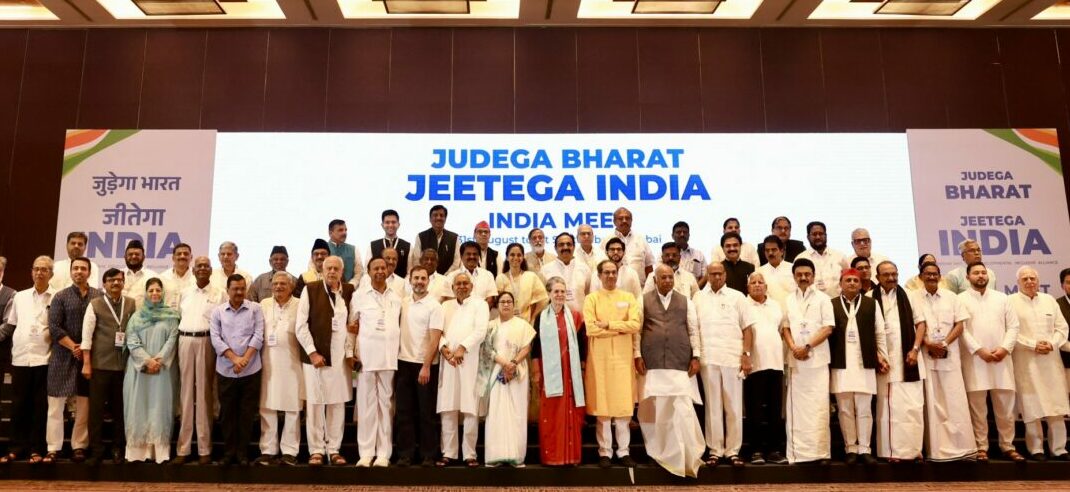
File photo of Opposition bloc INDIA meeting in Mumbai.

Synopsis: Opposition parties wrote to the Chief Justice of India and Supreme Court judges, saying they believe that the outcomes do not reflect the will of the people. They said that when institutions become instruments of oppression and carry the agenda of the government, the future of democracy is fraught with grave consequences.
Alleging manipulations in electoral processes in several states, 23 Opposition parties wrote to the Chief Justice of India and Supreme Court judges on Friday, 3 July, saying they believe that the outcomes do not reflect the will of the people.
Acknowledging that the Election Commission (ECI) has always been appointed by the government in power, they said there were hardly any instances before 2014, barring a few exceptions, when questions were raised about the integrity of people in the Commission.
“But since 2014, almost every appointment made by the government has been of persons closely associated with it and seen to be doing the bidding of the government, brazenly, to manipulate the outcome of election results,” they claimed.
They noted that even after the Supreme Court emphasised the need for a transparent and more independent process and opined that a three-member committee of the Prime Minister, the Leader of Opposition in Lok Sabha and the CJI, the BJP-led government removed the CJI from the panel and appointed a Union minister.
They said that the reconstitution of the committee led to the Union government controlling the appointment process, and alleged that there has been open and unabashed support for the BJP during the course of and in the outcome of electoral processes.
The Opposition claimed that the Union government has been using central agencies to manipulate the outcome of the elections.
“We find, and it is a matter of grave concern, that the agencies of the government, in particular the CBI, the ED and the NIA, are used only to target those in Opposition. These agencies are also used for the purpose of manipulating the outcome of results in the elections, apart from bringing down elected governments,” they said.
They said that when institutions become instruments of oppression and carry the agenda of the government, the future of democracy is fraught with grave consequences.
“Judges do not live in ivory towers. You too are aware of what is happening on the ground. The legacy media is largely compromised, but there are many independent platforms who are still speaking truth to power. We respect all institutions as we must. We honour them as we must. But when institutions themselves become instruments of oppression, carry forward the agenda of the government, then the future of our democracy is fraught with grave consequences,” they said.
“When all else fails, people still repose their trust in the judiciary. So when the judiciary fails to respond, it indicates a complete breakdown of the Republic. Democracies turn into anarchies when institutional mechanisms fail completely. Therefore, it is the responsibility of all of us to ensure that people’s faith in institutions must endure. And for that, institutions must play their role,” they added.
Noting that they are not questioning the judiciary, they said they are turn to the courts when every mechanism has failed. “When this too fails, it leaves open the question — who do we now turn to. We leave that question for you to ponder upon,” they said.
Opposition parties alleged that the EC has not been evenhanded by choosing not to take action when the Model Code of Conduct (MCC) is breached by the political party in power — the BJP — while targeting those in the Opposition.
“On multiple occasions, the Commission had maintained a stoic silence when openly toxic, communal statements contrary to the principles enunciated in the MCC, are routinely made by those in the BJP,” they alleged.
Noting that the letter was not to influence the decision of any cause pending before any court, they said, “Our sole purpose is to strengthen, and never to weaken, public confidence in the institutions of our democracy, and to place our concerns, in good faith, before the forum where the citizens of India have always reposed their final trust.”
They added that they chose this unusual path since democracy is in jeopardy, and added that democracy is a collaborative exercise. They added that if the election process is tainted and the outcome is suspect, the will of the people becomes the victim of this perfidy.
The Opposition also expressed concerns over the completed and ongoing Special Intensive Revision (SIR) of electoral rolls in several states.
They claimed that although the Chief Election Commissioner, Gyanesh Kumar, claimed that the SIR in each state was to ensure that they truly represent those who are entitled to vote, the result is quite the opposite.
“The experiment of the SIR was first launched in Bihar. The political rhetoric seeking to rationalise this process centred around the alleged infiltration of Bangladeshis into the Bihar electoral rolls. Now that the Bihar Assembly elections are over, there is absolutely no data to suggest that such an infiltration indeed took place, nor has the Election Commission made public any data with respect to the number of Bangladeshis having illegally acquired the right to vote in India,” they said in the letter.
They said the exercise, just before the Assembly elections, was inherently exclusionary and politically motivated. They noted that there were several malpractices and that the process was unfair towards the poor, uneducated, including Dalits, Adivasis, members of the minority community and migrant workers.
“The grievance redressal mechanism was inadequate and there was a massive arbitrary deletion of names without proper notice. The alleged objective of the
exercise was to remove duplicate voters and the names of the deceased and migrants from the voters’ lists. But the process, as implemented, lacked not just
transparency but was implemented in a manner unknown to all processes undertaken in the past,” the said and alleged that the whole process of the SIR was meant to favour the BJP.
Also Read: Siddaramaiah urges Congress workers to monitor SIR exercise
Noting that it raised no real issues of manipulation in states like Tamil Nadu, Kerala and Assam, there was a massive deletion of names from the electoral rolls in West Bengal, including those arbitrarily removed, under a never-used-before-category titled ‘logical discrepancies’.
“Most of the deletions were found to be in constituencies where the All India Trinamool Congress (AITC) was dominant. The SIR is an unusual process with which the ordinary voter is unfamiliar. The requirement of filling forms, forwarding them and furnishing of documents in a country where there is massive poverty and illiteracy is essentially exclusionary.”
The Opposition noted that even many BLOs in West Bengal were deprived of their right to vote and added that they believe that the recently conducted elections in Delhi, Haryana and Maharashtra were also manipulated.
“In light of what we have stated, we do expect the impending SIR process be suspended and be launched at a time when the next Assembly election is at least five years away so that representatives of the Commission can go to each house for verification of voters, instead of a process of documentation which has never been adopted in the past,” they said in the letter.
Quite apart from the electoral rolls, serious questions are also being raised about the process of electronic voting, and in particular about the role of electronic voting machines. A transparent electoral process, in which every Indian has full confidence, is essential to sustaining public trust in our democracy. We believe this is a matter that warrants wider public discussion, including a serious consideration of restoring ballot papers where appropriate.
(Edited by Muhammed Fazil.)



