

Published Sep 22, 2026 | 6:16 PM ⚊ Updated Sep 22, 2026 | 7:49 PM

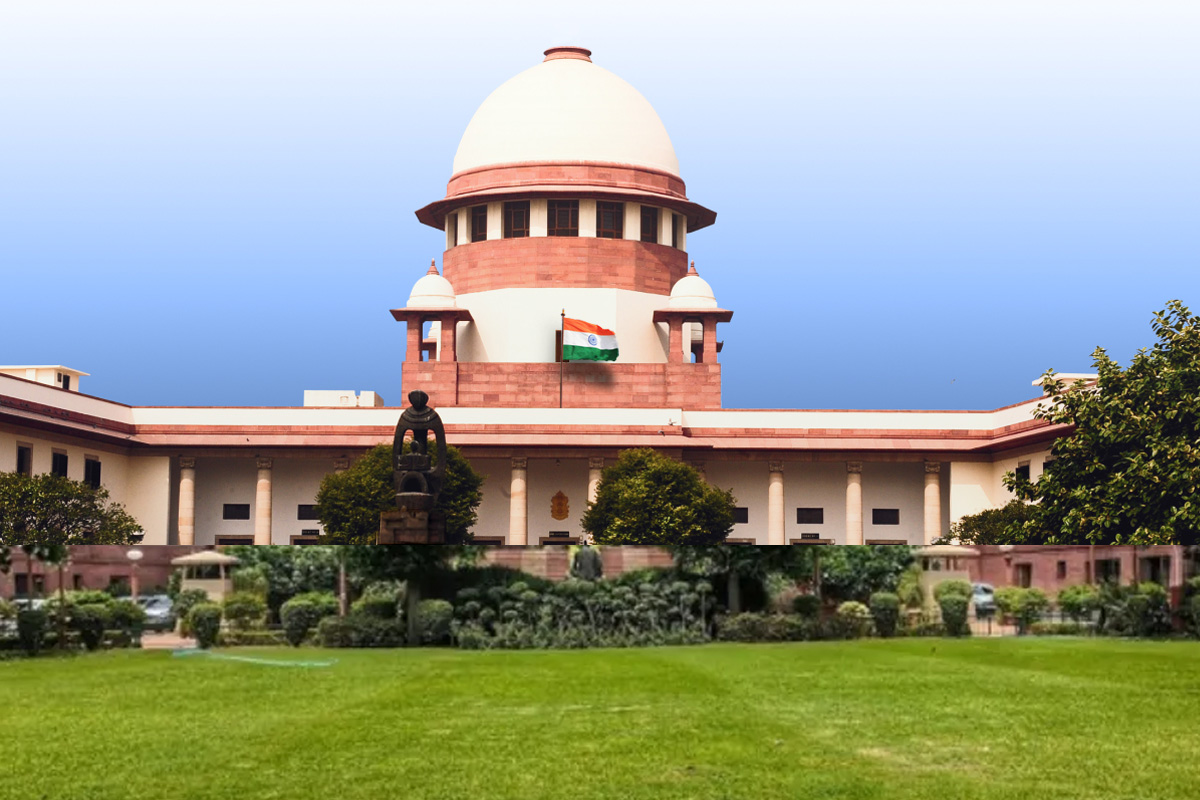
The Bench directed that Metro and rail facilities should function normally unless restrictions were required.

Synopsis: The Supreme Court further sought the Union Government’s response to the writ petition. Carnatic musician TM Krishna contended that the stanzas in question contained explicit references to Hindu deities, including Durga, Lakshmi and Saraswati. He argued that compelling citizens to sing them amounted to compelled religious and ideological affirmation, contrary to the Constitution’s secular character.
The Supreme Court on Tuesday, 22 September, orally observed that a person who does not sing all the stanzas of Vande Mataram for religious reasons will not face penal consequences.
Hearing a writ petition by Carnatic musician TM Krishna, a Bench of Chief Justice Surya Kant, Justice Joymala Bagchi and Justice V Mohana said the court was not within its remit to decide the National Song. The Bench added that the legal principle laid down in the 1986 Bijoe Emmanuel case applies here as well, LiveLaw reported.
Krishna’s petition challenged the constitutional validity of the 2026 amendment to the Prevention of Insults to National Honour Act, 1971, which extended penal protection to the National Song. The petitioner also challenged the Ministry of Home Affairs’ directive to sing the complete six stanzas of the song at official functions.
Also Read: Vande Mataram-150: Mother of Bharat or Mother of Hindu Rashtra?
The Supreme Court further sought the Union Government’s response to the writ petition. Krishna contended that the stanzas in question contained explicit references to Hindu deities, including Durga, Lakshmi and Saraswati. He argued that compelling citizens to sing them amounted to compelled religious and ideological affirmation, contrary to the Constitution’s secular character.
The amended law made it punishable with imprisonment of up to three years, a fine, or both, to intentionally prevent the singing of the National Anthem or National Song, or to disturb an assembly engaged in such singing.
“In consequence and in effect, the Impugned State Action does not merely regulate national protocol or prescribe a uniform code of conduct for public functions. It compels a ceremony of assent to a symbol whose last four stanzas, Stanzas 3 to 6, are expressly devotional, deity-invoking and non-secular,” contended the plea.
Also Read: Karnataka Governor asks CM Shivakumar to reconsider order limiting Vande Mataram rendition
The plea challenged the measures under Articles 14 (equality), 15(1) (protection against discrimination), 19(1)(a) (freedom of speech and expression), 21 (life and personal liberty) and 25(1) (freedom of conscience and religion).
Krishna contended that the criminal penalty makes the issue fundamentally different from a mere protocol governing national functions.
“By mandating the rendition of all six stanzas under penal sanction, the State transforms what is unquestionably a contested historical symbol into a compelled orthodoxy,” the plea submitted.
The petitioner extensively relied on the Supreme Court’s 1986 judgment in Bijoe Emmanuel v. State of Kerala—the judgment protected schoolchildren, who conscientiously declined to sing the National Anthem.
During the hearing, Senior Advocate S Muralidhar, representing Krishna, and Solicitor General (SG) Tushar Mehta had a heated exchange over the use of the word “Naxalite”.
The senior advocate said the government has abruptly changed the understanding of Vande Mataram through an Office Memorandum. The amendment was passed hastily, without building any national consensus, he added.
Responding, the SG commented that “lawmaking cannot be as per Naxalites idea”.
Muralidhar strongly objected to the “Naxalite” remark and demanded that the SG withdraw it, saying such a comment did not befit a law officer. The Solicitor, however, maintained that he was referring to those who were not respecting the law-making process.
Vande Mataram is a poem written by Bankim Chandra Chatterjee in the early 1870s, which was later included in his novel Anandamath.
It was used during the freedom struggle but later also adopted by the right-wing groups as a communal cry to unite Hindus against Muslims during riots and conflicts. This prompted leaders like Mahatma Gandhi and Rabindranath Tagore to suggest the removal of its controversial parts and keep the first two stanzas to be used as the national song.
The leaders also noted that some parts of the poem portray the nation as Goddess Durga, which goes against the religious beliefs of Muslims and Christians—at the advice of Gandhi and Tagore, the Congress under Jawaharlal Nehru decided to use just two stanzas of the song, a decision which the Constituent Assembly upheld in January 1950, when Rajendra Prasad declared it the national song.
However, the RSS and the BJP have long been pushing for the use of Vande Mataram’s full version, with Prime Minister Narendra Modi repeatedly accusing the Congress of demeaning the song and limiting it to two paragraphs to “appease” its Muslim vote bank.
Earlier this year, the Union Home Ministry issued directives requiring schools and government functions to recite the entire song, and said it should be given priority over the national anthem.
When the directive was challenged before the Supreme Court, the court dismissed the petition, saying there was no penalty for failing to follow the instructions, as it was merely advisory. However, the new Bill makes disrupting the singing of the national song an offence punishable with a penalty.
(Edited by Majnu Babu).



