

Published Feb 12, 2026 | 11:00 AM ⚊ Updated Feb 12, 2026 | 11:00 AM

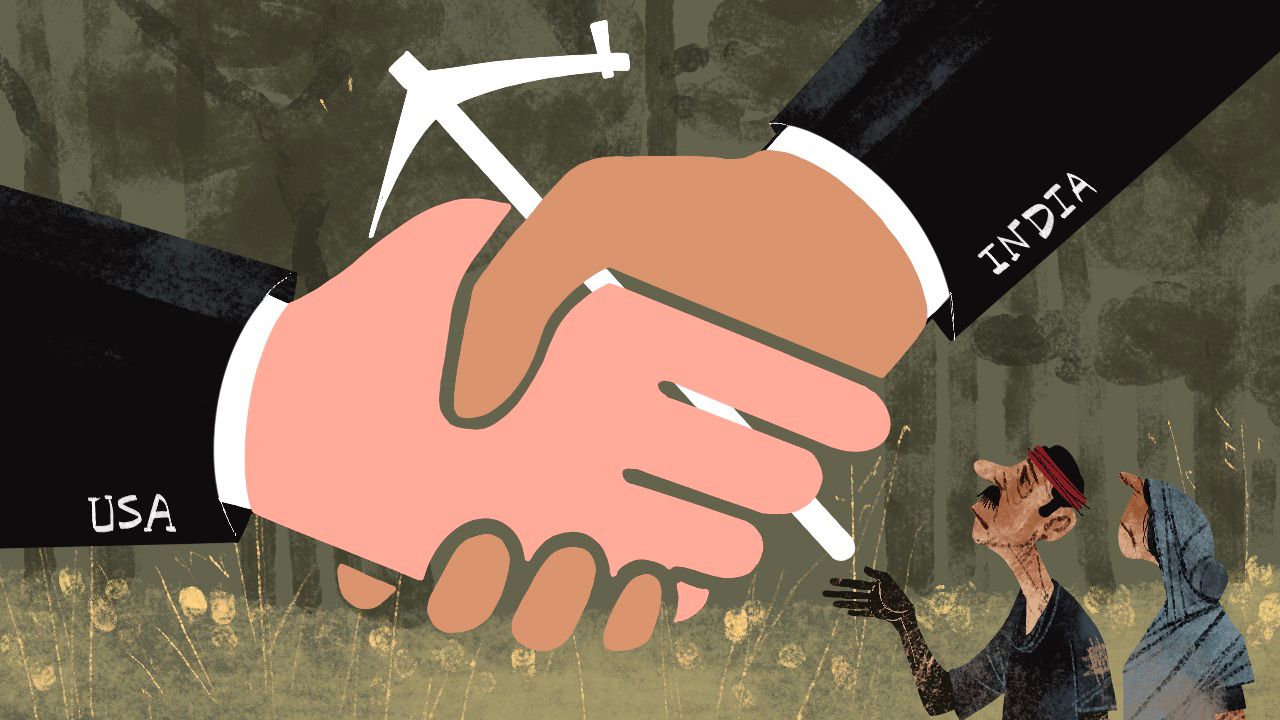
India-US trade deal.
Synopsis: Farmers across India are concerned about the repercussions of the India-US trade deal as they fear that it would affect their lives and livelihoods. Experts and farmers’ representatives said imports from the US would likely decrease the prices of Indian crops, while expressing concerns about India’s food security, citing the chances of importing genetically modified (GM) crops.
Several months after President Donald Trump imposed a 50 percent tariff on Indian goods, a joint statement by India and the US on 6 February said that the tariffs have been reduced to 18 percent.
However, confusion prevails over the deal as neither country has released the full terms of the agreement, and several Indian ministers have been releasing contradictory statements.
The US, in its latest statement, said India will eliminate or reduce tariffs on all US industrial goods and a wide range of US food and agricultural products, including dried distillers’ grains (DDGs), red sorghum, tree nuts, fresh and processed fruit, soybean oil, wine and spirits, and additional products.
In its 6 February release, the US said that it would apply a reciprocal tariff rate of 18 percent on goods originating from India, including textiles and apparel, leather and footwear, plastic and rubber, organic chemicals, home décor, artisanal products, and certain machinery.
Due to the lack of a proper announcement, farmers across India are concerned about its repercussions, as they fear that it would affect their lives and livelihoods.
In a press release on 8 February, Union Minister of Agriculture and Farmers’ Welfare Shivraj Singh Chouhan claimed that many agricultural products of Indian farmers will now be exported to the US with zero tariffs and that American farmers’ agricultural products will not receive this concession in the Indian market.
Experts and farmers’ representatives openly slammed the lack of transparency in the deal and said that it would negatively affect India’s farming sector.
They said that imports from the US would likely decrease the prices of Indian crops, while expressing concerns about India’s food security, citing the chances of importing genetically modified (GM) crops.
Nikhil Dey, founder-member of Mazdoor Kisan Shakti Sangathan, said the biggest issue in the deal is the lack of transparency.
“This is not just about farmers. The biggest issue here is transparency. People were not informed. This is a massive, across-the-board deal — it affects oil, energy, farming, and manufacturing. Every sector has serious implications. The fact that it was done in secrecy, without prior consultation, is both non-transparent and anti-democratic,” he told South First.
Dey said this deal impacts dairy, food grains, animal feed — the entire agricultural chain — and that it will have ripple effects in manufacturing as well.
“From the statements coming from the US, the situation appears alarming. It could have a disastrous impact on the farm sector — perhaps worse than the farm laws — because this is across the board. The US has openly described tariffs as economic leverage, even economic warfare. They are flexing their muscles and claiming victory,” he said.
“No farmers were consulted. When something affects the entire farming community — which employs nearly 60 percent of India’s workforce — it cannot be done behind closed doors,” he added.
“On tariffs, we are hearing conflicting statements. Some products are said to have zero tariffs, others at 18 percent, but there is no official clarity on the exact basket. Statements from different ministries do not match. Even on something as fundamental as oil — are we going to continue buying from Russia or not? — there is no clear answer.”
“Agriculture is not just about food security; it is about self-sufficiency. It ensures that no foreign power can twist our arm. Even with the existing crisis in farming, we have maintained a level of independence. That could now be under threat.”
“It is not only about imports. It is about the corporatisation of agriculture and increasing control by large corporations,” he added.
Speaking to South First, Rajesh Krishnan, a Kerala-based biotechnology-turned-organic farmer and activist, echoed Dey’s views.
“The deal is not yet fully public, and the government is not transparent about the terms. From past experience, such trade deals affect the market and market prices. Free trade agreements like this one should be read alongside recent developments, as they directly impact the availability of essential items in the market,” he said.
Manju Kiran, State Secretary of Karnataka Rajya Raitha Sangha and Hasiru Sene, said only half-truths have been released so far.
“Food is not a tradable commodity. It is the right of every human being, but politicians never seem to care. Whatever they claim now — that agriculture is untouched and farmers are not affected — is a false narrative. The US trade deal is going to have a very big impact,” he told South First.
“They are misleading people and hiding many aspects. We came to know many details only from the joint statements issued by the United States and India. They speak only half the truth.”
“This is going to have a very big impact. The collective leadership of KRRS has been speaking out strongly. Even before the agreement was signed, we were raising awareness. Now that the framework has been signed, people are beginning to talk,” he added.
Meanwhile, Reuters reported that Indian corn and soybean prices fell on Wednesday, 11 February. Soybean and corn prices have fallen by 10 percent and four percent respectively, since the interim framework was announced last week.
Krishnan said there are chances of reduced prices for crops and thereby reduced Minimum Support Prices (MSP), and that this could drive farmers away from cultivating specific crops.
“Low prices will drive farmers away from specific crops, as seen recently with oilseeds. A surge in production and imports has already pushed many away from oilseed farming. The Union government recently asked states to remove the bonus given to rice and wheat farmers, citing excess production and buffer stocks.”
“In Kerala, the MSP for rice procurement is ₹30 per kg, including the bonus. If the bonus is removed, it will drop to ₹23. Even ₹30 is barely profitable. A further reduction will force farmers to shift to other crops,” Krishnan added.
Kiran explained how the deal would affect local farmers, pointing specifically to maize cultivation.
“They are bringing maize through the back door in the form of DDGs — classifying it as fodder. Once classified as fodder, tariffs will likely be waived or kept minimal,” he said.
“We are the fifth-largest corn growers in the world, but rank 14th in exports. Most of our grain is consumed domestically. Opening the gates to such imports will significantly impact Indian farmers.”
“As for MSP, obviously, it will be affected. When foreign grains enter, the price of Indian farmers’ produce will fall. How will the government compensate for those losses? Is it prepared?”
“(Finance Minister) Nirmala Sitharaman never even mentioned MSP or any specific budgetary allocation to address a potential decline in the recent Union Budget,” Kiran added.
Dey also conveyed similar views. “Of course, this will affect MSP. MSP already covers only a limited number of crops, though we have long demanded it for many more. It supports the public distribution system and the entire food security cycle,” he said.
“Once trade is opened up, everything is affected — fertilisers, input costs, crop patterns. There will be ripple effects across the agricultural chain,” he added.
Reuters report noted that corn prices are trading around ₹1,820 per 100 kg, well below the government-set MSP of ₹2,400, as output hits a record high and demand slumps from ethanol producers.
Krishnan, who has been fighting against the introduction of GM crops in India, said the deal would weaken the country’s existing laws.
“The deal could push an inflow of genetically modified crops, starting with seeds. Such agreements may weaken existing laws on GM crops, affecting food security and harming farmers’ interests.”
Expressing concerns, Kiran said, “There was a ban on GM grains entering the country. Now, in the name of fodder, even GM grains may enter. Our cows will consume GM feed, and that milk will be consumed by people.”
“With this agreement, milk from cows fed on meat-based by-products used in Western fodder could enter India in processed forms. The government must answer citizens, especially vegetarians and communities that oppose such practices,” he added.
“There will certainly be pressure to allow GM imports. We have had serious debates about environmental impacts and seed sovereignty. Farmers are not protesting without reason,” said Dey.
Responding to concerns, Chouhan said that in the India-US trade deal, with respect to agriculture and agricultural products, no compromise has been made on the interests of Indian farmers, and no product that could harm farmers has been included in the agreement.
Chouhan said tariffs that were previously up to 50 percent on several agricultural products have now been reduced to zero by the USA, including spices, tea, coffee, coconut, coconut oil, betel nut, cashew, vegetable wax, avocado, banana, guava, mango, kiwi, papaya, pineapple, mushrooms, and some grains as well.
He mentioned in the press release that in the year 2024-25, India’s agricultural exports reached $4.45 billion. There has been an 88 percent increase in spice exports. Now, following this trade deal, our spices will also gain a new and large market in the USA.
Chouhan said all sensitive items have been kept outside the agreement and that no tariff concessions of any kind have been given on products such as soybean, corn, rice, wheat, sugar, coarse grains, poultry, dairy, banana, strawberry, cherry, citrus fruits, green peas, chickpeas, mung beans, oilseeds, ethanol, and tobacco.
He said that the biggest concern was regarding the country’s major grains. “The greatest worry was exactly this — that our major grains must remain secure, and I can proudly say that all of them have been kept completely secure. No doors have been opened for the USA for major grains, major fruits, and dairy products,” he said.
Chouhan noted that many American agricultural products will not be able to enter the Indian market. “Hulled grains, flour, wheat, corn, rice, millet, potato, onion, peas, beans, cucumber, mushrooms, pulses, frozen vegetables, oranges, grapes, lemons, strawberries, and mixed canned vegetables will not come to India,” he said.


