

Published Mar 18, 2026 | 11:37 AM ⚊ Updated Mar 18, 2026 | 11:37 AM

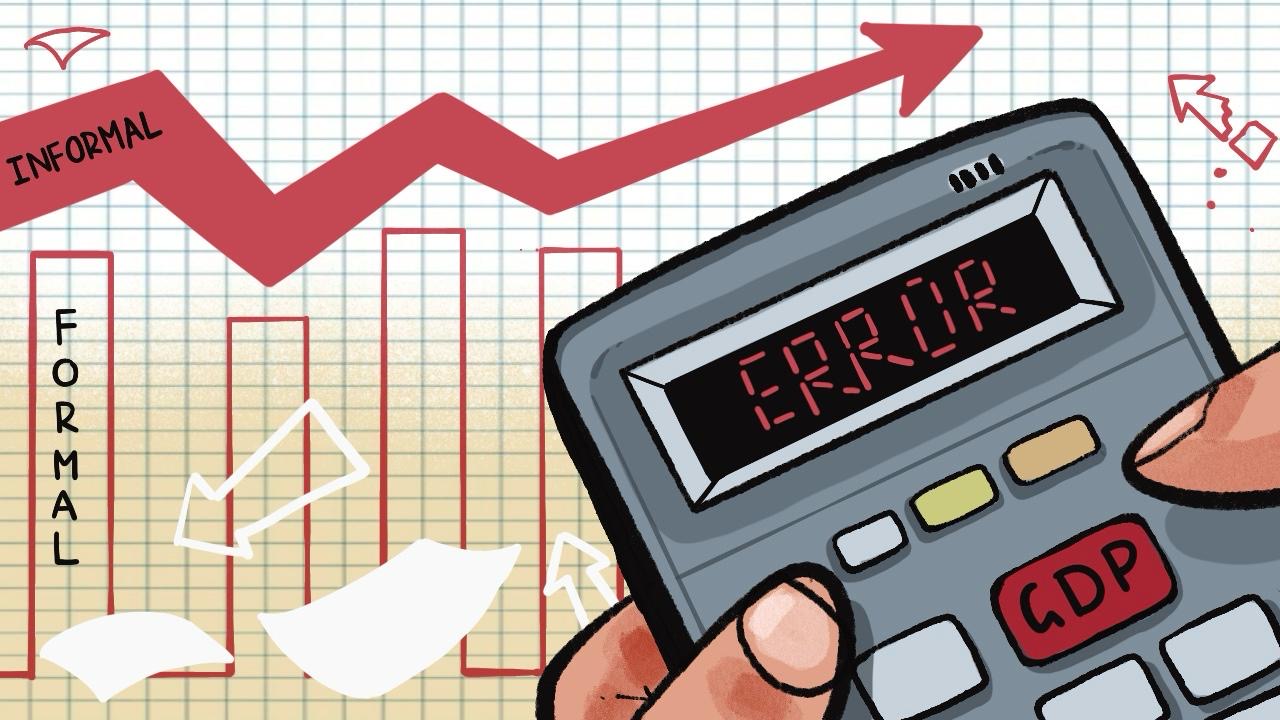
GDP data.
Synopsis: India’s GDP numbers over the past two decades have been misestimated, with growth during 2005–2011 understated and between 2012 and 2023 overstated, according to a new working paper co-authored by Arvind Subramanian, former Chief Economic Adviser to the Union government. It points to the use of formal sector data to estimate the informal economy, and a growing disconnect between GDP and key indicators such as corporate sales, credit and exports.
In April 2025, the International Monetary Fund (IMF) projected India’s GDP for 2025–26 at $4.197 trillion, slightly above Japan’s $4.196 trillion.
Weeks later, BVR Subrahmanyam, then Chief Executive Officer of NITI Aayog, cited this to controversially claim India had “officially” overtaken Japan. However, there was nothing official about the figures.
By October, the IMF revised its outlook: India would still trail Japan in 2026.
Even so, India’s nominal GDP has roughly doubled from ₹125.41 lakh crore ($2.04 trillion) in 2014–15 to ₹330.68 lakh crore ($4.13 trillion) in 2024–25, according to data from the Ministry of Statistics and Programme Implementation.
But a new working paper by the Peterson Institute for International Economics says even these numbers may overstate the economy’s true size and growth.
Co-authored by economist Arvind Subramanian, former Chief Economic Adviser to the Union government, along with economists Abhishek Anand and Josh Felman, the paper presents statistical evidence that India’s growth over the past two decades was misestimated.
The paper traces this to methodological changes introduced in 2015, changes experts have questioned since at least 2016.
Between 2005 and 2011, often seen as the peak of India’s post-1991 reform boom, official data shows average GDP growth of about 6.9 percent.
From 2012 to 2023, the growth was roughly six percent a year.
The paper says growth in the first period was understated by 1–1.5 percentage points on average, but growth in the second period was overstated by about 1.5–2 percentage points.
“It appears that the Indian economy did not grow at a stable rate over the past two decades but rather boomed during the early 2000s,” the authors write.
“We estimate that from 2011 to 2023, the economy actually grew at 4–4.5 percent on average instead of the six percent reported.”
The paper says India still ranks among the faster-growing major economies.
“India has taken considerable pride in the fact that it is among the fastest-growing economies in the world,” the authors write.
“Even with our revised estimates, India remains among the top seven or eight fastest-growing economies.”
The paper says GDP mismeasurement stems from flaws in the methodology introduced in January 2015, mainly “inappropriate data sources and inappropriate deflators”.
“Essentially, it comes down to how national income is measured. You can measure GDP in two ways. One is by counting all the inputs used to produce a good or service. The other is by measuring the final value of that product, which is the market price method,” economist Narendar Pani, Professor and Head of the Inequality and Human Development Programme at the National Institute of Advanced Studies, told South First.
“Before 2015, India used the factor cost method. That approach measures output by surveying inputs used in production. But this relies on extensive surveys, and those surveys are never complete. You do not always capture all inputs, especially in a large, complex economy. When that happens, growth is understated.”
The 2015 methodology mainly shifted to the market price method, which measures GDP using final prices.
“But India has a large unorganised sector, so the problem is where to get reliable data for it,” Prof Pani said. “What happens is that proxies are used from the formal economy. In effect, values from the formal sector are applied to the informal sector. These are approximations, and when used at scale, they tend to overstate growth. That is the central issue.”
The paper says that using the formal sector as a proxy for the much larger informal sector, even though the unorganised sector was hit harder after 2015 by demonetisation, the goods and services tax, and the Covid-19 pandemic, is particularly problematic.
They say concerns over the methodology first arose “when the demonetisation and withdrawal of 86 percent of the country’s currency apparently caused real GDP growth to accelerate to an eye‐popping annual rate of 8.3 percent. They resurfaced in 2019, when a credit crunch caused by a crisis in India’s nonbank financial institutions apparently caused only a minor blip in growth. Then, in June 2025, with private investment and job creation weak but GDP apparently booming, two former officials from the statistical agency expressed concern that ‘something does not add up’.”
From 2015 to the early 2020s, formal sector sales grew by about 10 percent a year, while informal sector sales grew by about 6.8 percent.
“From 2015 onward… sales in the two sectors diverged, with annual nominal growth averaging 10.0 percent in the formal sector and 6.8 percent in the informal sector,” the authors write.
“All things considered, the assumption that the informal sector was doing as well as the formal sector, during a period when it was falling far behind, seems to have inflated the estimates of GDP growth.”
In February this year, the Union government introduced a revised methodology to address these shortcomings.
The paper tests its claim by comparing GDP growth with macroeconomic indicators such as exports, bank credit, the index of industrial production (IIP), electricity consumption, tax revenues and corporate sales.
Before the methodology change, these indicators moved closely with GDP. From 1995 to 2011, under the older national accounts framework, their growth tracked GDP fairly tightly.
“A consistent pattern emerges. The correlation is strong for the 1995–2011 period, when GDP numbers are based on the ‘old’ methodology,” the authors write.
“The correlation… breaks down or weakens when the 2015 methodology is adopted.”
From 2012 onwards, the indicators slowed down dramatically, but official GDP data continues to show relatively strong growth. The gap appears across multiple datasets, not just one sector.
“Almost every indicator posted double-digit growth in the first period and collapsed in the second,” the paper notes.
The divergence is clear in specific years. During the 2016 demonetisation, real corporate sales grew 1.4 percent, but official gross value added growth was eight percent.
In 2019, corporate sales fell 4.5 percent, but gross value added still rose three percent. In 2024, corporate sales grew 2.2 percent, while gross value added was recorded at 6.4 percent.
The paper calls these gaps “particularly striking” cases where “real sales growth” diverged sharply from official gross value added growth.
Taken together, the authors say this shows a consistent pattern: GDP reports strong growth even when broad indicators of activity weaken or stall.
“Economist Robert Solow once famously said that we can see productivity growth everywhere but in the statistics. In India, growth has sometimes been evident nowhere but in the GDP statistics – and occasionally everywhere but in the GDP statistics,” they write.
How growth is measured has direct effects on public finances, according to Prof Pani.
“Taxes are collected on nominal income, not on real income. Real income is calculated after adjusting for inflation, but taxation is based on nominal values,” he said.
A deflator is the price index used to strip out inflation from nominal GDP to estimate real GDP. If it understates price increases, real GDP growth looks stronger than the underlying nominal expansion.
“If the deflator is reduced, you can show higher real growth rates even though the economy is not actually growing that fast,” Prof Pani said.
“Nominal income may not be increasing at the same pace. As a result, the tax base does not expand as quickly as the reported growth numbers suggest. One response has been a gradual shift from direct to indirect taxes.”
In practice, he said, this shifts the burden towards lower-income households, especially when essential goods are taxed.
“GST is essentially an unequal system because it is an indirect tax. Everybody pays it, the poor as well as the rich,” Prof Pani said. “If you are buying a basic commodity, it does not matter whether you are rich or poor. You still pay the same tax.”
The result, according to Prof Pani, has been growing inequality — among the worst in the world.
“Over time, when demand weakens at the lower end, the economy itself becomes increasingly divided. One part of the economy continues to function, but the other side slows down significantly,” he said.
“That generates political pressure, and the response is often through welfare measures — what are currently called guarantees. Various governments are moving in that direction, but these policies are essentially a response to the underlying pattern of growth.”
In 2023, the Monetary Fund downgraded the GDP methodology to a C grade. Prof Pani said the impact is visible in rising capital outflows.
“If you look at net capital inflows — foreign investment into India minus Indian investment abroad — you get a clearer picture,” he said.
“About four years ago, the net inflow was roughly $25 billion. Last year, that figure was less than $1 billion.”
Each year, state and Union governments highlight new foreign direct investment inflow, but Professor Pani said these agreements are often secured through a wide range of incentives.
“We give them land, we give them everything. The pattern is simple: Investors come in, bring large investments, use the concessions available, and then exit relatively quickly,” he said.
“Much of the foreign investment inflow is tied to these concessions. Governments provide large incentives, investors use them, and once those benefits are exhausted, they move out.”
At the same time, Indian firms are investing more abroad. Prof Pani pointed to reports about the Reliance investing in Texas, US, in a new oil refinery.
“That is a large investment and shows capital is also moving abroad,” Prof Pani said. “Indian firms are investing abroad on a large scale, which means domestic capital is also drying up.”


