

Published Jul 23, 2026 | 7:14 PM ⚊ Updated Jul 27, 2026 | 3:14 PM

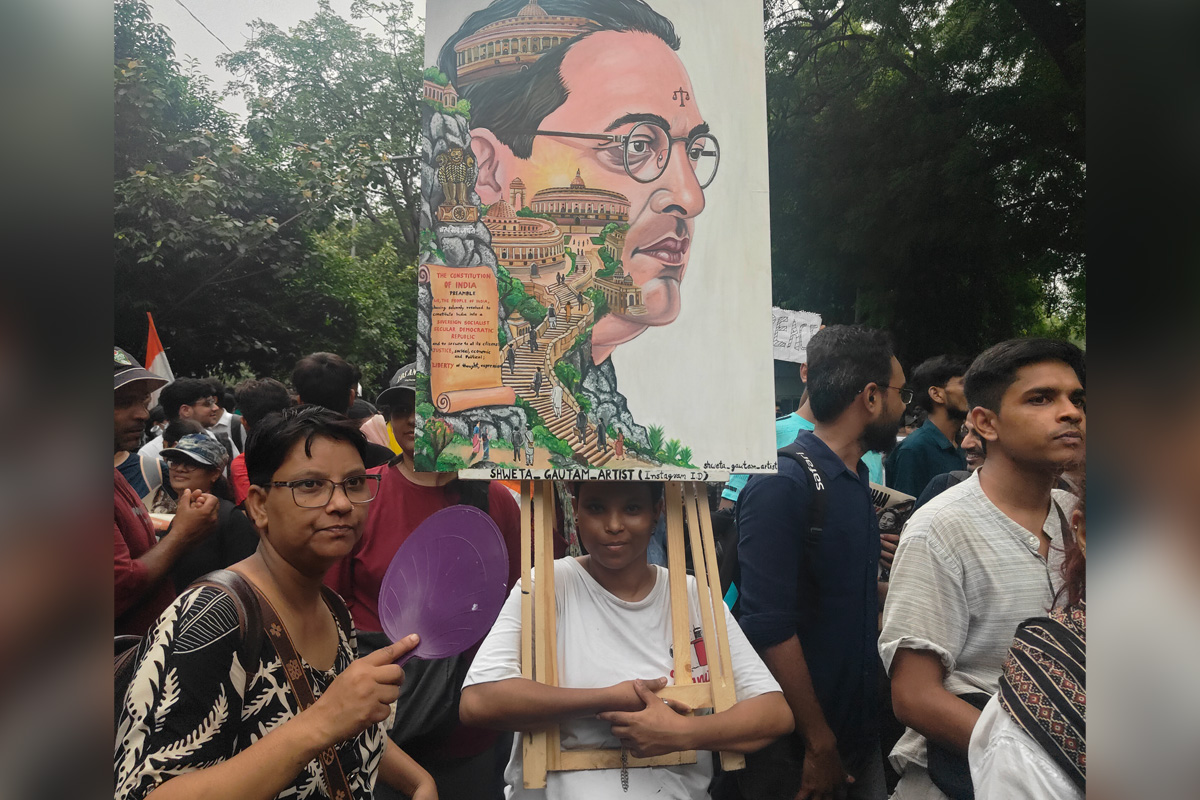
A protester holding a placard during the CJP protest against NEET-UG paper leak. (Photo | Kaushik Raj)

Synopsis: Jantar Mantar, envisaged as an observatory for tracking the movement of celestial bodies, has now transformed into a protest hotspot, facilitating dissent within its limitations.
Jantar Mantar, Delhi’s designated site for democratic dialogue, is bearing witness to a historic moment, a disruption that has been in the making for years now.
Once again, the narrow stretch close to the Parliament has become a platform showcasing the country’s inevitable diversity coming together for a cause and giving life to democracy.
From students to celebrities to the vulnerable and marginalised, people have gathered at the capital city’s protest hotspot, in solidarity with the demands raised by the Cockroach Janta Party, while also carrying their own grievances and finding space to voice them.
As much as Jantar Mantar carries the irony of being a designated site for protest in a democracy, it also bears a legacy of looking past the present, to the future and beyond.
Man (Human) is a “glorious thing made of stardust,” read the suicide note of Dalit student Rohith Vemula, whose death sparked a massive student-led movement in 2016, one of the first major disruptions that rattled the BJP-led central government, just two years after it first assumed power in 2014.
Another student movement, triggered by an allegedly unjust and faulty education system, is now out on the streets, questioning the same government. At the centre of the movement, facilitating what was assumed to be impossible in the current political scenario is Jantar Mantar.
The name Jantar Mantar originates from the Sanskrit words ‘yantra’ and ‘mantrana’, which roughly translates to instruments for calculation.
Jantar Mantar was envisaged and built by Maharaja Sawai Jai Singh II as an observatory for tracking the movement of celestial bodies and the sun in the 18th century. The structure, entirely built of masonry and stones, is an architectural wonder and stands as a stunning reminder of India’s long history of astronomical and scientific explorations.
However, Jantar Mantar was largely neglected during the British era, leading to the dilapidation of several of its astronomical observatories.
The transformation of the site to a protest hotspot happened in the late 20th century.
This came about after the massive farmers’ agitation led by Bharatiya Kisan Union leader Mahendra Singh Tikait in October 1988 at the Boat Club lawns near the India Gate. The Boat Club lawns used to be a major protest destination, even before Independence, owing to its proximity to the Parliament, Rashtrapati Bhavan and the country’s most important ministries. The location of the site left those in power with no choice but to listen to the grievances of the people, fulfilling the purpose of protests in a democracy.
However, five years after the 1988 protests, the then government decided against permitting any demonstration at the site, citing “security concerns” and instead set aside the Jantar Mantar stretch as the new venue, albeit for all the wrong reasons.
Dissent was transposed as protests shifted to Jantar Mantar, where those in power could maintain a safe distance while keeping watch and cracking down on protesters when needed. Though agitations at the Jantar Mantar have been criticised as largely innocuous when compared to protests elsewhere, the site does hold importance as a platform that normalised and celebrated dissent.
The site has hosted several movements that defined and impacted the political trajectory of the country, including the 2011 anti-corruption protests led by activist Anna Hazare, which resulted in the formation of the Aam Aadmi Party (AAP).
The 2023 wrestlers’ protest, demanding action against former Wrestling Federation of India (WFI) president Brij Bhushan Sharan Singh over allegations of sexual assault, was another major agitation that happened at the site.
Jantar Mantar has also felt the reverberations of other major protests, including the 2019 anti-CAA protests and the farmers’ agitation.
Despite the limitations imposed by the current dispensation, Jantar Mantar is now once again defying fear and showcasing resilience as hundreds of students and youth remain at the site, raising important questions and demanding justice, even after allegedly violent attempts to remove them.
What began as part of an attempt to observe and learn from the stars has become a platform that, to an extent, respects the glorious beings that humans are by making our voices heard.
Also Read:
India’s students’ revolt has exposed BJP’s biggest political blind spot
Gen Z protest is not ‘unserious’, it is civil disobedience dismantling Modi’s crafted image
(Edited by R Rajesh Kumar)



