

Published Apr 13, 2026 | 7:00 PM ⚊ Updated Apr 13, 2026 | 7:00 PM

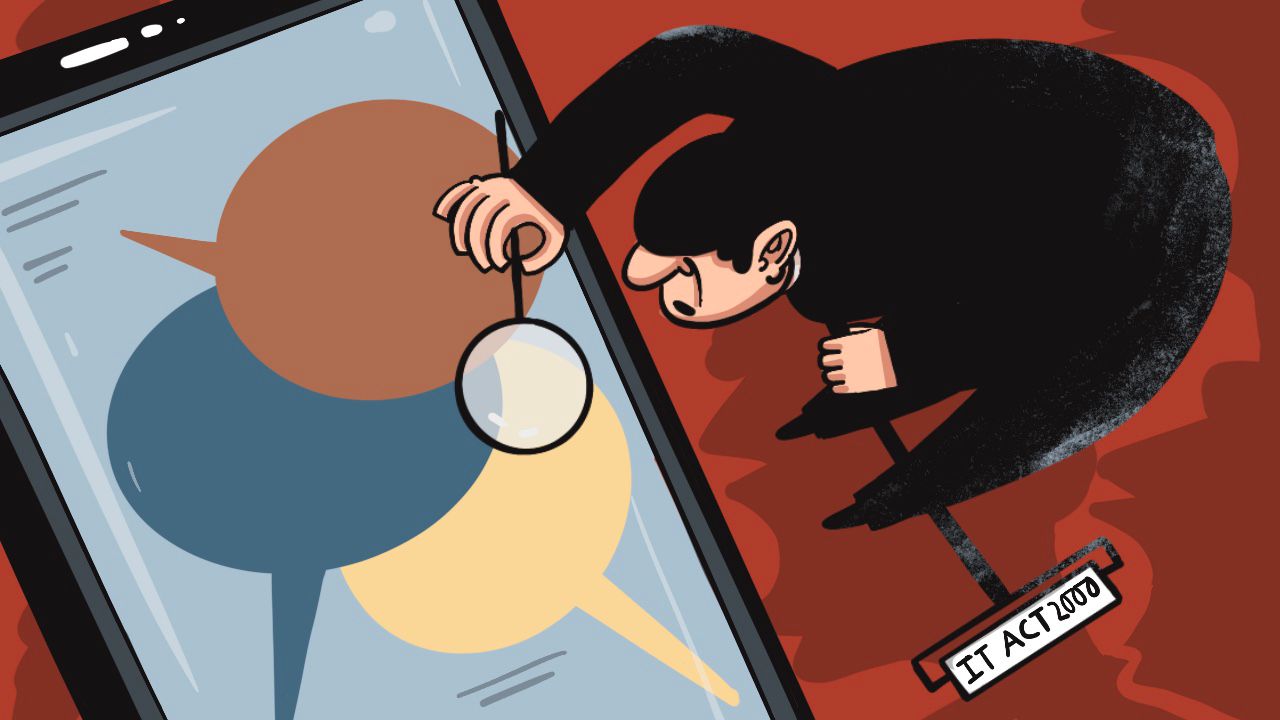
Social media has become an increasing part of young people’s lives in recent times.
Synopsis: For the past few weeks, the Centre has been cracking down on social media posts critical of the ruling dispensation and the Prime Minister using provisions of the Information Technology Act, 2000, prompting concerns over free speech among young people. Students said the takedowns, along with Instagram’s decision to remove end-to-end encryption from direct messages, are alarming for their implications for privacy and free speech.
Using the powers granted under the Information Technology Act, 2000, the central government has recently issued directives to several social media platforms, ordering them to take down numerous posts criticising the Centre and the Prime Minister.
The platforms accepted the directives and took down such posts, thereby making them unavailable in India but accessible in other countries.
While news media outlets, independent journalists and creators commenting on current affairs have been impacted by the government’s takedown orders, younger students have also been affected to an extent in their use of social media.
Speaking to South First, a 20-year-old student said, “The government taking down such posts is highly unjustified because the fact that they are taking down posts only against the government clearly points to an intent to remove any form of dissent. Dissent, however, is a core feature of a democracy.”
Cartoonist Satish Acharya said that on 10 March, he received notifications from X that the Ministry of Electronics and Information Technology had ordered the blocking of two of his cartoons regarding the Prime Minister’s silence on the conflict in West Asia.
In a post on X, he noted, “My experience over the last 15 years on social media teaches me that whenever any govt or politician tries to stop a cartoon by force, that cartoon normally reaches ten times more readers.”
In a similar incident, takedown orders were issued against two of The Wire’s satirical animation videos as well as against the website’s founder, Siddharth Varadarajan’s repost of those videos.
In addition to the government’s takedown orders, Instagram announcing that end-to-end encryption will no longer be available on direct messages between users from 8 May has also added to youngsters’ fears about expressing free speech.
While Instagram justified its move citing child safety and low user adoption of encryption, it has been criticised for invading privacy, with critics arguing that less restrictive measures could ensure child safety.
Social media has become an increasing part of young people’s lives in recent times. Speaking about the government’s takedown orders, Yuvanprabu, 19, a second-year student from Coimbatore, told South First that it is a violation of a person’s fundamental as well as natural right to express opinions, which can be reasonably monitored but not arbitrarily restricted.
Adding to this, Shravan S, 19, a second-year student from Bengaluru, told South First that while there are two sides to the issue, he “leans more towards the freedom of speech side” and does not think it appropriate for the government to issue such takedown orders.
Speaking about the removal of encryption on Instagram, he said that monitoring or having access to conversations between two people is a violation of their privacy and will lead to people not being able to comfortably talk to their peers. He also added that end-to-end encryption should be the default rather than an option, as people would not be comfortable with the possibility of their chats being read by others.
With respect to this, Shravan told South First that the government’s takedown orders as well as the removal of end-to-end encryption would not impact the way he uses social media.
Another 19-year-old second-year student from the city, speaking to South First, drew a parallel with the Karnataka Hate Speech Bill, which has been criticised for infringing on freedom of speech. She said that by resorting to censorship, “the government is giving away valuable input and constructive criticism and it is also showcasing itself as extremely insecure.”
She also noted that end-to-end encryption is a guarantee to users that whatever they share will be protected by Instagram, and its removal creates a sense of insecurity among users, making it difficult to share or discuss anything related to politics.
This view was echoed by a 20-year-old second-year student from the city, who told South First that the government’s takedown orders suppress dissent, which is a “core feature of a democracy,” and that the government has not provided the grounds on which such orders have been issued. She also noted that Instagram’s removal of end-to-end encryption makes it difficult to discuss politics on direct messages.
While the government’s numerous orders have been criticised by young people as a violation of the right to express themselves, it remains unclear whether these actions will hinder the way they use social media.
Even Meta’s move to remove end-to-end encryption on Instagram has been criticised by many young users, though they also said it may become difficult to continue conversations, especially of a political nature, on direct messages.
This raises the question of whether alternative measures can be adopted by Meta and the government to address concerns related to cybersecurity and sedition, respectively.
Yuvanprabu noted that if child safety was the primary concern behind Meta’s move, the company should first focus on filtering content in the public domain, as monitoring such content would be more appropriate than decrypting private messages.
With respect to the government’s takedown orders, a 20-year-old student told South First that less restrictive measures could be used to impose limits on free speech for security purposes “if the country has to continue as a democracy where free speech is given its role as an inalienable feature of democracy.”
(Edited by Dese Gowda)


