

Published Jun 18, 2026 | 12:22 PM ⚊ Updated Jun 18, 2026 | 12:23 PM

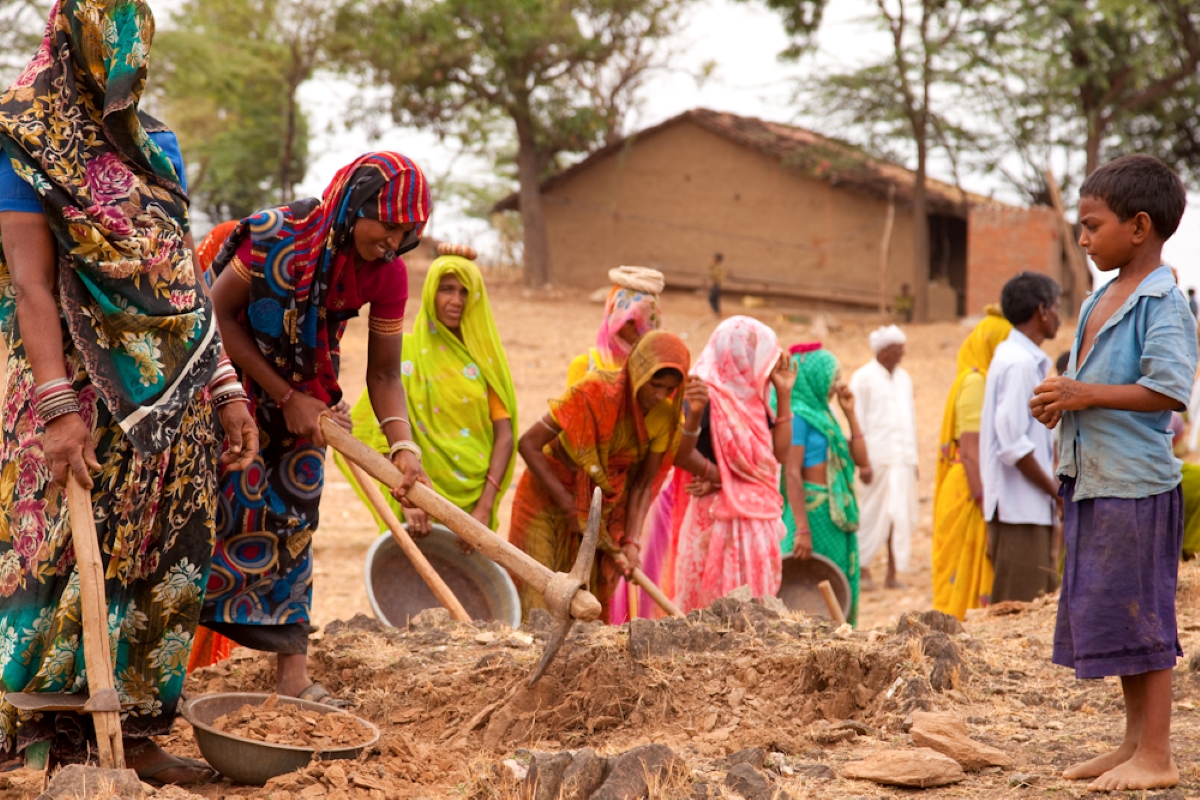
Women engaged in MGNREGA work. (Creative Commons)

Synopsis: The Centre’s proposed 125-day employment guarantee under the VB-GRAMG Act is not financially or administratively viable, according to the NREGA Sangharsh Morcha which said that state allocations are too low to support even existing levels of rural employment. It also flagged a decline in person-days generated across several states, and warned that rural employment opportunities are already shrinking under the new framework.
The NREGA Sangharsh Morcha (NSM) said on Wednesday, 17 June, that the Centre’s promise of an “enhanced” 125-day employment guarantee under the Viksit Bharat–Guarantee for Rozgar and Ajeevika Mission (Gramin) Act, 2025 (VB-GRAMG Act), which replaced the Mahatma Gandhi National Rural Employment Guarantee Act (MGNREGA) last year, is “neither financially backed nor administratively feasible”.
Citing an analysis of Union government data and proposed fund allocations, the organisation said the Centre’s claim that rural employment would be strengthened by increasing the statutory guarantee from 100 to 125 days was not supported by the interim allocations proposed for states.
“The Centre has repeatedly argued that replacing MGNREGA with VB-GRAMG would strengthen rural employment by increasing the statutory guarantee from 100 to 125 days. Yet the proposed interim allocations to states are grossly inadequate to support even the current level of employment generation at 100 days, let alone an expanded guarantee of 125 days,” the organisation said in a statement.
According to the NSM, the number of person-days that can be generated under the proposed allocations falls far short of the promised 125 days for every active Job Card.
“In no major state does the proposed allocation support even half of the promised entitlement. In several states, the allocation would finance barely one-fifth of the claimed guarantee,” it said.
Based on its analysis, Andhra Pradesh would be able to generate only 42.35 person-days per active Job Card, followed by Chhattisgarh (39.07), Bihar (30.94), Uttar Pradesh (27.50), Karnataka (26.44), Madhya Pradesh (25.66), Maharashtra (14.40) and Haryana (13.78).
Also Read: From court to coalition: How can Karnataka sustain its challenge to VB-GRAMG?
The NSM also pointed to a “massive funding gap” between the allocations required to provide 125 days of employment and the funds proposed by the Union government.
According to its estimates, Andhra Pradesh would require an additional ₹9,901 crore to provide 125 days of employment per Job Card. Bihar would require ₹15,939 crore, Karnataka ₹17,481 crore, Uttar Pradesh ₹27,987 crore, Madhya Pradesh ₹20,037 crore, Maharashtra ₹31,013 crore, Rajasthan ₹22,549 crore and Tamil Nadu ₹27,212 crore.
The organisation also said there had been a “substantial decline in employment generation across most states” since the enactment of the VB-GRAMG Act in December 2025.
Comparing data from the first five months of 2025 and 2026, it said person-days generated declined from 25.3 crore to 16.6 crore in January, from 23.3 crore to 15.3 crore in February, from 17.6 crore to 9.4 crore in March, from 23 crore to 12.3 crore in April and from 34.5 crore to 24.3 crore in May.
“The decline is particularly severe in large rural states. Between January and May 2026, states such as Uttar Pradesh, Rajasthan, Karnataka, Madhya Pradesh, Maharashtra, Kerala, Andhra Pradesh and Jharkhand recorded significant reductions in person-days generated compared to the previous year,” the NSM said.
“The data clearly indicates that rural employment opportunities are already contracting under the proposed transition framework,” it added.
The organisation said the government could not claim to be expanding rural employment while reducing the resources needed to sustain it.
“The proposed VB-GRAMG framework, despite promises of an expanded guarantee, appears to rely on allocations that are insufficient even to sustain current employment levels. An employment guarantee without adequate funding is not a guarantee at all,” it said.
Also Read: Global academics pen an open letter opposing the repeal of MGNREGA
The organisation also raised concerns about the draft VB-GRAMG Rules, saying they did not guarantee payment of statutory minimum wages to workers.
Calling the omission “equally troubling”, the NSM said the draft rules remained silent on wage rates despite replacing an existing national employment guarantee framework.
“This omission comes at a time when workers across the country have spontaneously organised themselves to demand better wages and more dignified working conditions,” it said.
“If the government truly intended VB-GRAMG to strengthen workers’ rights, it had a clear opportunity to explicitly guarantee payment of statutory minimum wages in the draft rules,” it added.
The organisation also criticised the continued reliance on digital monitoring systems. It said NREGA workers had, over the past three years, repeatedly documented and protested failures of the National Mobile Monitoring System (NMMS), including attendance losses caused by app crashes, biometric and facial recognition errors, unannounced software updates, connectivity failures and the denial of wages despite workers reporting for duty.
According to the organisation, testimonies from Rajasthan, Bihar, Uttar Pradesh and other states showed workers losing workdays and wages because of technological failures beyond their control.
“When students and parents used social media and public platforms to expose digital infrastructure failures that disrupted CBSE examination results, the government was compelled to respond. NREGA workers, by contrast, have raised concerns through protests, public hearings and Parliamentary Standing Committees, yet these problems have largely been denied or dismissed,” it said.
“Instead of addressing these failures, the draft VB-GRAMG Rules appear to institutionalise many of these digital requirements. It is difficult to avoid the conclusion that the responsiveness of public institutions varies depending on whose voices are affected and whose grievances are heard,” it added.
The organisation called on the Central government to immediately repeal the VB-GRAMG Act and restore a strengthened MGNREGA framework, ensure payment of statutory minimum wages, and remove NMMS, facial and biometric authentication requirements, and discretionary direct benefit transfer (DBT) guidelines.
(Edited by Dese Gowda)



