

Published Mar 27, 2026 | 8:00 AM ⚊ Updated Mar 27, 2026 | 8:00 AM


Kerala Chief Minister Pinarayi Vijayan, LoP VD Satheesan (Facebook)
The “deal” narrative in Kerala’s election season is back.
It has now slipped out of rally grounds and television studios and settled, quite comfortably, into Facebook timelines and WhatsApp forwards.
What began as a familiar CPI(M) versus Congress slugfest over alleged backroom understandings with the BJP has, over the past few days, taken a more curious turn — senior leaders rummaging through political memory, dusting off old photographs, half-forgotten meetings, and long-denied encounters.
It began, as these things often do, with specific seats.
Palakkad quickly emerged as the showpiece.
The Congress claims the CPI(M)’s decision to back an independent candidate, NMR Razak, is not accidental — that it is calibrated to slice into minority votes that usually consolidate behind the UDF, thereby easing the path for the BJP. The CPI(M), predictably, has dismissed this as nervous speculation, while the BJP has called it outright panic.
But Palakkad, Congress leaders insist, is only the surface.
They point to Ettumanoor, where the BJP’s new ally Twenty20 fielded candidates who, awkwardly, didn’t even figure on the voters’ list. That, they argue, is not incompetence but design — part of a broader understanding to influence outcomes in tightly contested seats. According to them, similar “arrangements” are in play in at least 10 constituencies where the UDF senses an advantage.
From the CPI(M)’s side, the counter is just as sweeping.
Chief Minister Pinarayi Vijayan has alleged that the Congress and BJP have, at different points, entered into tacit understandings — particularly in local body polls and earlier Assembly elections.
Congress leaders, however, flip that narrative. They argue that Vijayan’s persistent attacks on Rahul Gandhi and his relative restraint in criticising Prime Minister Narendra Modi hint at something deeper.
Ramesh Chennithala has gone further, alleging an “understanding” involving Vijayan, Modi, and Amit Shah to weaken the UDF’s prospects in the State.
At the centre of the latest round is Chief Minister Pinarayi Vijayan’s Facebook post on 26 March, which reads less like a routine rebuttal and more like a pointed archival query.
His target: Opposition Leader VD Satheesan.
The question: what exactly happened in Paravur, Satheesan’s constituency, in 2006?
Vijayan has asked Satheesan to explain his presence at an RSS-linked event marking MS Golwalkar’s birth centenary, where, according to the Chief Minister, the Congress leader lit a ceremonial lamp and paid respects.
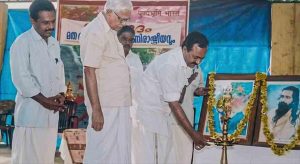
A photograph shared by Pinarayi Vijayan showing V D Satheesan at an alleged RSS event
The timing, Vijayan underlined, was just before the Assembly election that year — a detail he clearly doesn’t consider incidental.
He also revived an older claim, aired by a Hindu Aikya Vedi leader in 2022, that Satheesan had sought RSS backing in both 2001 and 2006.
The insinuation is obvious, even if not explicitly stated: was that Paravur appearance political outreach dressed up as courtesy?
Satheesan, for his part, did not merely deny.
He counter-attacked — and how.
His response reads like a catalogue of CPI(M)’s alleged flirtations with the Sangh Parivar over decades.
If Vijayan went digging into 2006, Satheesan went all the way back to 1977.
He claimed it was Vijayan, not him, who benefited from RSS support in an Assembly election, invoking the Uduma contest and dragging in names like KG Marar, former state president of the BJP.
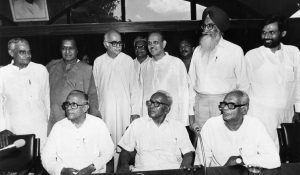
A photograph shared by V D Satheesan showing Communist stalwarts EMS Namboodiripad and Jyoti Basu with BJP leaders, including Atal Bihari Vajpayee
From there, the list grew longer and sharper.
Photographs of EMS Namboodiripad and Jyoti Basu alongside LK Advani and Atal Bihari Vajpayee during the VP Singh era soon surfaced.
So were campaign episodes, alleged meetings, and even informal interactions — from Mascot Hotel whispers to Delhi breakfast diplomacy with Union ministers.
Some of the accusations were familiar, recycled from past political exchanges.
Others felt more like political folklore — stories that surface every election season, acquire new embellishments, and then retreat again.
But Satheesan’s broader argument was clear: the CPI(M), he suggested, cannot claim ideological purity while selectively forgetting its own history.
Meanwhile, on the ground, the “deal” accusation continues to shape campaign rhetoric in key constituencies.
Senior Congress leaders have expanded the charge, pointing to multiple constituencies and even dragging in newer NDA allies like Twenty20.
The CPI(M) has responded by widening the lens — accusing the Congress of indirectly helping the BJP in elections outside Kerala, from Delhi to Haryana.
For voters, it’s becoming a bit of a déjà vu.
Every election brings its own “secret deal” theory.
This time, the difference is the medium. The battleground is as much digital as physical. Old images circulate faster than speeches. Half-answers linger longer than clarifications.


