

Published Sep 17, 2026 | 11:07 AM ⚊ Updated Sep 17, 2026 | 11:07 AM

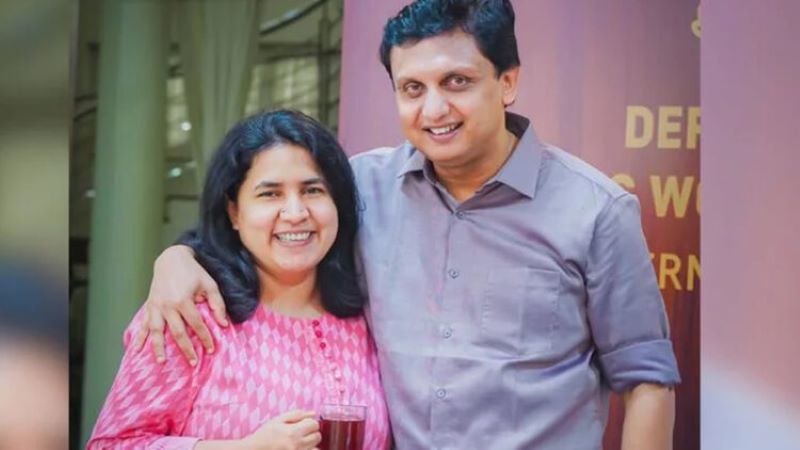
Veena with her husband and former minister Muhammed Riyas.

In Keralam, political trouble does not always arrive in the form of a leaked audio clip, a video or a confidential government file.
Sometimes, it comes as a notebook — filled with hurried handwriting, initials and numbers that may have meant one thing to the writer and something altogether different to investigators years later.
The curious thing about these scribblings is their ability to grow.
A name becomes an allegation, an initial becomes a political identity, a payment becomes a possible payoff and, before anyone has finished deciphering the handwriting, Keralam is already debating the contents as if they were a balance sheet of guilt.
Also Read: CMRL-Exalogic case: ED letter puts Riyas, Veena under fresh scrutiny
The state has seen this script before — in the diary associated with abkari businessman Chandran alias Manichan after the Kalluvathukkal hooch tragedy in 2000.
The Kalluvathukkal tragedy killed at least 31 people and left hundreds injured, some blinded, after spurious liquor mixed with methanol was consumed in October 2000. During the investigations, a diary/notebook recovered from Manichan became an important piece of the wider controversy over alleged monthly payments, or masappadi.
Names of politicians, police and Excise officials reportedly appeared in the records.
Around 20 people were booked.
Before the VP Mohankumar Commission, several of those named admitted receiving money but maintained that the payments were for party funds or election-related purposes. The commission did not accept that explanation and recommended action.
A Vigilance probe followed, but the political consequences proved rather less durable than the headlines.
The notebook had done its job, politically speaking.
It had turned handwriting into evidence, evidence into allegations and allegations into a full-blown political storm. What it could not do was automatically translate every entry into a conviction.
Also Read: ED conducts third round of raids in CMRL-Exalogic case involving T Veena
Nearly two decades later, another set of scribblings entered Kerala’s political vocabulary.
The latest controversy centres on handwritten notes described as a ‘Red Book’, linked to the Exalogic investigation involving T Veena, daughter of Pinarayi Vijayan.
Income Tax searches connected to Cochin Minerals and Rutile Limited (CMRL) brought out records containing initials alongside payment entries.
Statements attributed to former CMRL CFO KS Suresh Kumar interpreted initials such as PV, OC, RC and KK as references to Pinarayi Vijayan, Oommen Chandy, Ramesh Chennithala and PK Kunhalikutty respectively. Other names were also linked to entries.
The allegations were that the payments formed part of a wider system of spending to secure business advantages. Some leaders named in connection with the records acknowledged receiving money but described it as party contributions.
Pinarayi Vijayan denied that ‘PV’ referred to him.
Again, the notebook became bigger than the notebook itself.
It’s learnt that in ED’s communication to the Kerala State Police Chief, the agency has treated entries in the notebook, including handwritten figures and details of money transactions, as material pointing to alleged hawala transfers to Dubai involving Veena and her husband, CPI(M) leader PA Mohamed Riyas.
The agency’s interpretation of the scribblings has, however, been strongly disputed by Riyas.
Speaking to reporters in Kozhikode on 15 September, Riyas rejected reports that Veena had admitted to hawala transactions before the ED. He alleged that such reports were part of an attempt to discredit his wife.
Riyas also offered a different explanation for the handwritten entries seized by the agency. He said the notes were connected to a business venture Veena had been planning and were not records of hawala transactions.
That leaves the familiar question: what exactly did the person who wrote the scribblings mean?
For the ED, the entries form part of the material it is examining in the CMRL-linked case. For Riyas, they are being given a meaning they do not have.
And for now, the ‘red book’ sits at the centre of two sharply different readings — one by the investigating agency and another by the person defending its contents.
There is an irony here.
In an age of encrypted messages, digital payments and electronic records, the most politically explosive evidence can still be a line in a notebook or diary.
But a scribble is not self-explanatory. An initial is not automatically an identification. A payment entry is not, by itself, proof of a bribe.
Its meaning depends on who wrote it, why it was written, what other evidence supports it and, ultimately, what a court makes of it.



