

Published Feb 14, 2026 | 7:00 AM ⚊ Updated Feb 14, 2026 | 7:00 AM

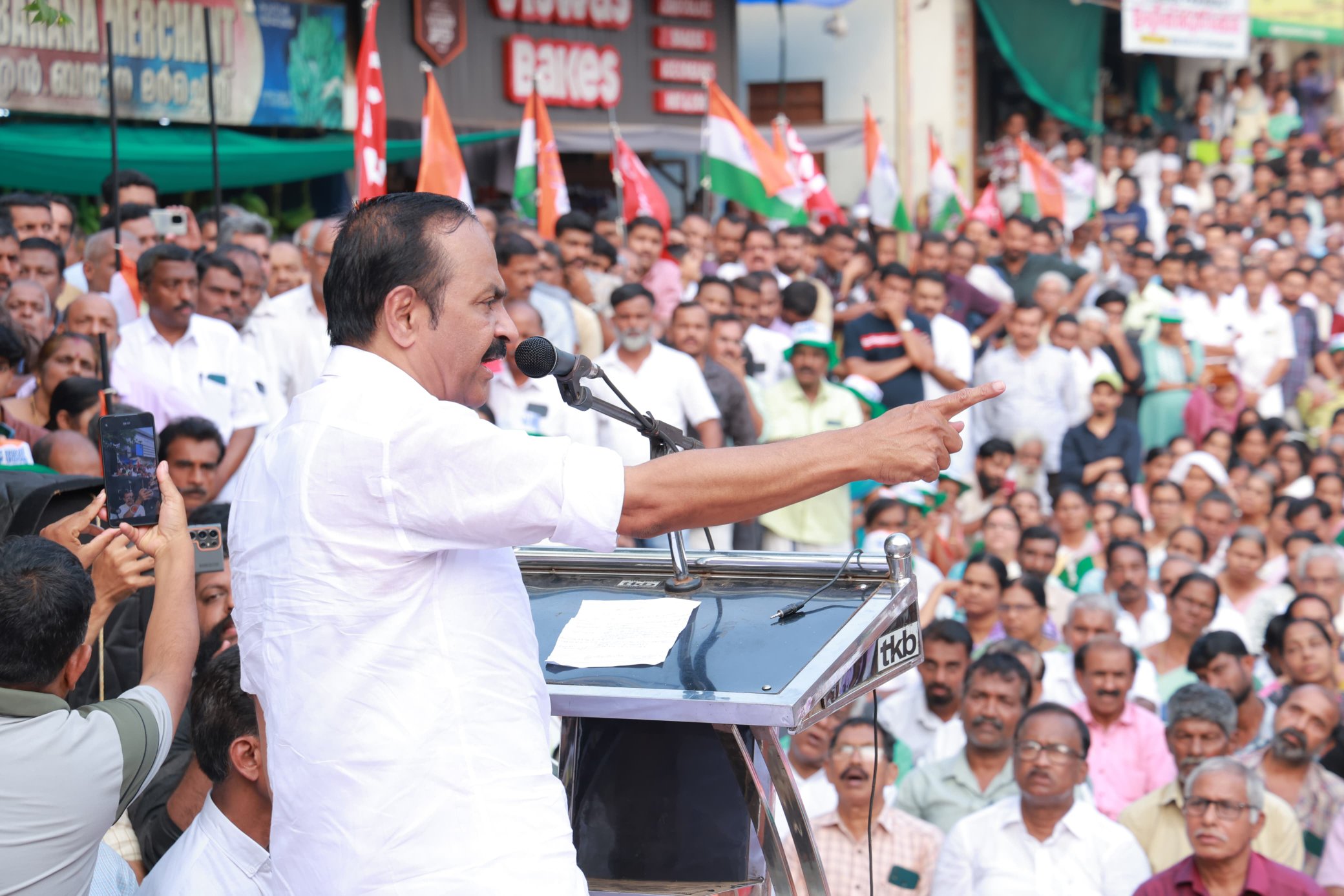
VD Satheesan addressing a meeting in Kannur as part of the Puthuyuga Yatra.
The Congress party in poll-bound Kerala is facing a problem of plenty.
Unlike previous years, the party has more than two candidates, who could become the chief minister if the UDF that it heads emerges victorious in the Assembly polls expected in April-May.
For now, the party seems to be projecting — albeit unofficially — VD Satheesan, the Opposition Leader, as its chief ministerial candidate. Satheesan is currently undertaking the Front’s Puthuyuga Yatra — or the New Age Rally — across the state.
Interestingly, a survey that poll strategist Sunil Kanugolu conducted came out in support of Satheesan. The Opposition Leader has emerged as the most popular contender among party workers and voters, leaving party veterans Ramesh Chennithala, KC Venugopal, Shashi Tharoor and K Muraleedharan behind.
The Puthuyuga Yatra provided its own share of entertainment with what seemed like a scuffle a few days ago at Kuttiyadi in Kozhikode. The presiding local leader forgot to invite the local MP, Shafi Parambil, to speak before Satheesan, which led to the expected ‘show’, which many interpreted as factionalism, something often said to be so aligned with the Congress party.
Parambil refused to speak, but the local leader insisted, and braved efforts by others, including the MP, to physically restrain him. He announced the MP’s name, who took the microphone and expressed his unwillingness to speak.
Though his expression was devoid of any signs of dissidence, political pundits noted the incident with interest.
Still, Parambil delivered a single-line speech, which was accepted with thunderous applause. “When you count beyond a hundred, make sure to count Kuttiyadi as well,” he said.
The reference was to Satheesan’s claim that the UDF would win 100 seats in the upcoming Assembly election. Parambil took it further beyond the three-digit mark.
Meanwhile, in a bid to streamline election preparations, the Congress recently announced the formation of two critical committees. Chennithala has been appointed chairman, and Tharoor co-chairman of the campaign committee, with Parambil serving as its convener.
Other members include Hibi Eden, Roji M John, CR Mahesh, Mathew Kuzhalnadan, Ramya Haridas, M Liju, and Deepthi Mary Varghese.
Meanwhile, the manifesto committee is headed by Benny Behanan, with Kodikkunnil Suresh as co-chairman. Dean Kuriakose and Jebi Mather, too, are on the committee.
Notably, Satheesan is absent from both committees. Instead, he is spearheading the Puthuyuga Yatra, following his previous Malayora Samara Yatra last year.
While the committees will handle campaign messaging and manifesto drafting, Satheesan’s role as the ”public face” of the party during the outreach yatra highlights the internal bifurcation of responsibilities—and perhaps a subtle message from the high command.
Congress insiders are closely watching the party’s internal survey conducted by Kanugolu.
The survey, aimed at gauging public perception on candidate selection and preferred chief ministerial candidates, included 12 questions covering issues such as incumbency fatigue, preferred candidates for each Assembly constituency, and whether Congress should pre-announce its chief ministerial candidate.
Yet, beyond the survey and stage mishaps, the real story lies in the intense jockeying among Congress leaders, which is being heavily influenced by caste equations.
For the first time in decades, the party faces a ”problem of plenty” in selecting a chief ministerial candidate. Unlike previous eras where leaders like K Karunakaran, AK Antony, and Oommen Chandy were uncontested due to seniority and political dominance, today’s Congress sees multiple strong contenders.
Interestingly, all current front-runners belong to the Nair community—a fact that has prompted speculation about an unofficial ”Nair reservation” for the next Congress CM in Kerala.
Historically, Congress has rarely allowed leaders from communities outside the upper Hindu castes to ascend to the top post. Even K Sudhakaran, the former KPCC president, is largely excluded from the chief ministerial race, ostensibly due to caste considerations.
This caste-based competition is further intensified by party workers’ alignment with community networks. Chennithala, for example, is consolidating support among the NSS, SNDP, and Muslim League, the very constituencies that once bolstered Karunakaran’s strength.
Meanwhile, Congress’s Dalit leadership appears sidelined.
Kodikkunnil Suresh, the party’s longest-serving MP and a former Union Minister, is chief whip in the Lok Sabha and a member of the Congress Working Committee. Pandalam Sudhakaran, another senior Dalit leader, has been pushed to the margins.


