


Published Feb 11, 2026 | 3:51 PM ⚊ Updated Feb 11, 2026 | 3:51 PM

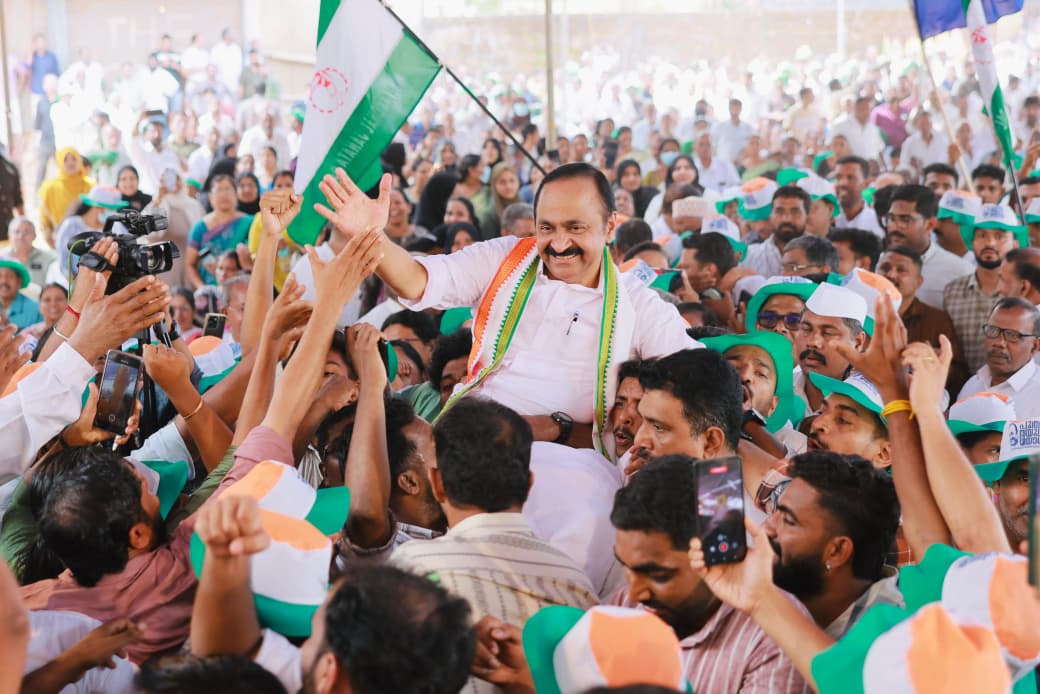
Congress workers welcoming Opposition Leader VD Satheesan, leading the Puthuyuga Yatra, in Kannur. (X)
Candidate selection in the Congress has never been a routine organisational exercise. It is closer to a high-wire act—one wobble, and the fall can be spectacular.
The variables are many: winnability sits at the centre, but tugging at it from all sides are community equations, religious balance, factional claims, local leadership egos and, not least, personal chemistry.
This time around, the Kerala unit of the party insists it has learned its lessons. Compared to previous elections, there is visible clarity and a stricter framework.
So far, so good. But the headaches have only begun.
Even as the Congress struggles to finalise a delicate seat-sharing arrangement within the UDF—while accommodating newly joined associates like the Trinamool Congress (Kerala unit) led by PV Anvar and the Janadhipathya Rashtriya Party led by CK Janu—the party has run into a familiar jigsaw puzzle: should sitting MPs be allowed to contest Assembly elections?
The question is not new. Five years ago, on the eve of the 2021 Assembly polls, the AICC was trapped in the same dilemma.
Then, the central leadership slammed the door shut on MPs seeking a return to state politics, terrified that resignations would trigger a chain of Lok Sabha by-elections and weaken the party nationally.
That call, in hindsight, did not age well.
After storming Kerala in the 2019 Lok Sabha polls by winning 19 out of 20 seats, the Congress-led UDF failed to translate that surge into Assembly success.
The only exception—K Muraleedharan being fielded from Nemom to block the BJP—ended in an electoral misfire. Muraleedharan, who won from Vadakara to the Lok Sabha, was fielded at Nemom and ended up in the third slot.
Now, history seems eager to repeat itself.
Former KPCC president K Sudhakaran has openly expressed his desire to return to state politics.
“If the party asks, I will contest—and I hope it does,” he declared, carefully leaving the ball in the high command’s court.
KPCC confirmed that several MPs had expressed interest, though he stressed that the decision rested entirely with the party leadership.
Alongside Sudhakaran, Attingal MP Adoor Prakash, Kozhikode MP MK Raghavan and Vadakara MP Shafi Parambil are among those keen on Assembly tickets.
For many senior leaders, the national stage has become too centralised, dulling their local influence.
Their argument is simple: lost bastions can only be reclaimed with leaders who still command grassroots loyalty.
Echoing that sentiment, senior Congress leader Kodikunnil Suresh argued that deploying experienced MPs might be justified if it improves the UDF’s strike rate.
Victory, he insisted, must trump personal ambition.
The AICC, however, sees the flipside.
Letting MPs flood the Assembly battlefield could overcrowd the already sensitive Chief Ministerial race, potentially igniting turf wars involving VD Satheesan and Ramesh Chennithala.
Breaking from its earlier rigidity, the Congress has quietly relaxed its no-MP rule.
Based on a report by election strategist Sunil Kanugolu—and after discussions with Rahul Gandhi—the AICC is said to have cleared exemptions for three MPs: K Sudhakaran, MK Raghavan and Adoor Prakash — as of now.
Sudhakaran is set to contest from Kannur, Raghavan from Kozhikode North and Prakash from Konni.
The rationale: political survival demands selective risks.
But every exemption comes with baggage.
It’s said preparations have already begun to identify candidates capable of holding these Lok Sabha seats in the inevitable by-elections—a challenge significant enough to block similar clearances for others.
Not everyone is convinced.
During interactions with the screening committee led by Madhusudan Mistry, several leaders warned that fielding MPs could send the wrong message to voters.
Others demanded deeper consultations to gauge ground sentiment.
Meanwhile, the high command has laid down strict rules: sitting MLAs get a free pass, near-winners from last time get preference, and lobbying is strictly forbidden.
Unity, merit and winnability are the official mantra.
Adding to the unease, two MPs—Prakash and Anto Antony—now face allegations ranging from association with the Sabarimala gold theft accused to financial fraud cases under the ED’s scanner.
As the Congress sharpens its candidate lists and prepares to take the fight to the Left, one thing is clear: in Kerala politics, even a calculated step can feel like walking on a wire—with the crowd watching, and the net nowhere in sight.


