

Published May 13, 2026 | 11:27 AM ⚊ Updated May 13, 2026 | 2:13 PM

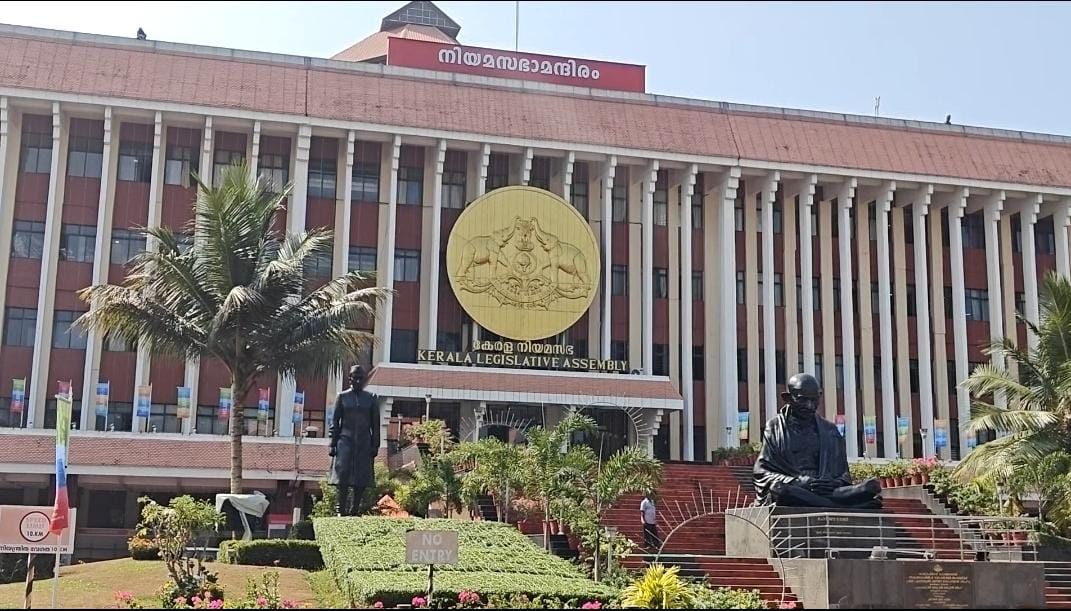
Kerala Legislative Assembly.

Eight days after the Assembly verdict handed the Congress-led UDF a comfortable return to power, Kerala still has what can best be described as a “government under construction”.
The numbers are clear, the mandate is decisive, but the chair at the top remains officially vacant.
And in the long vacuum between election victory and oath-taking, the result is a state functioning in slow motion.
Inside government offices, files move cautiously, officers avoid risk, and secretaries prefer silence over signatures.
Outside those same offices, however, another machinery is humming efficiently: lobbying.
The capital is now witnessing the traditional post-election migration season.
IAS officers are seeking “administratively important” departments.
IPS officers are rediscovering interest in intelligence, vigilance and city policing.
Retired bureaucrats are reappearing with renewed public spirit.
Aspirants for ministerial staff positions are polishing biodata. Political loyalists are circulating résumés for chairmanships of boards, corporations and academies.
In Kerala politics, governments may change once every five years. But the competition for chairs begins on counting day itself.
Also Read: 41+10 MLAs-elect pick Venugopal as Kerala CM; so what is Congress’ hold up?
Though the election code of conduct ended days ago, the administration continues to behave as if the Election Commission might walk in at any moment.
Departments are carrying out only routine work.
Major policy decisions are effectively frozen. Secretaries are unwilling to approve anything that may later invite political scrutiny from the incoming ministers. In several departments, even transfers are stuck midway between proposal and implementation.
The paralysis is most visible in the education sector and police department.
Police reshuffling, usually completed soon after elections, remains pending.
Officers who were temporarily shifted during poll duty continue in limbo. Minor district-level adjustments attempted in some places reportedly triggered protests and were quietly rolled back. The unofficial message circulating through police headquarters is simple: wait for the new government.
In departments such as Revenue, Health, Cooperation and Technical Education, “administrative convenience” transfers have happened in bits and pieces. Nobody seriously believes they are merely administrative.
Officials transferred during the previous regime are themselves reluctant to take bold decisions, anticipating another reshuffle once ministers occupy their cabins.
Kerala’s bureaucracy has seen enough political transitions to understand one unwritten rule: do not unpack too quickly.
Meanwhile, real governance issues are beginning to surface beneath the political suspense.
Schools are scheduled to reopen soon, but textbook distribution has not progressed at the expected pace.
Files needing ministerial or Finance Department intervention remain stuck in procedural traffic.
Promotions in several departments are also delayed because senior officers are unwilling to clear decisions without political approval.
The absence of some directors and secretaries, who are currently on leave, has added to the confusion.
The irony is difficult to miss.
Kerala has a caretaker government, fully functioning departments and an experienced bureaucracy.
Yet the absence of political leadership has created a system where everybody is technically in charge and practically unwilling to act.
Also Read: KC vs VDS vs RC: Congress in dilemma as Kerala leadership puzzle enters final leg
The uncertainty has now spilled into one of Kerala’s most sensitive annual events: SSLC results.
The outgoing General Education Minister had earlier announced that results would be published this week.
The processing is complete, valuation is over, and the examination board is expected to grant approval. Officials insist the results are ready.
But the unresolved question is now almost philosophical: who will announce them?
Teachers’ organisations are alarmed that delay or confusion could damage the state’s public education reputation and affect Plus One admissions. They point out, not without sarcasm, that CBSE and ICSE students already know their futures while Kerala students continue refreshing news portals waiting for political clarity.
Teacher unions have argued that the General Education Secretary and Director can formally announce the results, just as senior officials did during an earlier election-period delay in 2019.
In a state where exam-result day carries the emotional weight of a festival, postponement caused by political indecision would be a particularly Kerala-style embarrassment.
If governance is paused, cultural politics certainly is not.
Even before the new ministry takes oath, discussions have intensified over who will head Kerala’s vast network of cultural institutions.
The change of government has triggered expectation, anxiety and silent campaigning across the arts and literary establishment.
Only a few appointees from the previous regime have resigned voluntarily so far.
Others appear willing to wait until they are politely — or impolitely — removed.
Behind closed doors, conversations are already underway regarding appointments to institutions such as the Kerala Sahitya Akademi, Kerala Sangeetha Nataka Akademi, Kerala State Chalachitra Academy, Kerala Kalamandalam and Malayalam Mission, among many others.
Writers, filmmakers, television personalities and Congress-aligned cultural figures are all being discussed for various posts.
Some veterans from earlier UDF eras are attempting a comeback, while another camp argues that only those who remained loyal during the opposition years deserve consideration now.
There is also quiet concern within Congress circles that CPI(M)-friendly intellectuals may attempt ideological survival through institutional continuity.
In Kerala, even literature can require political clearance.
Also Read: After CM lobbying, PR battle for ministerial berths begins in Kerala
So Kerala waits.
Not for election results. Those came long ago.
The wait now is for signatures, transfers, appointments, textbook clearances, police postings, academy chairs, ministerial staff selections and, somewhere above all this, a final decision on who gets the top office.
Until then, the state resembles a theatre before curtain rise — backstage crowded with actors, technicians and hopefuls, while the audience sits waiting for the lead character to finally enter the stage.



