

Published Mar 30, 2026 | 3:21 PM ⚊ Updated Mar 30, 2026 | 3:21 PM

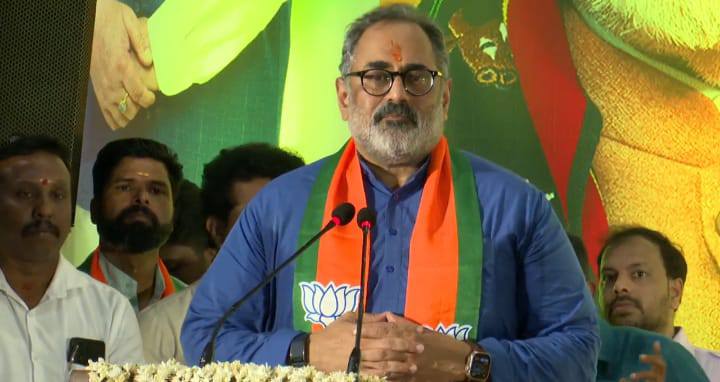
Forced to explain the Foreign Contribution (Regulation) Amendment Bill, BJP State president Rajeev Chandrasekhar tried to allay the fears.
A Bill tabled in the Lok Sabha has landed rather efficiently — not just through legislative procedure, but straight into Kerala’s election chatter.
And for the Bharatiya Janata Party (BJP) in the state, this is not quite the kind of circulation it had in mind.
The timing, to put it mildly, is awkward.
The party has been trying — carefully, sometimes quietly — to make inroads among minority voters ahead of the 2026 Assembly polls.
Meetings, outreach, calibrated messaging. Nothing too loud, nothing too abrupt. And then comes the Foreign Contribution (Regulation) Amendment Bill, 2026.
Not exactly helpful.
Introduced on 25 March by Union Minister of State for Home Nityanand Rai, the Bill proposes tighter control over foreign-funded organisations.
There’s talk of a “designated authority” stepping in to manage the funds and assets of NGOs that lose or surrender their registration. The Centre’s line is familiar — plug misuse, enforce compliance, no nonsense.
In Delhi, that’s policy language. In Kerala, it’s political shorthand. Because in the State, NGOs are not just NGOs.
A good number of them are tied, directly or indirectly, to Christian and Muslim community networks — schools, hospitals, welfare groups, charitable trusts.
So, when you say “tighter control,” what many hear is something else entirely. And just like that, a Bill becomes a campaign issue.
The BJP, sensing the drift, has gone into what can only be described as explanation mode.
Workers have been told to go out and “create awareness” — explain what FCRA is, why the regulation is needed, and why there is “nothing to fear.”
State president Rajeev Chandrasekhar, who himself is contesting the Assembly polls from Nemom, tried to strike a reassuring tone.
Those who do no wrong have nothing to worry about, he said. Those who do — well, they should worry. And, if there are concerns, he added, “I am here.”
It’s the kind of line that sounds better on a stage than in a parish hall discussion. Because elsewhere, the reaction has been less accommodating.
Chief Minister Pinarayi Vijayan has already written to the Prime Minister, flagging what he called “fears and anxiety,” especially among minorities. His concern is not just about intent, but scope — provisions that could allow authorities to step in even in cases of what he described as technical lapses.
That word — “technical” — is doing a lot of work here.
Leader of the Opposition VD Satheesan, in his own letter, chose a slightly softer tone, but landed in roughly the same place. Procedural delays, he warned, should not end up hurting bona fide institutions. A missed renewal deadline shouldn’t suddenly turn into a takeover story.
From the Congress side, AICC general secretary KC Venugopal was less restrained. He called the move deliberate, political, even conspiratorial. A “black law,” he said, suggesting it casts suspicion on thousands of organisations that have been around for decades.
The Communist Party of India (Marxist) didn’t bother with soft phrasing either. In a statement, the party warned of asset seizures, government control, and a pathway — they say — that could extend to institutions, even places of worship.
And then the churches spoke.
Baselios Marthoma Mathews III called for a review, warning the amendment could suffocate church activities. The Catholic Bishops’ Conference of India, meanwhile, raised questions about intent, even hinting at a “double standard.”
At this point, the BJP’s problem is not the Bill itself. It is the pile-up. Because in Kerala’s political ecosystem, once multiple voices — government, opposition, religious bodies — start saying versions of the same thing, it stops being a debate and starts becoming a perception.
And perception, especially days before an election, is a stubborn thing.
On the ground, BJP workers now find themselves doing two campaigns at once. One against the Left Democratic Front government. The other, oddly enough, explains a Bill brought by their own government.
It’s not that the party doesn’t argue. It does. Regulation, accountability, and misuse of funds — all valid points.
But elections are rarely fought on the fine print of legislation.
They’re fighting over what people think the fine print means.
And right now, in Kerala, that meaning is being written somewhere far away from Delhi — in conversations, in WhatsApp groups, in church compounds, in local meetings where nuance doesn’t travel very well.
The BJP would have preferred a cleaner narrative at this stage. A sharper attack line. Less explaining, more accusing.
Instead, it is stuck clarifying.


