

Published Nov 21, 2026 | 10:23 PM ⚊ Updated Nov 21, 2026 | 10:24 PM

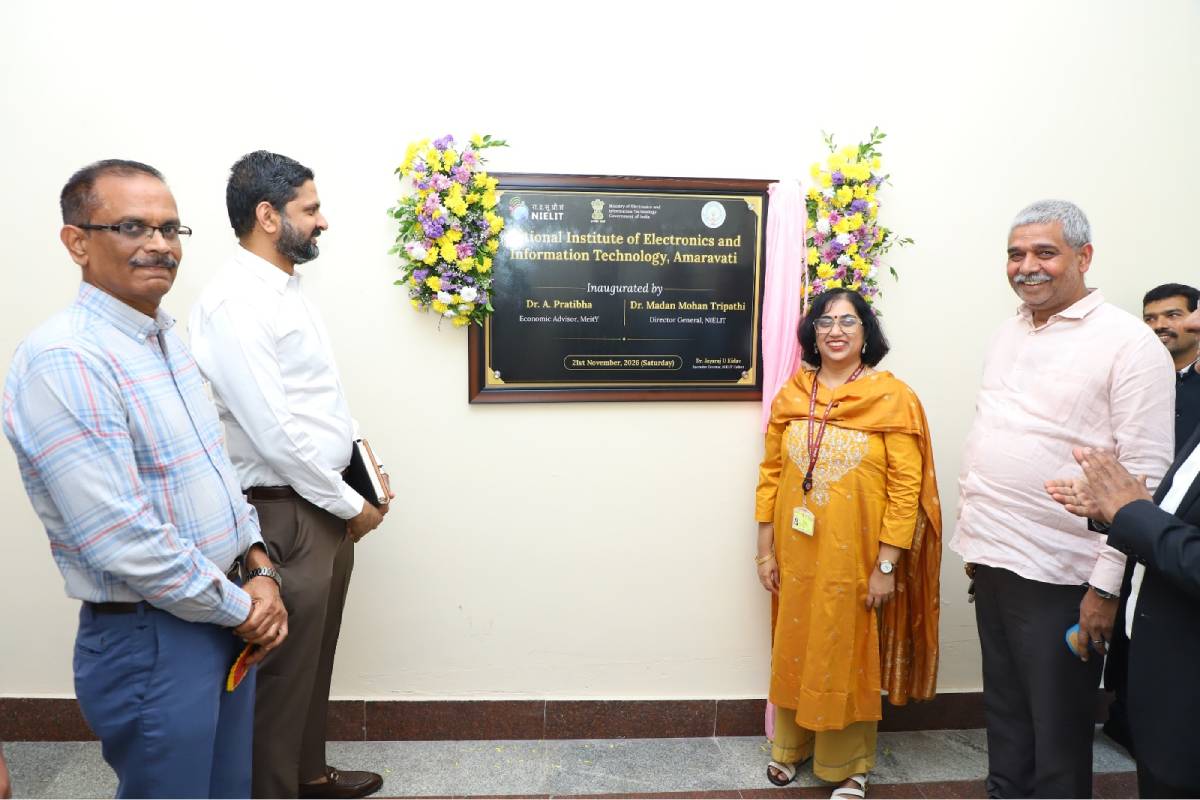
The interim campus was inaugurated by Dr A. Pratibha, Financial Advisor at the Union Ministry of Electronics and Information Technology.

In a key step toward developing Amaravati into a world-class quantum technology hub, the central government-run National Institute of Electronics and Information Technology (NIELIT) Deemed to be University is setting up a dedicated campus in Andhra Pradesh’s capital at an estimated cost of Rs 730.70 crore.
The Andhra government described it as the world’s first university campus being set up exclusively for quantum computing and AI.
The facility will integrate education, research, and skill development in emerging fields such as quantum computing, artificial intelligence (AI), and semiconductors.
As part of this initiative, an interim campus established on the premises of Acharya Nagarjuna University in Guntur was inaugurated on Saturday.
The interim campus was inaugurated by Dr A. Pratibha, Financial Advisor at the Union Ministry of Electronics and Information Technology, in the presence of NIELIT Director General Dr Madan Mohan Tripathi.
In the first phase, four state-of-the-art laboratories are being established at a cost of ₹47 crore. Students will receive hands-on training in these labs covering quantum computing, quantum communication, chip design and VLSI, and AI and computing. The objective is to make modern equipment and technology used in world-class tech institutions accessible to students.
Starting in January, the institute will launch 10 advanced certificate courses spanning two to three months in areas such as quantum computing, quantum communication, AI applications in science and engineering, chip design, VLSI, embedded systems, IoT, and machine learning. It will also conduct 16 short-term courses and an ‘O’ Level programme covering data science, information security, automotive electronics, battery management, blockchain, and semiconductor assembly and testing. Classes will be held in hybrid mode, alongside faculty development programmes in 10 disciplines for college lecturers across the state.
Also Read: NDA’s sweeping victory in local body polls a rejection of YSRCP’s attempts to stall elections: Naidu
The state government has allotted 8.5 acres at Nidamarru for the project after Chief Minister N. Chandrababu Naidu approved the permanent campus in August this year at an estimated cost of ₹730.70 crore. Developed in phases over five years, it will be funded by the Union Ministry of Electronics and Information Technology through a grant-in-aid.
The campus will house smart classrooms, student hostels, advanced research laboratories, innovation and incubation facilities, and semiconductor research centres. Special focus will be placed on quantum photonics, quantum security, cryogenic systems, high-performance computing, nanofabrication, and chip design.
The university aims to train 8,250 individuals over five years:1,650 through undergraduate, postgraduate, doctoral, and diploma programmes, and 6,600 through short-term skill and certification courses. Students will also get the opportunity to work on an IBM quantum computer, alongside support for startup creation and technological innovation.
Once the permanent campus is ready, the operations, laboratories, faculty, and students currently based at Acharya Nagarjuna University will shift to the new premises. Meanwhile, steps have been initiated to expand the NIELIT centre in Tirupati by relocating it from its temporary accommodation at Sri Venkateswara University to a permanent three-acre campus offering specialised training in electronics, embedded systems, and semiconductor skills.
Proposals for setting up the NIELIT campus were prepared in line with the state government’s plan to develop Amaravati as a Quantum Valley. A Memorandum of Understanding (MoU) was signed between NIELIT and the Andhra Pradesh government on February 20, 2026, during the India AI Impact Summit in New Delhi. Commencing operations at the interim campus within nine months marks a key milestone in the project.
(Edited by Fayisa CA)



