

Published Jun 12, 2026 | 8:00 AM ⚊ Updated Jun 12, 2026 | 5:26 PM

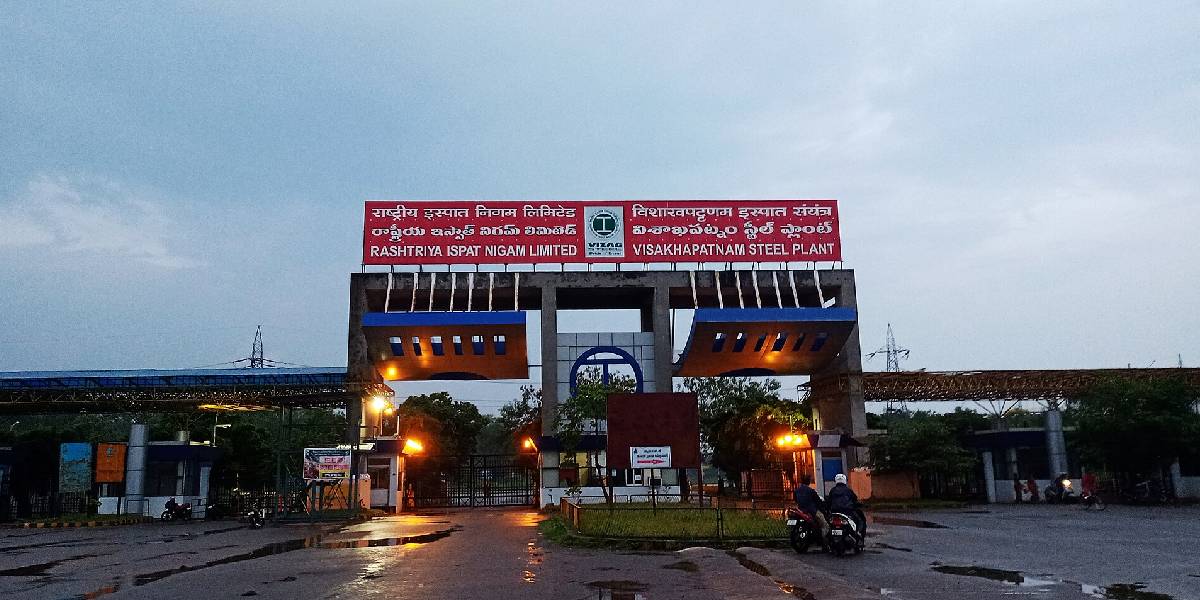
Vizag Steel Plant (Wikimedia Commons)

Synopsis: Workers and trade unions blamed poor maintenance, manpower shortage, mismanagement, and covert privatisation moves for the tragedy that killed nine employees at the Vizag Steel Plant. Meanwhile, the NHRC took suo motu cognisance of the incident and has asked Andhra Pradesh for a detailed report within a fortnight.
Taking suo motu cognisance of the Vizag Steel Plant accident that killed nine workers and injured five others, the National Human Rights Commission (NHRC) issued a notice to the Chief Secretary of Andhra Pradesh for a detailed report.
The report, which must be submitted within two weeks, must include the injured person’s status and the ex gratia amount, the NHRC said.
Meanwhile, preliminary reports suggested that entrapped gases in the molten steel may have caused the accident on 8 June.
An explosion around 4:15 pm at the Steel Meltshop -1 led to the spillage of molten steel at a temperature of up to 1,500 Celsius. Eight workers were killed instantly, while another, operator K Pydiraju, died while receiving treatment at MGM Seven Hills Hospital.
Five critically injured workers were being treated at MGM and KIMS hospitals. Three of them were declared out of danger, while the other two workers continued to receive intensive care.
A Union Ministry of Steel-appointed three-member committee visited the plant on Tuesday, 9 June. Rashtriya Ispat Nigam Limited (RINL), also known as Vizag Steel, has launched an internal probe into the incident. The outcomes of the two probes would shed more light on the causes of the tragedy.
Related: Tensions escalate as Left, TU leaders confront Minister Lokesh
The tragic incident has sparked an uproar among workers and trade unions, triggering protests to highlight the alleged deviation from standard operating procedures.
They argued that substandard raw material, inadequate maintenance, and understaffing may have led to the tragedy. They blamed what they called gradual privatisation efforts as the reason for the mismanagement.
Workers accused the management of negligence and inaction. They claimed that the plant was using sub-standard raw materials, and lacked quality control and supervision, besides using outdated equipment.
Internal transfers caused severe mismanagement as people had to handle unfamiliar tasks, the workers said. It was also alleged that third-party bricks were used for the refractory wall of the ladle.
Two employees told South First that the Steel Meltshops were running at a lower capacity due to reduced manpower. They also claimed a shortage of experienced employees in various divisions as several personnel retired, and hiring remained stagnant.
The plant has launched a three-phase Voluntary Retirement Scheme (VRS) from January to December 2025, with over 2,000 employees opting for it.
Employees from middle and young ages also applied for VRS amid salary delays and disinvestment scare. Furthermore, limited recruitment and the dismissal of a large number of skilled contract workers also affected regular functioning.
According to the Annual Report 2025-26 released by the Ministry of Steel, RINL’s manpower stood at 9,311 (2797 – Executive and 6514 – Non-Executive) as of December 2025, and the plant’s production capacity was 7.3 Mtpa (Million Tonnes per Annum).
For comparison, RINL’s capacity in 2016 was 6.3 Mtpa when it had 17,945 regular employees (5907 – Executives, 170 – Non-unionised supervisors (JOs), and 11,868 – Non-executives).
Output increased between these two periods by over 1 Mtpa. Workers alleged that they were being overworked to meet production requirements, despite being short-staffed by 50%, compared to 2016.
An employee alleged that working conditions at RINL significantly worsened over the years. He claimed that the workers were not allowed designated lunch breaks, and multiple canteens were closed down except for those serving tea.
Related: Workers killed as molten steel ladle collapses in Vizag Steel Plant
Despite the Union and state government refuting reports of moves to privatise RINL, workers claimed that disinvestment efforts were still on. They said that privatisation efforts were underway through the outsourcing of maintenance and operations to private players across various divisions.
A major concern flagged by several trade unions was RINL inviting Expressions of Interest (EoIs) for the operation and maintenance of various divisions of the plant. Many of those expired EoIs could be found on the Vizag Steel website.
Workers said that it was an ‘open secret’ at VSP that the operation and maintenance of the sinter plant had been handed over to TPL Services Private Limited (TPLSPL), a Tata Projects Limited subsidiary.
However, RINL has not made public any involvement of the Tata firm. TPLSPL had placed several advertisements on online platforms for hiring hands to operate and maintain the sinter plant at a “Vizag-based” steel plant.
Related: Union Minister HD Kumaraswamy visits Vizag Steel plant
Ayodhya Ram of the CPI(M)-affiliated Centre for Indian Trade Unions (CITU) said the plant authorities had not learnt from previous incidents.
In June 2012, a massive explosion at the newly installed Oxygen Plant resulted in the death of 19 workers. The Union Ministry ordered an inquiry into the accident by forming a committee headed by SR Jain, former chairman of Steel Authority of India Limited (SAIL).
The committee gave a clean chit to the steel plant management in August of the same year. However, the committee’s complete report was unavailable in the public domain.
The Human Rights Forum (HRF) has now called for the release of the SR Jain committee report.
The latest accident at Vizag Steel Plant was part of a series of similar mishaps in recent years.
Among them were:
Related: Vizag Steel Plant caught between assurances and privatisation fears
Meanwhile, Union Minister of Steel HD Kumaraswamy announced an ex gratia of ₹25 lakh each to the families of the deceased and promised permanent employment to one member per family.
The ministry also announced ₹10 lakh each to the families of the injured and vowed to cover medical expenses.
However, the Joint Action Committee (JAC) of trade unions, workers, and civil society groups staged a protest in Visakhapatnam on Wednesday, 10 June, demanding an ex gratia of ₹1 crore to the families of the deceased.
They alleged that the ₹1.72 crore compensation package floated by the state government was actually part of the benefits provided by the Vizag Steel Plant, and thus should not be publicised as ex gratia.
The JAC also demanded a thorough probe into the accident and asserted that the incident should not be looked at in isolation, but as part of larger structural problems.
(Edited by Majnu Babu).



